

their inner cores. This so-called “nano-to-nano” effect [15] may be responsible
for the observed activity, where heating is not needed notwithstanding the heterogeneous nature of the catalysis.
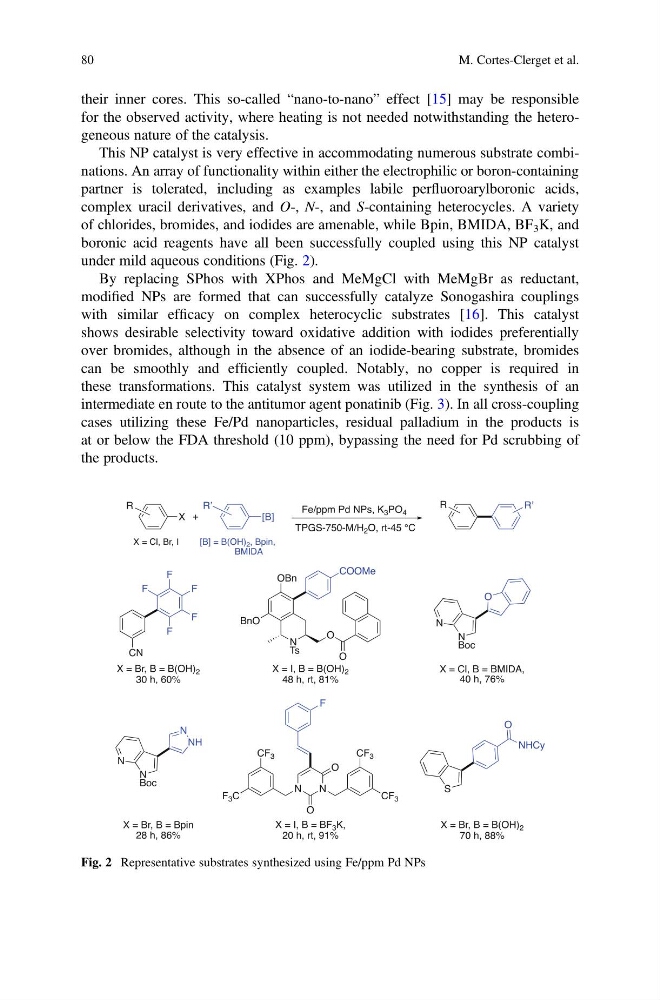
This NP catalyst is very effective in accommodating numerous substrate combinations. An array of functionality within either the electrophilic or boron-containing
partner is tolerated, including as examples labile perfluoroarylboronic acids,
complex uracil derivatives, and O-, N-, and S-containing heterocycles. A variety
of chlorides, bromides, and iodides are amenable, while Bpin, BMIDA, BF 3 K, and
boronic acid reagents have all been successfully coupled using this NP catalyst
under mild aqueous conditions (Fig. 2).
By replacing SPhos with XPhos and MeMgCl with MeMgBr as reductant,
modified NPs are formed that can successfully catalyze Sonogashira couplings
with similar efficacy on complex heterocyclic substrates [16]. This catalyst
shows desirable selectivity toward oxidative addition with iodides preferentially
over bromides, although in the absence of an iodide-bearing substrate, bromides
can be smoothly and efficiently coupled. Notably, no copper is required in
these transformations. This catalyst system was utilized in the synthesis of an
intermediate en route to the antitumor agent ponatinib (Fig. 3). In all cross-coupling
cases utilizing these Fe/Pd nanoparticles, residual palladium in the products is
at or below the FDA threshold (10 ppm), bypassing the need for Pd scrubbing of
the products.
Fig. 2 Representative substrates synthesized using Fe/ppm Pd NPs
80
M. Cortes-Clerget et al.
for the observed activity, where heating is not needed notwithstanding the heterogeneous nature of the catalysis.
This NP catalyst is very effective in accommodating numerous substrate combinations. An array of functionality within either the electrophilic or boron-containing
partner is tolerated, including as examples labile perfluoroarylboronic acids,
complex uracil derivatives, and O-, N-, and S-containing heterocycles. A variety
of chlorides, bromides, and iodides are amenable, while Bpin, BMIDA, BF 3 K, and
boronic acid reagents have all been successfully coupled using this NP catalyst
under mild aqueous conditions (Fig. 2).
By replacing SPhos with XPhos and MeMgCl with MeMgBr as reductant,
modified NPs are formed that can successfully catalyze Sonogashira couplings
with similar efficacy on complex heterocyclic substrates [16]. This catalyst
shows desirable selectivity toward oxidative addition with iodides preferentially
over bromides, although in the absence of an iodide-bearing substrate, bromides
can be smoothly and efficiently coupled. Notably, no copper is required in
these transformations. This catalyst system was utilized in the synthesis of an
intermediate en route to the antitumor agent ponatinib (Fig. 3). In all cross-coupling
cases utilizing these Fe/Pd nanoparticles, residual palladium in the products is
at or below the FDA threshold (10 ppm), bypassing the need for Pd scrubbing of
the products.
Fig. 2 Representative substrates synthesized using Fe/ppm Pd NPs
80
M. Cortes-Clerget et al.