

The high surface area to volume ratio of Pd NPs makes them especially reactive
[13]. Heterogeneous Pd NPs as catalysts are finding increased use due to their overall
stability, as avoidance of phosphine ligands on Pd in solution is readily appreciated
given their potential instability, toxicity, and susceptibility to oxidation. Thus, there
has been increased interest in ligand-free palladium nanoparticles. On the other
hand, many examples exist where phosphines have been incorporated into palladium
complexes and their derived NPs, since the presence of a ligand can significantly
affect both reactivity and selectivity associated with the reaction of interest. Preparations of palladium NPs can oftentimes be straightforward and, in most cases of
interest, are well documented. The flexibility in their preparation leading to NPs of
different sizes and their demonstrated recyclability and catalytic efficiency make
them attractive alternatives to traditional methods involving homogeneous catalysis.
A general mechanistic understanding as to the exact location of catalysis in many
cases, however, remains for the future [8].
A report in 2015 in Science disclosed that a mixture composed of an inexpensive
Fe
III salt doped with ppm levels of Pd and a suitable phosphine ligand could be
converted upon the addition of MeMgCl in THF into highly active NPs capable of
catalyzing Suzuki-Miyaura couplings in micellar media under very mild conditions
[14]. Each component of the catalyst proved to be critical to its activity. Anhydrous
FeCl 3 , 320–500 ppm Pd(OAc) 2 (relative to 0.5 mmol of halide substrate), and
MeMgCl were optimal, while alternative alkyl or aryl Grignard reagents were
found to afford far less effective catalysts. The inclusion of a suitable phosphine
ligand, SPhos in this case, was crucial for high catalyst activity, with other
phosphine ligands leading to inferior levels of conversion. This observation is of
particular note, since phosphine ligands traditionally tend to play a critical role in
homogeneous catalysis, but less so in heterogeneous processes.
Remarkably, these NPs were found to contain ca. 40% THF by weight, which
was later observed to be essential for catalytic activity. TGA analysis revealed a
sharp loss of mass from ca. 60 to 145
C. While the material itself maintained thermal
stability from 145 to 380
C, the catalytic activity dropped precipitously after loss of
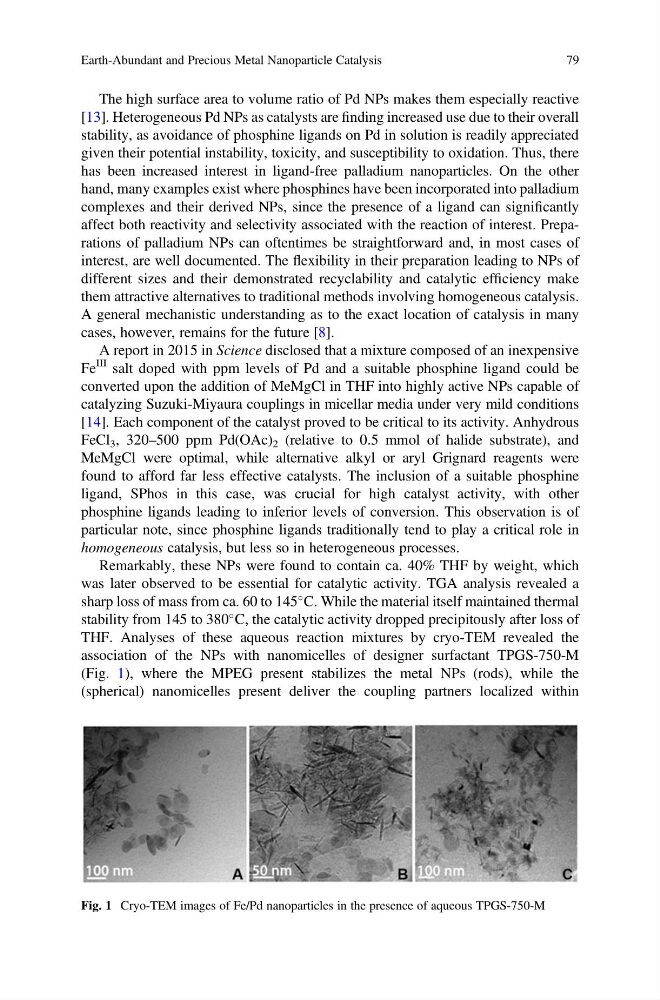
THF. Analyses of these aqueous reaction mixtures by cryo-TEM revealed the
association of the NPs with nanomicelles of designer surfactant TPGS-750-M
(Fig. 1), where the MPEG present stabilizes the metal NPs (rods), while the
(spherical) nanomicelles present deliver the coupling partners localized within
Fig. 1 Cryo-TEM images of Fe/Pd nanoparticles in the presence of aqueous TPGS-750-M
Earth-Abundant and Precious Metal Nanoparticle Catalysis
79
[13]. Heterogeneous Pd NPs as catalysts are finding increased use due to their overall
stability, as avoidance of phosphine ligands on Pd in solution is readily appreciated
given their potential instability, toxicity, and susceptibility to oxidation. Thus, there
has been increased interest in ligand-free palladium nanoparticles. On the other
hand, many examples exist where phosphines have been incorporated into palladium
complexes and their derived NPs, since the presence of a ligand can significantly
affect both reactivity and selectivity associated with the reaction of interest. Preparations of palladium NPs can oftentimes be straightforward and, in most cases of
interest, are well documented. The flexibility in their preparation leading to NPs of
different sizes and their demonstrated recyclability and catalytic efficiency make
them attractive alternatives to traditional methods involving homogeneous catalysis.
A general mechanistic understanding as to the exact location of catalysis in many
cases, however, remains for the future [8].
A report in 2015 in Science disclosed that a mixture composed of an inexpensive
Fe
III salt doped with ppm levels of Pd and a suitable phosphine ligand could be
converted upon the addition of MeMgCl in THF into highly active NPs capable of
catalyzing Suzuki-Miyaura couplings in micellar media under very mild conditions
[14]. Each component of the catalyst proved to be critical to its activity. Anhydrous
FeCl 3 , 320–500 ppm Pd(OAc) 2 (relative to 0.5 mmol of halide substrate), and
MeMgCl were optimal, while alternative alkyl or aryl Grignard reagents were
found to afford far less effective catalysts. The inclusion of a suitable phosphine
ligand, SPhos in this case, was crucial for high catalyst activity, with other
phosphine ligands leading to inferior levels of conversion. This observation is of
particular note, since phosphine ligands traditionally tend to play a critical role in
homogeneous catalysis, but less so in heterogeneous processes.
Remarkably, these NPs were found to contain ca. 40% THF by weight, which
was later observed to be essential for catalytic activity. TGA analysis revealed a
sharp loss of mass from ca. 60 to 145
C. While the material itself maintained thermal
stability from 145 to 380
C, the catalytic activity dropped precipitously after loss of
THF. Analyses of these aqueous reaction mixtures by cryo-TEM revealed the
association of the NPs with nanomicelles of designer surfactant TPGS-750-M
(Fig. 1), where the MPEG present stabilizes the metal NPs (rods), while the
(spherical) nanomicelles present deliver the coupling partners localized within
Fig. 1 Cryo-TEM images of Fe/Pd nanoparticles in the presence of aqueous TPGS-750-M
Earth-Abundant and Precious Metal Nanoparticle Catalysis
79