

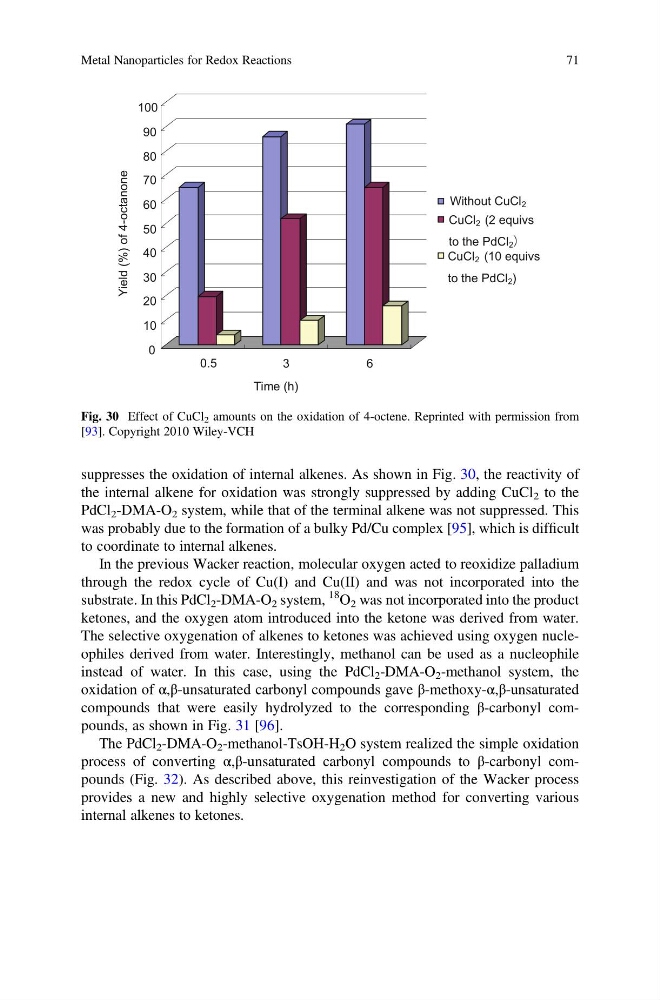
suppresses the oxidation of internal alkenes. As shown in Fig. 30, the reactivity of
the internal alkene for oxidation was strongly suppressed by adding CuCl 2 to the
PdCl 2 -DMA-O 2 system, while that of the terminal alkene was not suppressed. This
was probably due to the formation of a bulky Pd/Cu complex [95], which is difficult
to coordinate to internal alkenes.
In the previous Wacker reaction, molecular oxygen acted to reoxidize palladium
through the redox cycle of Cu(I) and Cu(II) and was not incorporated into the
substrate. In this PdCl 2 -DMA-O 2 system,
18 O 2 was not incorporated into the product
ketones, and the oxygen atom introduced into the ketone was derived from water.
The selective oxygenation of alkenes to ketones was achieved using oxygen nucleophiles derived from water. Interestingly, methanol can be used as a nucleophile
instead of water. In this case, using the PdCl 2 -DMA-O 2 -methanol system, the
oxidation of α,β-unsaturated carbonyl compounds gave β-methoxy-α,β-unsaturated
compounds that were easily hydrolyzed to the corresponding β-carbonyl compounds, as shown in Fig. 31 [96].
The PdCl 2 -DMA-O 2 -methanol-TsOH-H 2 O system realized the simple oxidation
process of converting α,β-unsaturated carbonyl compounds to β-carbonyl compounds (Fig. 32). As described above, this reinvestigation of the Wacker process
provides a new and highly selective oxygenation method for converting various
internal alkenes to ketones.
31
0
10
20
30
40
50
60
70
80
90
100
0.5
3
6
Time (h)
Without CuCl 2
CuCl 2 (2 equivs
to the PdCl 2
CuCl 2 (10 equivs
to the PdCl 2 )
4
f
o
)
%
(
d
l
e
i
Y
-
e
n
o
n
a
t
c
o
Fig. 30 Effect of CuCl 2 amounts on the oxidation of 4-octene. Reprinted with permission from
[93]. Copyright 2010 Wiley-VCH
Metal Nanoparticles for Redox Reactions
71
the internal alkene for oxidation was strongly suppressed by adding CuCl 2 to the
PdCl 2 -DMA-O 2 system, while that of the terminal alkene was not suppressed. This
was probably due to the formation of a bulky Pd/Cu complex [95], which is difficult
to coordinate to internal alkenes.
In the previous Wacker reaction, molecular oxygen acted to reoxidize palladium
through the redox cycle of Cu(I) and Cu(II) and was not incorporated into the
substrate. In this PdCl 2 -DMA-O 2 system,
18 O 2 was not incorporated into the product
ketones, and the oxygen atom introduced into the ketone was derived from water.
The selective oxygenation of alkenes to ketones was achieved using oxygen nucleophiles derived from water. Interestingly, methanol can be used as a nucleophile
instead of water. In this case, using the PdCl 2 -DMA-O 2 -methanol system, the
oxidation of α,β-unsaturated carbonyl compounds gave β-methoxy-α,β-unsaturated
compounds that were easily hydrolyzed to the corresponding β-carbonyl compounds, as shown in Fig. 31 [96].
The PdCl 2 -DMA-O 2 -methanol-TsOH-H 2 O system realized the simple oxidation
process of converting α,β-unsaturated carbonyl compounds to β-carbonyl compounds (Fig. 32). As described above, this reinvestigation of the Wacker process
provides a new and highly selective oxygenation method for converting various
internal alkenes to ketones.
31
0
10
20
30
40
50
60
70
80
90
100
0.5
3
6
Time (h)
Without CuCl 2
CuCl 2 (2 equivs
to the PdCl 2
CuCl 2 (10 equivs
to the PdCl 2 )
4
f
o
)
%
(
d
l
e
i
Y
-
e
n
o
n
a
t
c
o
Fig. 30 Effect of CuCl 2 amounts on the oxidation of 4-octene. Reprinted with permission from
[93]. Copyright 2010 Wiley-VCH
Metal Nanoparticles for Redox Reactions
71