

be extended to the terminal alkenes. This process, the Wacker–Tsuji reaction, is an
effective means of selective methyl ketone synthesis from a wide range of terminal
alkenes [91].
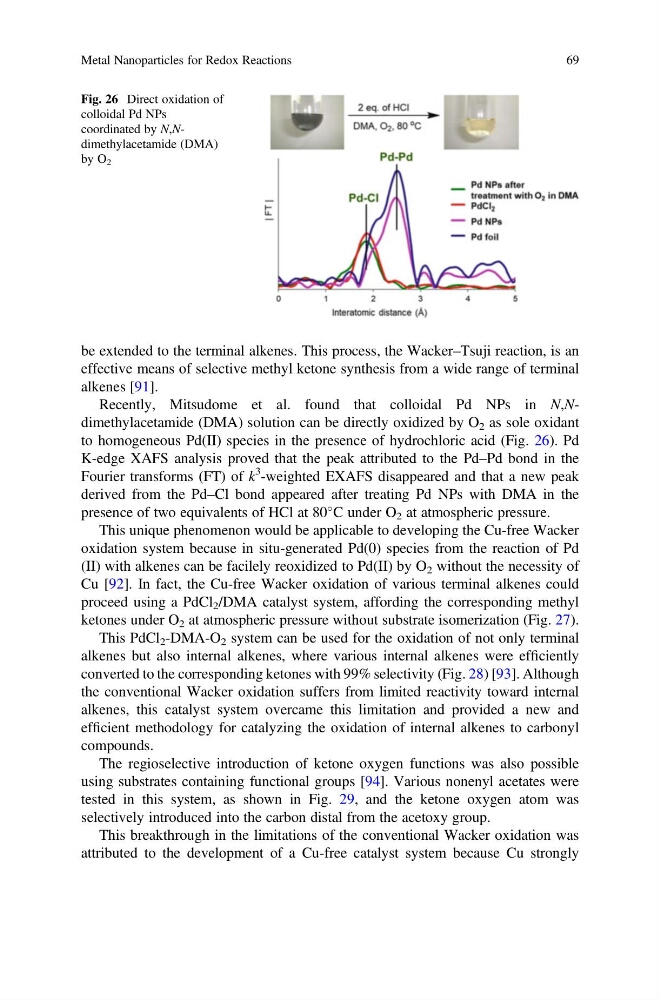
Recently, Mitsudome et al. found that colloidal Pd NPs in N,Ndimethylacetamide (DMA) solution can be directly oxidized by O 2 as sole oxidant
to homogeneous Pd(II) species in the presence of hydrochloric acid (Fig. 26). Pd
K-edge XAFS analysis proved that the peak attributed to the Pd–Pd bond in the
Fourier transforms (FT) of k
3 -weighted EXAFS disappeared and that a new peak
derived from the Pd–Cl bond appeared after treating Pd NPs with DMA in the
presence of two equivalents of HCl at 80
C under O 2 at atmospheric pressure.
This unique phenomenon would be applicable to developing the Cu-free Wacker
oxidation system because in situ-generated Pd(0) species from the reaction of Pd
(II) with alkenes can be facilely reoxidized to Pd(II) by O 2 without the necessity of
Cu [92]. In fact, the Cu-free Wacker oxidation of various terminal alkenes could
proceed using a PdCl 2 /DMA catalyst system, affording the corresponding methyl
ketones under O 2 at atmospheric pressure without substrate isomerization (Fig. 27).
This PdCl 2 -DMA-O 2 system can be used for the oxidation of not only terminal
alkenes but also internal alkenes, where various internal alkenes were efficiently
converted to the corresponding ketones with 99% selectivity (Fig. 28) [93]. Although
the conventional Wacker oxidation suffers from limited reactivity toward internal
alkenes, this catalyst system overcame this limitation and provided a new and
efficient methodology for catalyzing the oxidation of internal alkenes to carbonyl
compounds.
The regioselective introduction of ketone oxygen functions was also possible
using substrates containing functional groups [94]. Various nonenyl acetates were
tested in this system, as shown in Fig. 29, and the ketone oxygen atom was
selectively introduced into the carbon distal from the acetoxy group.
This breakthrough in the limitations of the conventional Wacker oxidation was
attributed to the development of a Cu-free catalyst system because Cu strongly
Fig. 26 Direct oxidation of
colloidal Pd NPs
coordinated by N,Ndimethylacetamide (DMA)
by O 2
Metal Nanoparticles for Redox Reactions
69
effective means of selective methyl ketone synthesis from a wide range of terminal
alkenes [91].
Recently, Mitsudome et al. found that colloidal Pd NPs in N,Ndimethylacetamide (DMA) solution can be directly oxidized by O 2 as sole oxidant
to homogeneous Pd(II) species in the presence of hydrochloric acid (Fig. 26). Pd
K-edge XAFS analysis proved that the peak attributed to the Pd–Pd bond in the
Fourier transforms (FT) of k
3 -weighted EXAFS disappeared and that a new peak
derived from the Pd–Cl bond appeared after treating Pd NPs with DMA in the
presence of two equivalents of HCl at 80
C under O 2 at atmospheric pressure.
This unique phenomenon would be applicable to developing the Cu-free Wacker
oxidation system because in situ-generated Pd(0) species from the reaction of Pd
(II) with alkenes can be facilely reoxidized to Pd(II) by O 2 without the necessity of
Cu [92]. In fact, the Cu-free Wacker oxidation of various terminal alkenes could
proceed using a PdCl 2 /DMA catalyst system, affording the corresponding methyl
ketones under O 2 at atmospheric pressure without substrate isomerization (Fig. 27).
This PdCl 2 -DMA-O 2 system can be used for the oxidation of not only terminal
alkenes but also internal alkenes, where various internal alkenes were efficiently
converted to the corresponding ketones with 99% selectivity (Fig. 28) [93]. Although
the conventional Wacker oxidation suffers from limited reactivity toward internal
alkenes, this catalyst system overcame this limitation and provided a new and
efficient methodology for catalyzing the oxidation of internal alkenes to carbonyl
compounds.
The regioselective introduction of ketone oxygen functions was also possible
using substrates containing functional groups [94]. Various nonenyl acetates were
tested in this system, as shown in Fig. 29, and the ketone oxygen atom was
selectively introduced into the carbon distal from the acetoxy group.
This breakthrough in the limitations of the conventional Wacker oxidation was
attributed to the development of a Cu-free catalyst system because Cu strongly
Fig. 26 Direct oxidation of
colloidal Pd NPs
coordinated by N,Ndimethylacetamide (DMA)
by O 2
Metal Nanoparticles for Redox Reactions
69