

Therefore, high selectivity is usually achieved at the expense of activity, resulting in
a trade-off relationship between the activity and selectivity. Therefore, the development of surface-modified metal NPs with both high selectivity and activity is a great
challenge in chemoselective hydrogenation.
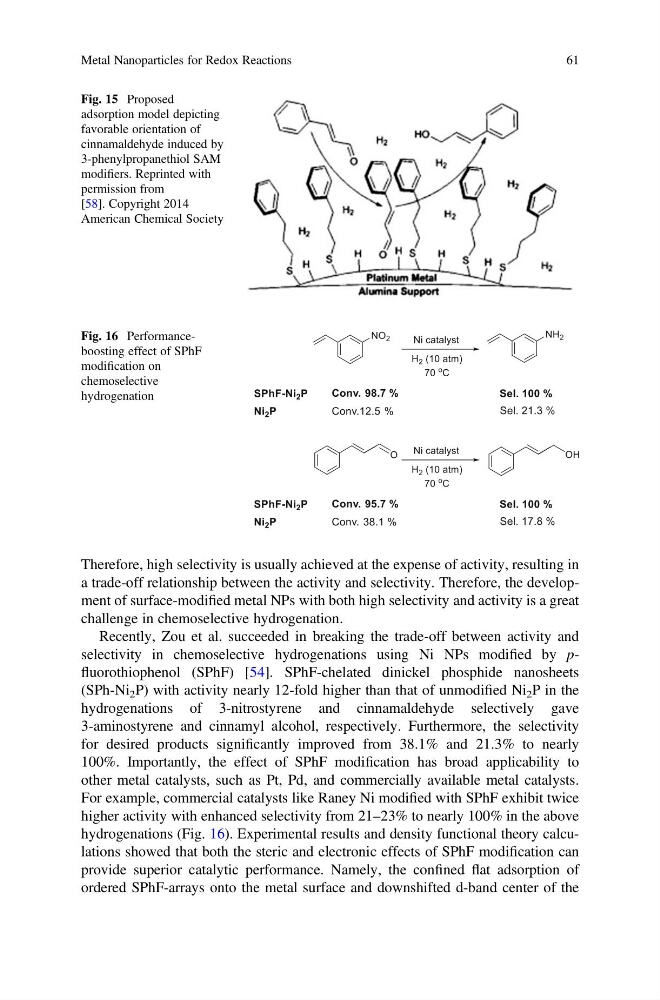
Recently, Zou et al. succeeded in breaking the trade-off between activity and
selectivity in chemoselective hydrogenations using Ni NPs modified by pfluorothiophenol (SPhF) [54]. SPhF-chelated dinickel phosphide nanosheets
(SPh-Ni 2 P) with activity nearly 12-fold higher than that of unmodified Ni 2 P in the
hydrogenations of 3-nitrostyrene and cinnamaldehyde selectively gave
3-aminostyrene and cinnamyl alcohol, respectively. Furthermore, the selectivity
for desired products significantly improved from 38.1% and 21.3% to nearly
100%. Importantly, the effect of SPhF modification has broad applicability to
other metal catalysts, such as Pt, Pd, and commercially available metal catalysts.
For example, commercial catalysts like Raney Ni modified with SPhF exhibit twice
higher activity with enhanced selectivity from 21–23% to nearly 100% in the above
hydrogenations (Fig. 16). Experimental results and density functional theory calculations showed that both the steric and electronic effects of SPhF modification can
provide superior catalytic performance. Namely, the confined flat adsorption of
ordered SPhF-arrays onto the metal surface and downshifted d-band center of the
Fig. 16 Performanceboosting effect of SPhF
modification on
chemoselective
hydrogenation
Fig. 15 Proposed
adsorption model depicting
favorable orientation of
cinnamaldehyde induced by
3-phenylpropanethiol SAM
modifiers. Reprinted with
permission from
[58]. Copyright 2014
American Chemical Society
Metal Nanoparticles for Redox Reactions
61
a trade-off relationship between the activity and selectivity. Therefore, the development of surface-modified metal NPs with both high selectivity and activity is a great
challenge in chemoselective hydrogenation.
Recently, Zou et al. succeeded in breaking the trade-off between activity and
selectivity in chemoselective hydrogenations using Ni NPs modified by pfluorothiophenol (SPhF) [54]. SPhF-chelated dinickel phosphide nanosheets
(SPh-Ni 2 P) with activity nearly 12-fold higher than that of unmodified Ni 2 P in the
hydrogenations of 3-nitrostyrene and cinnamaldehyde selectively gave
3-aminostyrene and cinnamyl alcohol, respectively. Furthermore, the selectivity
for desired products significantly improved from 38.1% and 21.3% to nearly
100%. Importantly, the effect of SPhF modification has broad applicability to
other metal catalysts, such as Pt, Pd, and commercially available metal catalysts.
For example, commercial catalysts like Raney Ni modified with SPhF exhibit twice
higher activity with enhanced selectivity from 21–23% to nearly 100% in the above
hydrogenations (Fig. 16). Experimental results and density functional theory calculations showed that both the steric and electronic effects of SPhF modification can
provide superior catalytic performance. Namely, the confined flat adsorption of
ordered SPhF-arrays onto the metal surface and downshifted d-band center of the
Fig. 16 Performanceboosting effect of SPhF
modification on
chemoselective
hydrogenation
Fig. 15 Proposed
adsorption model depicting
favorable orientation of
cinnamaldehyde induced by
3-phenylpropanethiol SAM
modifiers. Reprinted with
permission from
[58]. Copyright 2014
American Chemical Society
Metal Nanoparticles for Redox Reactions
61