

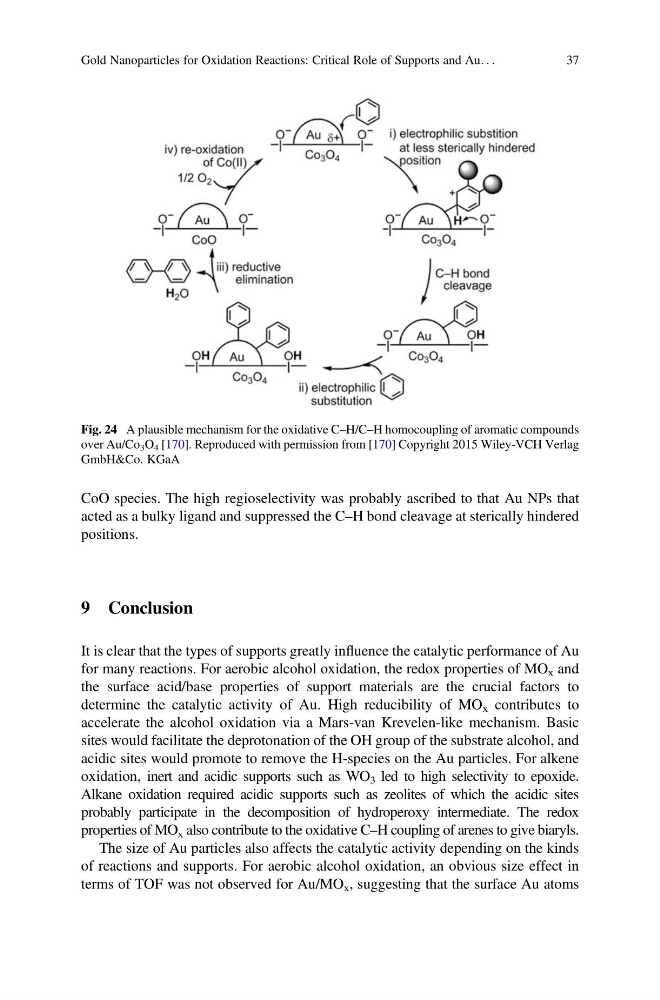
CoO species. The high regioselectivity was probably ascribed to that Au NPs that
acted as a bulky ligand and suppressed the C–H bond cleavage at sterically hindered
positions.
9 Conclusion
It is clear that the types of supports greatly influence the catalytic performance of Au
for many reactions. For aerobic alcohol oxidation, the redox properties of MO x and
the surface acid/base properties of support materials are the crucial factors to
determine the catalytic activity of Au. High reducibility of MO x contributes to
accelerate the alcohol oxidation via a Mars-van Krevelen-like mechanism. Basic
sites would facilitate the deprotonation of the OH group of the substrate alcohol, and
acidic sites would promote to remove the H-species on the Au particles. For alkene
oxidation, inert and acidic supports such as WO 3 led to high selectivity to epoxide.
Alkane oxidation required acidic supports such as zeolites of which the acidic sites
probably participate in the decomposition of hydroperoxy intermediate. The redox
properties of MO x also contribute to the oxidative C–H coupling of arenes to give biaryls.
The size of Au particles also affects the catalytic activity depending on the kinds
of reactions and supports. For aerobic alcohol oxidation, an obvious size effect in
terms of TOF was not observed for Au/MO x , suggesting that the surface Au atoms
Fig. 24 A plausible mechanism for the oxidative C–H/C–H homocoupling of aromatic compounds
over Au/Co 3 O 4 [170]. Reproduced with permission from [170] Copyright 2015 Wiley-VCH Verlag
GmbH&Co. KGaA
Gold Nanoparticles for Oxidation Reactions: Critical Role of Supports and Au. . .
37
acted as a bulky ligand and suppressed the C–H bond cleavage at sterically hindered
positions.
9 Conclusion
It is clear that the types of supports greatly influence the catalytic performance of Au
for many reactions. For aerobic alcohol oxidation, the redox properties of MO x and
the surface acid/base properties of support materials are the crucial factors to
determine the catalytic activity of Au. High reducibility of MO x contributes to
accelerate the alcohol oxidation via a Mars-van Krevelen-like mechanism. Basic
sites would facilitate the deprotonation of the OH group of the substrate alcohol, and
acidic sites would promote to remove the H-species on the Au particles. For alkene
oxidation, inert and acidic supports such as WO 3 led to high selectivity to epoxide.
Alkane oxidation required acidic supports such as zeolites of which the acidic sites
probably participate in the decomposition of hydroperoxy intermediate. The redox
properties of MO x also contribute to the oxidative C–H coupling of arenes to give biaryls.
The size of Au particles also affects the catalytic activity depending on the kinds
of reactions and supports. For aerobic alcohol oxidation, an obvious size effect in
terms of TOF was not observed for Au/MO x , suggesting that the surface Au atoms
Fig. 24 A plausible mechanism for the oxidative C–H/C–H homocoupling of aromatic compounds
over Au/Co 3 O 4 [170]. Reproduced with permission from [170] Copyright 2015 Wiley-VCH Verlag
GmbH&Co. KGaA
Gold Nanoparticles for Oxidation Reactions: Critical Role of Supports and Au. . .
37