

8 Oxidative C–H Coupling Reaction
Metal-catalyzed C–C bond coupling reactions have been one of the most important
research topics in organic chemistry. In particular, direct C–H bond functionalization
to transform into C–C bond has been rapidly growing interest owing to the high atom
efficiency and environmentally friendly reactions. Corma et al. reported the coupling
of electron-rich arene and propiolate over Au/C in the presence of O 2 (Scheme 10a)
[168]. They also reported a direct oxidative homocoupling of aryl C–H bonds to
produce biaryls (Scheme 10b) [169]. For these reactions, H 2 O is the only
by-product, and transformation of unreactive C–H bonds into reactive C–X (X ¼ halogen) or C–M (M ¼ transition metal) bonds in advance of the coupling reaction can
be avoided. However, the yield of biaryl is very low, and the regioselectivity could
not be controlled [169]. The oxidative C–H homocoupling to synthesize biaryls is
currently used in industry for the production of tetramethyl (1,1
0 -biphenyl)-3,3
0 ,4,40 -tetracarboxylate (S-DM) which leads to high thermally stable polyimide resin using
homogenous Pd catalysts with Cu co-catalyst (Scheme 11). However, the conversion
is controlled to not exceed 10% to avoid trimerization, and a bulky ligand is required
to achieve high regioselectivity to S-DM. Au/MO x , such as Au/Co 3 O 4 , Au/ZrO 2 ,
and Au/TiO 2 appeared to catalyze the oxidative C–H coupling of dimethyl phthalate
to produce S-DM with excellent regioselectivity in the absence of either co-catalysts
or ligands even at high conversions [170]. In particular, Au/Co 3 O 4 showed 98%
dimer selectivity (total yield of S-DM and A-DM) and 94% regioselectivity to S-DM
at 49% conversion. Au/ZrO 2 showed 83% dimer selectivity and 95% regioselectivity
to S-DM at 88% conversion. It is worth to note that PdO/Co 3 O 4 showed almost
negligible catalytic activity. Pd(OH) 2 /Co 3 O 4 showed catalytic activity but was much
less active and low regioselectivity (67%).
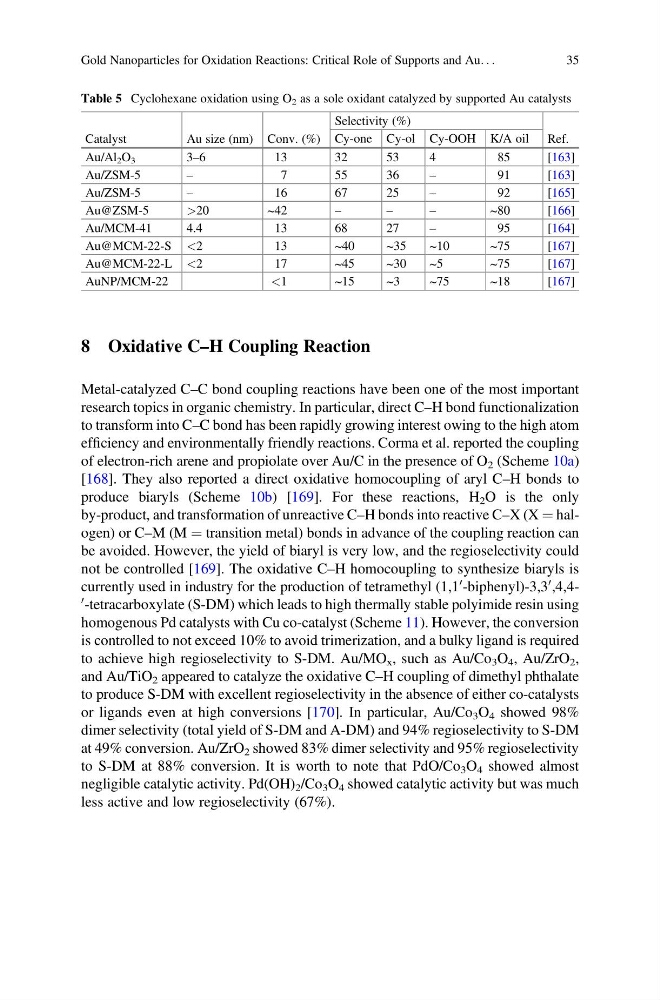
Table 5 Cyclohexane oxidation using O 2 as a sole oxidant catalyzed by supported Au catalysts
Catalyst
Au size (nm) Conv. (%)
Selectivity (%)
Ref.
Cy-one Cy-ol Cy-OOH K/A oil
Au/Al 2 O 3
3–6
13
32
53
4
85
[163]
Au/ZSM-5
–
7
5 5
3 6
–
91
[163]
Au/ZSM-5
–
16
67
25
–
92
[165]
Au@ZSM-5
>20
~42
–
–
–
~80
[166]
Au/MCM-41
4.4
13
68
27
–
95
[164]
Au@MCM-22-S <2
13
~40
~35
~10
~75
[167]
Au@MCM-22-L <2
17
~45
~30
~5
~75
[167]
AuNP/MCM-22
<1
~15
~3
~75
~18
[167]
Gold Nanoparticles for Oxidation Reactions: Critical Role of Supports and Au. . .
35
Metal-catalyzed C–C bond coupling reactions have been one of the most important
research topics in organic chemistry. In particular, direct C–H bond functionalization
to transform into C–C bond has been rapidly growing interest owing to the high atom
efficiency and environmentally friendly reactions. Corma et al. reported the coupling
of electron-rich arene and propiolate over Au/C in the presence of O 2 (Scheme 10a)
[168]. They also reported a direct oxidative homocoupling of aryl C–H bonds to
produce biaryls (Scheme 10b) [169]. For these reactions, H 2 O is the only
by-product, and transformation of unreactive C–H bonds into reactive C–X (X ¼ halogen) or C–M (M ¼ transition metal) bonds in advance of the coupling reaction can
be avoided. However, the yield of biaryl is very low, and the regioselectivity could
not be controlled [169]. The oxidative C–H homocoupling to synthesize biaryls is
currently used in industry for the production of tetramethyl (1,1
0 -biphenyl)-3,3
0 ,4,40 -tetracarboxylate (S-DM) which leads to high thermally stable polyimide resin using
homogenous Pd catalysts with Cu co-catalyst (Scheme 11). However, the conversion
is controlled to not exceed 10% to avoid trimerization, and a bulky ligand is required
to achieve high regioselectivity to S-DM. Au/MO x , such as Au/Co 3 O 4 , Au/ZrO 2 ,
and Au/TiO 2 appeared to catalyze the oxidative C–H coupling of dimethyl phthalate
to produce S-DM with excellent regioselectivity in the absence of either co-catalysts
or ligands even at high conversions [170]. In particular, Au/Co 3 O 4 showed 98%
dimer selectivity (total yield of S-DM and A-DM) and 94% regioselectivity to S-DM
at 49% conversion. Au/ZrO 2 showed 83% dimer selectivity and 95% regioselectivity
to S-DM at 88% conversion. It is worth to note that PdO/Co 3 O 4 showed almost
negligible catalytic activity. Pd(OH) 2 /Co 3 O 4 showed catalytic activity but was much
less active and low regioselectivity (67%).
Table 5 Cyclohexane oxidation using O 2 as a sole oxidant catalyzed by supported Au catalysts
Catalyst
Au size (nm) Conv. (%)
Selectivity (%)
Ref.
Cy-one Cy-ol Cy-OOH K/A oil
Au/Al 2 O 3
3–6
13
32
53
4
85
[163]
Au/ZSM-5
–
7
5 5
3 6
–
91
[163]
Au/ZSM-5
–
16
67
25
–
92
[165]
Au@ZSM-5
>20
~42
–
–
–
~80
[166]
Au/MCM-41
4.4
13
68
27
–
95
[164]
Au@MCM-22-S <2
13
~40
~35
~10
~75
[167]
Au@MCM-22-L <2
17
~45
~30
~5
~75
[167]
AuNP/MCM-22
<1
~15
~3
~75
~18
[167]
Gold Nanoparticles for Oxidation Reactions: Critical Role of Supports and Au. . .
35