

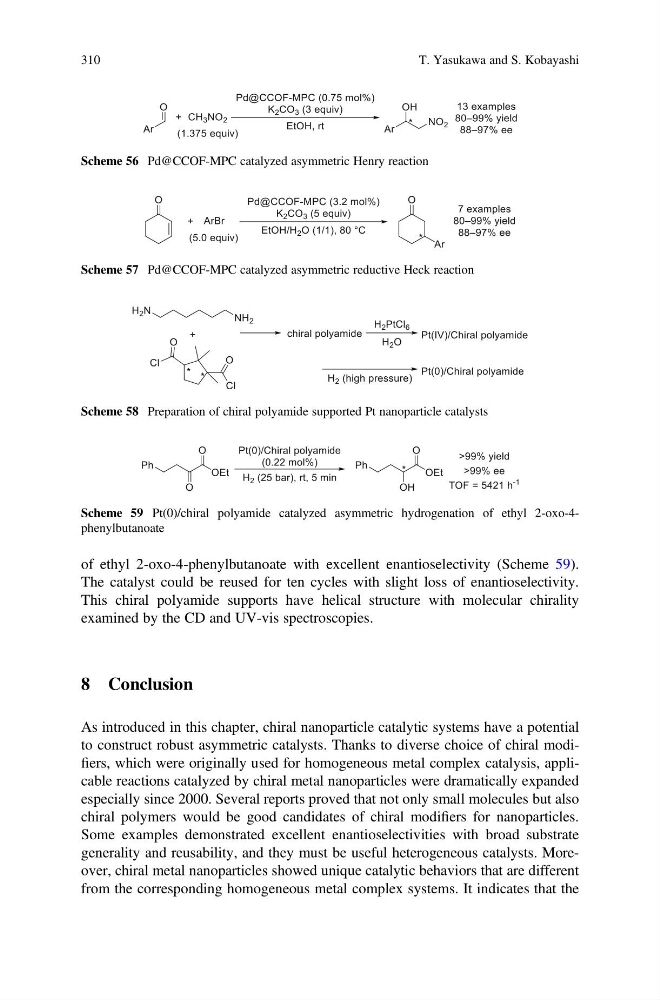
of ethyl 2-oxo-4-phenylbutanoate with excellent enantioselectivity (Scheme 59).
The catalyst could be reused for ten cycles with slight loss of enantioselectivity.
This chiral polyamide supports have helical structure with molecular chirality
examined by the CD and UV-vis spectroscopies.
8 Conclusion
As introduced in this chapter, chiral nanoparticle catalytic systems have a potential
to construct robust asymmetric catalysts. Thanks to diverse choice of chiral modifiers, which were originally used for homogeneous metal complex catalysis, applicable reactions catalyzed by chiral metal nanoparticles were dramatically expanded
especially since 2000. Several reports proved that not only small molecules but also
chiral polymers would be good candidates of chiral modifiers for nanoparticles.
Some examples demonstrated excellent enantioselectivities with broad substrate
generality and reusability, and they must be useful heterogeneous catalysts. Moreover, chiral metal nanoparticles showed unique catalytic behaviors that are different
from the corresponding homogeneous metal complex systems. It indicates that the
Scheme 58 Preparation of chiral polyamide supported Pt nanoparticle catalysts
Scheme 56 Pd@CCOF-MPC catalyzed asymmetric Henry reaction
Scheme 57 Pd@CCOF-MPC catalyzed asymmetric reductive Heck reaction
Scheme 59 Pt(0)/chiral polyamide catalyzed asymmetric hydrogenation of ethyl 2-oxo-4phenylbutanoate
310
T. Yasukawa and S. Kobayashi
The catalyst could be reused for ten cycles with slight loss of enantioselectivity.
This chiral polyamide supports have helical structure with molecular chirality
examined by the CD and UV-vis spectroscopies.
8 Conclusion
As introduced in this chapter, chiral nanoparticle catalytic systems have a potential
to construct robust asymmetric catalysts. Thanks to diverse choice of chiral modifiers, which were originally used for homogeneous metal complex catalysis, applicable reactions catalyzed by chiral metal nanoparticles were dramatically expanded
especially since 2000. Several reports proved that not only small molecules but also
chiral polymers would be good candidates of chiral modifiers for nanoparticles.
Some examples demonstrated excellent enantioselectivities with broad substrate
generality and reusability, and they must be useful heterogeneous catalysts. Moreover, chiral metal nanoparticles showed unique catalytic behaviors that are different
from the corresponding homogeneous metal complex systems. It indicates that the
Scheme 58 Preparation of chiral polyamide supported Pt nanoparticle catalysts
Scheme 56 Pd@CCOF-MPC catalyzed asymmetric Henry reaction
Scheme 57 Pd@CCOF-MPC catalyzed asymmetric reductive Heck reaction
Scheme 59 Pt(0)/chiral polyamide catalyzed asymmetric hydrogenation of ethyl 2-oxo-4phenylbutanoate
310
T. Yasukawa and S. Kobayashi