

avoided. However, supported Au catalysts often require base for the oxidation of
alcohols to yield carboxylic acids irrespective to the kind of supports, and the reports
on base-free oxidation of aliphatic alcohols to the corresponding carboxylic acids are
still limited. Au/HT appeared to be highly active for 1-phenylethanol oxidation to
give acetophenone under base-free conditions, but Au/HT gave unsatisfactory
results for the oxidation of primary aliphatic alcohols, such as 1-octanol [47]. On
the other hand, ethanol oxidation to acetic acid was achieved by Christensen et al.
using Au/MgAl 2 O 4 [100]. Au/MgAl 2 O 4 gave acetic acid in 83% yield (86% selectivity), while Pd/MgAl 2 O 4 and Pt/MgAl 2 O 4 gave acetic acid with worse selectivity,
65 and 20%, respectively, at similar conversions due to the formation of acetaldehyde as a by-product. Several Au/MO x , such as Au/TiO 2 [101], Au/ZnO [102],
Au/SiO 2 [77], and Au/NiCuO x [103], were also reported to be active and selective
for the base-free ethanol oxidation to give acetic acid.
The oxidation of aliphatic alcohols having a long alkyl chain is a more challenging research target because these alcohols are less reactive than ethanol and benzylic
alcohols. Au/NiO appeared to be active and selective for the base-free oxidation of
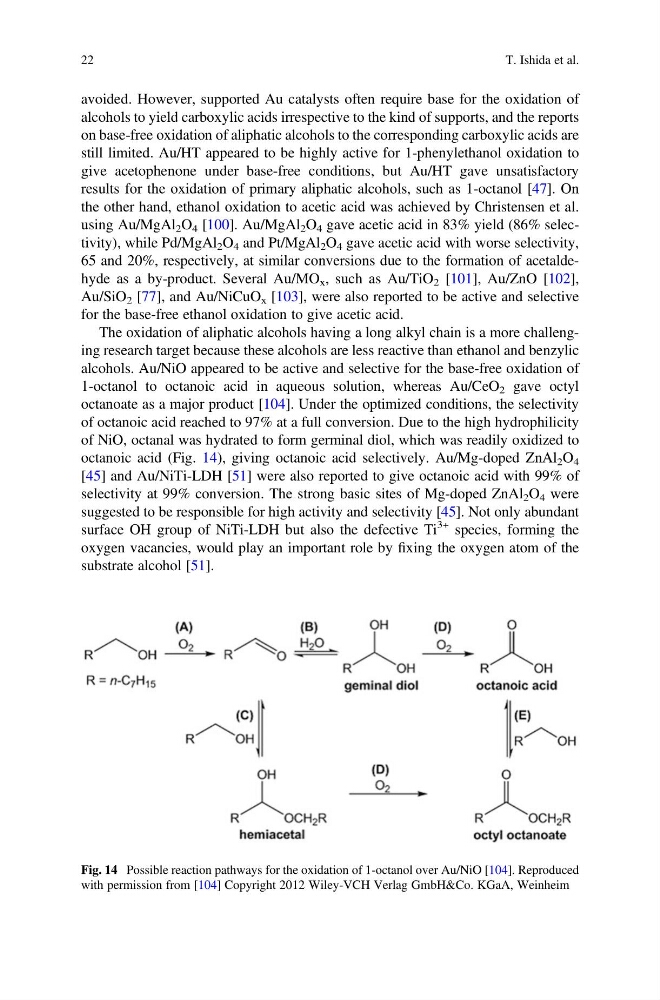
1-octanol to octanoic acid in aqueous solution, whereas Au/CeO 2 gave octyl
octanoate as a major product [104]. Under the optimized conditions, the selectivity
of octanoic acid reached to 97% at a full conversion. Due to the high hydrophilicity
of NiO, octanal was hydrated to form germinal diol, which was readily oxidized to
octanoic acid (Fig. 14), giving octanoic acid selectively. Au/Mg-doped ZnAl 2 O 4
[45] and Au/NiTi-LDH [51] were also reported to give octanoic acid with 99% of
selectivity at 99% conversion. The strong basic sites of Mg-doped ZnAl 2 O 4 were
suggested to be responsible for high activity and selectivity [45]. Not only abundant
surface OH group of NiTi-LDH but also the defective Ti
3+ species, forming the
oxygen vacancies, would play an important role by fixing the oxygen atom of the
substrate alcohol [51].
Fig. 14 Possible reaction pathways for the oxidation of 1-octanol over Au/NiO [104]. Reproduced
with permission from [104] Copyright 2012 Wiley-VCH Verlag GmbH&Co. KGaA, Weinheim
22
T. Ishida et al.
alcohols to yield carboxylic acids irrespective to the kind of supports, and the reports
on base-free oxidation of aliphatic alcohols to the corresponding carboxylic acids are
still limited. Au/HT appeared to be highly active for 1-phenylethanol oxidation to
give acetophenone under base-free conditions, but Au/HT gave unsatisfactory
results for the oxidation of primary aliphatic alcohols, such as 1-octanol [47]. On
the other hand, ethanol oxidation to acetic acid was achieved by Christensen et al.
using Au/MgAl 2 O 4 [100]. Au/MgAl 2 O 4 gave acetic acid in 83% yield (86% selectivity), while Pd/MgAl 2 O 4 and Pt/MgAl 2 O 4 gave acetic acid with worse selectivity,
65 and 20%, respectively, at similar conversions due to the formation of acetaldehyde as a by-product. Several Au/MO x , such as Au/TiO 2 [101], Au/ZnO [102],
Au/SiO 2 [77], and Au/NiCuO x [103], were also reported to be active and selective
for the base-free ethanol oxidation to give acetic acid.
The oxidation of aliphatic alcohols having a long alkyl chain is a more challenging research target because these alcohols are less reactive than ethanol and benzylic
alcohols. Au/NiO appeared to be active and selective for the base-free oxidation of
1-octanol to octanoic acid in aqueous solution, whereas Au/CeO 2 gave octyl
octanoate as a major product [104]. Under the optimized conditions, the selectivity
of octanoic acid reached to 97% at a full conversion. Due to the high hydrophilicity
of NiO, octanal was hydrated to form germinal diol, which was readily oxidized to
octanoic acid (Fig. 14), giving octanoic acid selectively. Au/Mg-doped ZnAl 2 O 4
[45] and Au/NiTi-LDH [51] were also reported to give octanoic acid with 99% of
selectivity at 99% conversion. The strong basic sites of Mg-doped ZnAl 2 O 4 were
suggested to be responsible for high activity and selectivity [45]. Not only abundant
surface OH group of NiTi-LDH but also the defective Ti
3+ species, forming the
oxygen vacancies, would play an important role by fixing the oxygen atom of the
substrate alcohol [51].
Fig. 14 Possible reaction pathways for the oxidation of 1-octanol over Au/NiO [104]. Reproduced
with permission from [104] Copyright 2012 Wiley-VCH Verlag GmbH&Co. KGaA, Weinheim
22
T. Ishida et al.