

DFT calculation of the alcohol oxidation over naked Au 6 clusters suggested that
the neutral Au 6 clusters did not activate O 2 , whereas the alkoxide or hydride
adsorbed Au 6 clusters could activate O 2 because of the electron donation from
anionic adsorbates to the Au 6 cluster [97].
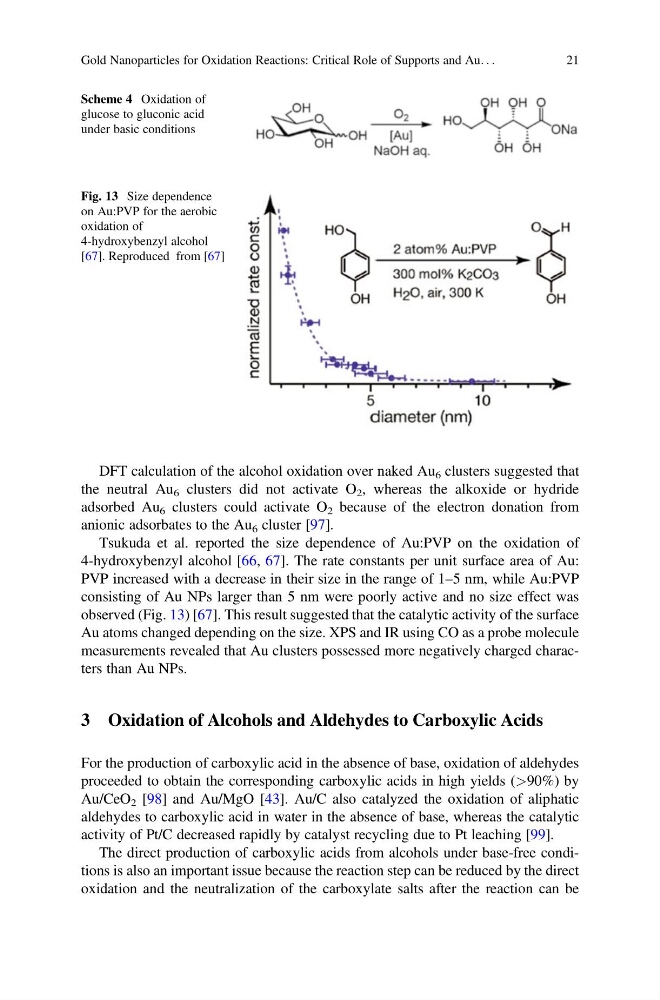
Tsukuda et al. reported the size dependence of Au:PVP on the oxidation of
4-hydroxybenzyl alcohol [66, 67]. The rate constants per unit surface area of Au:
PVP increased with a decrease in their size in the range of 1–5 nm, while Au:PVP
consisting of Au NPs larger than 5 nm were poorly active and no size effect was
observed (Fig. 13) [67]. This result suggested that the catalytic activity of the surface
Au atoms changed depending on the size. XPS and IR using CO as a probe molecule
measurements revealed that Au clusters possessed more negatively charged characters than Au NPs.
3 Oxidation of Alcohols and Aldehydes to Carboxylic Acids
For the production of carboxylic acid in the absence of base, oxidation of aldehydes
proceeded to obtain the corresponding carboxylic acids in high yields (>90%) by
Au/CeO 2 [98] and Au/MgO [43]. Au/C also catalyzed the oxidation of aliphatic
aldehydes to carboxylic acid in water in the absence of base, whereas the catalytic
activity of Pt/C decreased rapidly by catalyst recycling due to Pt leaching [99].
The direct production of carboxylic acids from alcohols under base-free conditions is also an important issue because the reaction step can be reduced by the direct
oxidation and the neutralization of the carboxylate salts after the reaction can be
Fig. 13 Size dependence
on Au:PVP for the aerobic
oxidation of
4-hydroxybenzyl alcohol
[67]. Reproduced from [67]
Scheme 4 Oxidation of
glucose to gluconic acid
under basic conditions
Gold Nanoparticles for Oxidation Reactions: Critical Role of Supports and Au. . .
21
the neutral Au 6 clusters did not activate O 2 , whereas the alkoxide or hydride
adsorbed Au 6 clusters could activate O 2 because of the electron donation from
anionic adsorbates to the Au 6 cluster [97].
Tsukuda et al. reported the size dependence of Au:PVP on the oxidation of
4-hydroxybenzyl alcohol [66, 67]. The rate constants per unit surface area of Au:
PVP increased with a decrease in their size in the range of 1–5 nm, while Au:PVP
consisting of Au NPs larger than 5 nm were poorly active and no size effect was
observed (Fig. 13) [67]. This result suggested that the catalytic activity of the surface
Au atoms changed depending on the size. XPS and IR using CO as a probe molecule
measurements revealed that Au clusters possessed more negatively charged characters than Au NPs.
3 Oxidation of Alcohols and Aldehydes to Carboxylic Acids
For the production of carboxylic acid in the absence of base, oxidation of aldehydes
proceeded to obtain the corresponding carboxylic acids in high yields (>90%) by
Au/CeO 2 [98] and Au/MgO [43]. Au/C also catalyzed the oxidation of aliphatic
aldehydes to carboxylic acid in water in the absence of base, whereas the catalytic
activity of Pt/C decreased rapidly by catalyst recycling due to Pt leaching [99].
The direct production of carboxylic acids from alcohols under base-free conditions is also an important issue because the reaction step can be reduced by the direct
oxidation and the neutralization of the carboxylate salts after the reaction can be
Fig. 13 Size dependence
on Au:PVP for the aerobic
oxidation of
4-hydroxybenzyl alcohol
[67]. Reproduced from [67]
Scheme 4 Oxidation of
glucose to gluconic acid
under basic conditions
Gold Nanoparticles for Oxidation Reactions: Critical Role of Supports and Au. . .
21