

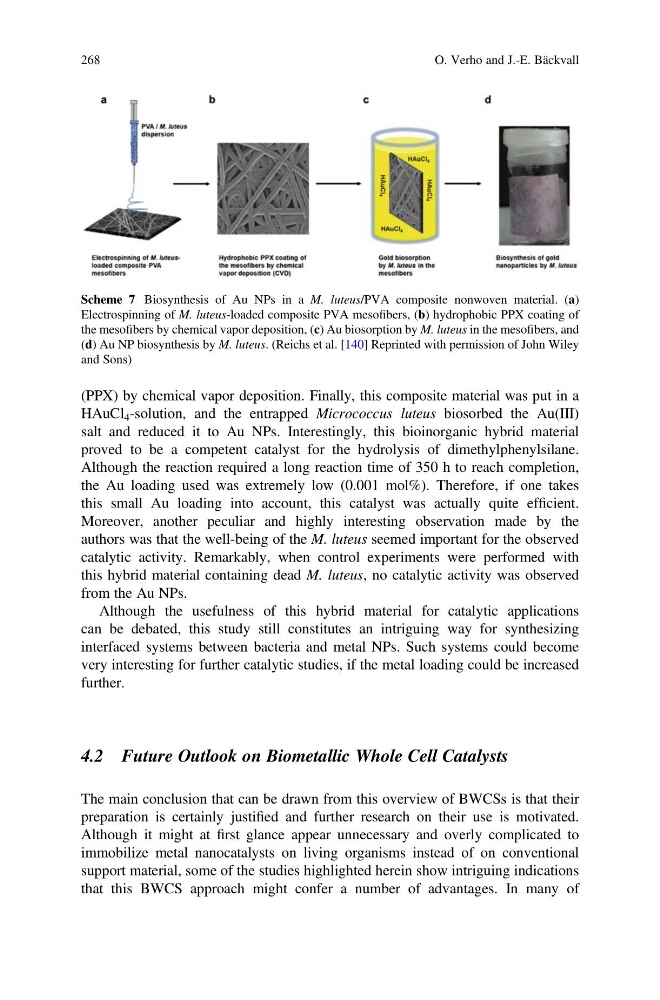
(PPX) by chemical vapor deposition. Finally, this composite material was put in a
HAuCl 4 -solution, and the entrapped Micrococcus luteus biosorbed the Au(III)
salt and reduced it to Au NPs. Interestingly, this bioinorganic hybrid material
proved to be a competent catalyst for the hydrolysis of dimethylphenylsilane.
Although the reaction required a long reaction time of 350 h to reach completion,
the Au loading used was extremely low (0.001 mol%). Therefore, if one takes
this small Au loading into account, this catalyst was actually quite efficient.
Moreover, another peculiar and highly interesting observation made by the
authors was that the well-being of the M. luteus seemed important for the observed
catalytic activity. Remarkably, when control experiments were performed with
this hybrid material containing dead M. luteus, no catalytic activity was observed
from the Au NPs.
Although the usefulness of this hybrid material for catalytic applications
can be debated, this study still constitutes an intriguing way for synthesizing
interfaced systems between bacteria and metal NPs. Such systems could become
very interesting for further catalytic studies, if the metal loading could be increased
further.
4.2 Future Outlook on Biometallic Whole Cell Catalysts
The main conclusion that can be drawn from this overview of BWCSs is that their
preparation is certainly justified and further research on their use is motivated.
Although it might at first glance appear unnecessary and overly complicated to
immobilize metal nanocatalysts on living organisms instead of on conventional
support material, some of the studies highlighted herein show intriguing indications
that this BWCS approach might confer a number of advantages. In many of
Scheme 7 Biosynthesis of Au NPs in a M. luteus/PVA composite nonwoven material. (a)
Electrospinning of M. luteus-loaded composite PVA mesofibers, (b) hydrophobic PPX coating of
the mesofibers by chemical vapor deposition, (c) Au biosorption by M. luteus in the mesofibers, and
(d) Au NP biosynthesis by M. luteus. (Reichs et al. [140] Reprinted with permission of John Wiley
and Sons)
268
O. Verho and J.-E. Bäckvall
HAuCl 4 -solution, and the entrapped Micrococcus luteus biosorbed the Au(III)
salt and reduced it to Au NPs. Interestingly, this bioinorganic hybrid material
proved to be a competent catalyst for the hydrolysis of dimethylphenylsilane.
Although the reaction required a long reaction time of 350 h to reach completion,
the Au loading used was extremely low (0.001 mol%). Therefore, if one takes
this small Au loading into account, this catalyst was actually quite efficient.
Moreover, another peculiar and highly interesting observation made by the
authors was that the well-being of the M. luteus seemed important for the observed
catalytic activity. Remarkably, when control experiments were performed with
this hybrid material containing dead M. luteus, no catalytic activity was observed
from the Au NPs.
Although the usefulness of this hybrid material for catalytic applications
can be debated, this study still constitutes an intriguing way for synthesizing
interfaced systems between bacteria and metal NPs. Such systems could become
very interesting for further catalytic studies, if the metal loading could be increased
further.
4.2 Future Outlook on Biometallic Whole Cell Catalysts
The main conclusion that can be drawn from this overview of BWCSs is that their
preparation is certainly justified and further research on their use is motivated.
Although it might at first glance appear unnecessary and overly complicated to
immobilize metal nanocatalysts on living organisms instead of on conventional
support material, some of the studies highlighted herein show intriguing indications
that this BWCS approach might confer a number of advantages. In many of
Scheme 7 Biosynthesis of Au NPs in a M. luteus/PVA composite nonwoven material. (a)
Electrospinning of M. luteus-loaded composite PVA mesofibers, (b) hydrophobic PPX coating of
the mesofibers by chemical vapor deposition, (c) Au biosorption by M. luteus in the mesofibers, and
(d) Au NP biosynthesis by M. luteus. (Reichs et al. [140] Reprinted with permission of John Wiley
and Sons)
268
O. Verho and J.-E. Bäckvall