

bacteria, and these have, for example, been studied as catalysts for the hydrogenation
of alkenes [135], reduction of chromium species [136, 137], as well as H 2
generation from hypophosphite [138]. Another very impressive example of an
elaborately designed BWCS with dual catalytic functions was described by
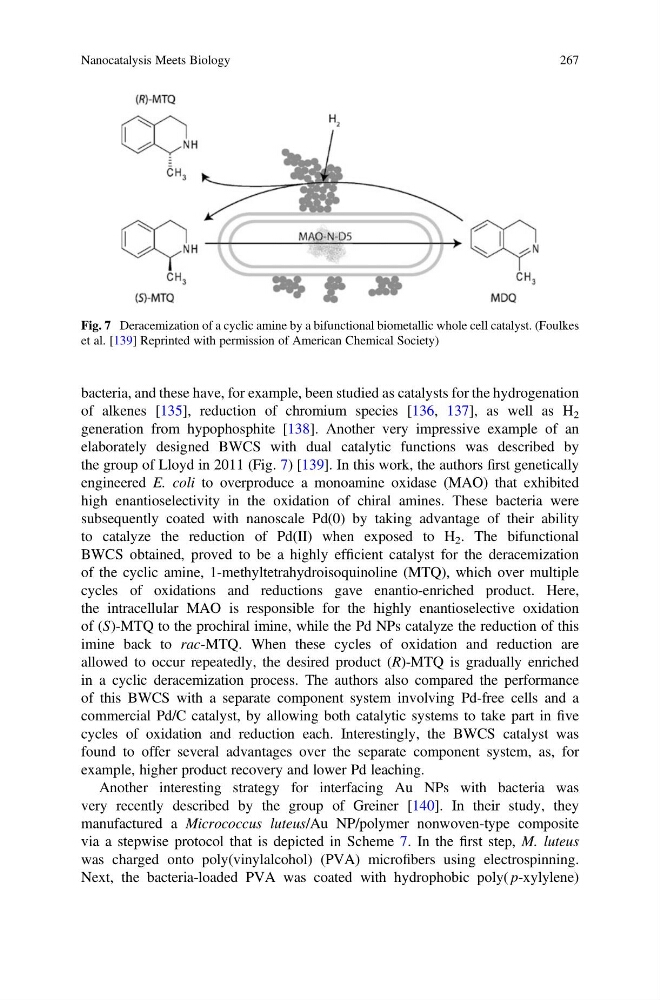
the group of Lloyd in 2011 (Fig. 7) [139]. In this work, the authors first genetically
engineered E. coli to overproduce a monoamine oxidase (MAO) that exhibited
high enantioselectivity in the oxidation of chiral amines. These bacteria were
subsequently coated with nanoscale Pd(0) by taking advantage of their ability
to catalyze the reduction of Pd(II) when exposed to H 2 . The bifunctional
BWCS obtained, proved to be a highly efficient catalyst for the deracemization
of the cyclic amine, 1-methyltetrahydroisoquinoline (MTQ), which over multiple
cycles of oxidations and reductions gave enantio-enriched product. Here,
the intracellular MAO is responsible for the highly enantioselective oxidation
of (S)-MTQ to the prochiral imine, while the Pd NPs catalyze the reduction of this
imine back to rac-MTQ. When these cycles of oxidation and reduction are
allowed to occur repeatedly, the desired product (R)-MTQ is gradually enriched
in a cyclic deracemization process. The authors also compared the performance
of this BWCS with a separate component system involving Pd-free cells and a
commercial Pd/C catalyst, by allowing both catalytic systems to take part in five
cycles of oxidation and reduction each. Interestingly, the BWCS catalyst was
found to offer several advantages over the separate component system, as, for
example, higher product recovery and lower Pd leaching.
Another interesting strategy for interfacing Au NPs with bacteria was
very recently described by the group of Greiner [140]. In their study, they
manufactured a Micrococcus luteus/Au NP/polymer nonwoven-type composite
via a stepwise protocol that is depicted in Scheme 7. In the first step, M. luteus
was charged onto poly(vinylalcohol) (PVA) microfibers using electrospinning.
Next, the bacteria-loaded PVA was coated with hydrophobic poly( p-xylylene)
Fig. 7 Deracemization of a cyclic amine by a bifunctional biometallic whole cell catalyst. (Foulkes
et al. [139] Reprinted with permission of American Chemical Society)
Nanocatalysis Meets Biology
267
of alkenes [135], reduction of chromium species [136, 137], as well as H 2
generation from hypophosphite [138]. Another very impressive example of an
elaborately designed BWCS with dual catalytic functions was described by
the group of Lloyd in 2011 (Fig. 7) [139]. In this work, the authors first genetically
engineered E. coli to overproduce a monoamine oxidase (MAO) that exhibited
high enantioselectivity in the oxidation of chiral amines. These bacteria were
subsequently coated with nanoscale Pd(0) by taking advantage of their ability
to catalyze the reduction of Pd(II) when exposed to H 2 . The bifunctional
BWCS obtained, proved to be a highly efficient catalyst for the deracemization
of the cyclic amine, 1-methyltetrahydroisoquinoline (MTQ), which over multiple
cycles of oxidations and reductions gave enantio-enriched product. Here,
the intracellular MAO is responsible for the highly enantioselective oxidation
of (S)-MTQ to the prochiral imine, while the Pd NPs catalyze the reduction of this
imine back to rac-MTQ. When these cycles of oxidation and reduction are
allowed to occur repeatedly, the desired product (R)-MTQ is gradually enriched
in a cyclic deracemization process. The authors also compared the performance
of this BWCS with a separate component system involving Pd-free cells and a
commercial Pd/C catalyst, by allowing both catalytic systems to take part in five
cycles of oxidation and reduction each. Interestingly, the BWCS catalyst was
found to offer several advantages over the separate component system, as, for
example, higher product recovery and lower Pd leaching.
Another interesting strategy for interfacing Au NPs with bacteria was
very recently described by the group of Greiner [140]. In their study, they
manufactured a Micrococcus luteus/Au NP/polymer nonwoven-type composite
via a stepwise protocol that is depicted in Scheme 7. In the first step, M. luteus
was charged onto poly(vinylalcohol) (PVA) microfibers using electrospinning.
Next, the bacteria-loaded PVA was coated with hydrophobic poly( p-xylylene)
Fig. 7 Deracemization of a cyclic amine by a bifunctional biometallic whole cell catalyst. (Foulkes
et al. [139] Reprinted with permission of American Chemical Society)
Nanocatalysis Meets Biology
267