

commercial Pd(0) powder, it was found that Pd loadings of 500 mg/L were required
to give similar results as those of the S. oneidensis-generated bioPd. From this
comparison study, it was evident that the S. oneidensis-based bioreduction approach
allowed for the generation of remarkably efficient Pd nanocatalysts. In a follow-up
study, Verstraete and coworkers showed that this Pd/S. oneidensis BWCS could also
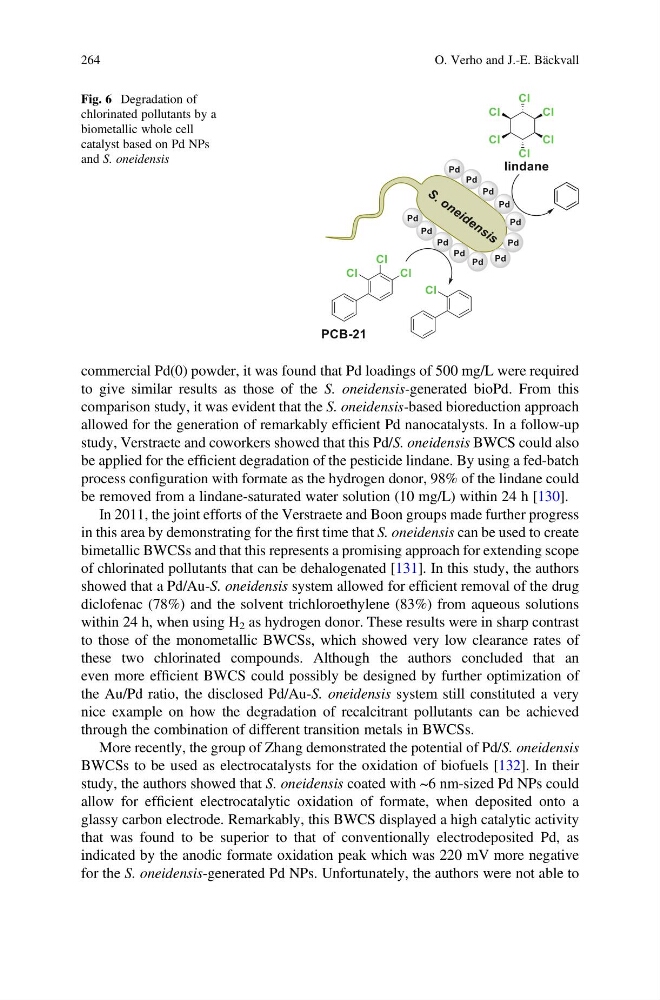
be applied for the efficient degradation of the pesticide lindane. By using a fed-batch
process configuration with formate as the hydrogen donor, 98% of the lindane could
be removed from a lindane-saturated water solution (10 mg/L) within 24 h [130].
In 2011, the joint efforts of the Verstraete and Boon groups made further progress
in this area by demonstrating for the first time that S. oneidensis can be used to create
bimetallic BWCSs and that this represents a promising approach for extending scope
of chlorinated pollutants that can be dehalogenated [131]. In this study, the authors
showed that a Pd/Au-S. oneidensis system allowed for efficient removal of the drug
diclofenac (78%) and the solvent trichloroethylene (83%) from aqueous solutions
within 24 h, when using H 2 as hydrogen donor. These results were in sharp contrast
to those of the monometallic BWCSs, which showed very low clearance rates of
these two chlorinated compounds. Although the authors concluded that an
even more efficient BWCS could possibly be designed by further optimization of
the Au/Pd ratio, the disclosed Pd/Au-S. oneidensis system still constituted a very
nice example on how the degradation of recalcitrant pollutants can be achieved
through the combination of different transition metals in BWCSs.
More recently, the group of Zhang demonstrated the potential of Pd/S. oneidensis
BWCSs to be used as electrocatalysts for the oxidation of biofuels [132]. In their
study, the authors showed that S. oneidensis coated with ~6 nm-sized Pd NPs could
allow for efficient electrocatalytic oxidation of formate, when deposited onto a
glassy carbon electrode. Remarkably, this BWCS displayed a high catalytic activity
that was found to be superior to that of conventionally electrodeposited Pd, as
indicated by the anodic formate oxidation peak which was 220 mV more negative
for the S. oneidensis-generated Pd NPs. Unfortunately, the authors were not able to
Fig. 6 Degradation of
chlorinated pollutants by a
biometallic whole cell
catalyst based on Pd NPs
and S. oneidensis
264
O. Verho and J.-E. Bäckvall
to give similar results as those of the S. oneidensis-generated bioPd. From this
comparison study, it was evident that the S. oneidensis-based bioreduction approach
allowed for the generation of remarkably efficient Pd nanocatalysts. In a follow-up
study, Verstraete and coworkers showed that this Pd/S. oneidensis BWCS could also
be applied for the efficient degradation of the pesticide lindane. By using a fed-batch
process configuration with formate as the hydrogen donor, 98% of the lindane could
be removed from a lindane-saturated water solution (10 mg/L) within 24 h [130].
In 2011, the joint efforts of the Verstraete and Boon groups made further progress
in this area by demonstrating for the first time that S. oneidensis can be used to create
bimetallic BWCSs and that this represents a promising approach for extending scope
of chlorinated pollutants that can be dehalogenated [131]. In this study, the authors
showed that a Pd/Au-S. oneidensis system allowed for efficient removal of the drug
diclofenac (78%) and the solvent trichloroethylene (83%) from aqueous solutions
within 24 h, when using H 2 as hydrogen donor. These results were in sharp contrast
to those of the monometallic BWCSs, which showed very low clearance rates of
these two chlorinated compounds. Although the authors concluded that an
even more efficient BWCS could possibly be designed by further optimization of
the Au/Pd ratio, the disclosed Pd/Au-S. oneidensis system still constituted a very
nice example on how the degradation of recalcitrant pollutants can be achieved
through the combination of different transition metals in BWCSs.
More recently, the group of Zhang demonstrated the potential of Pd/S. oneidensis
BWCSs to be used as electrocatalysts for the oxidation of biofuels [132]. In their
study, the authors showed that S. oneidensis coated with ~6 nm-sized Pd NPs could
allow for efficient electrocatalytic oxidation of formate, when deposited onto a
glassy carbon electrode. Remarkably, this BWCS displayed a high catalytic activity
that was found to be superior to that of conventionally electrodeposited Pd, as
indicated by the anodic formate oxidation peak which was 220 mV more negative
for the S. oneidensis-generated Pd NPs. Unfortunately, the authors were not able to
Fig. 6 Degradation of
chlorinated pollutants by a
biometallic whole cell
catalyst based on Pd NPs
and S. oneidensis
264
O. Verho and J.-E. Bäckvall