

S. oneidensis has received particular attention over the years since it has proved to be
very efficient in reducing many different catalytically relevant transition metals, and
moreover the electron transfer pathway responsible for its extraordinary electrochemical activity is well-characterized [126–128]. To achieve the metal reduction,
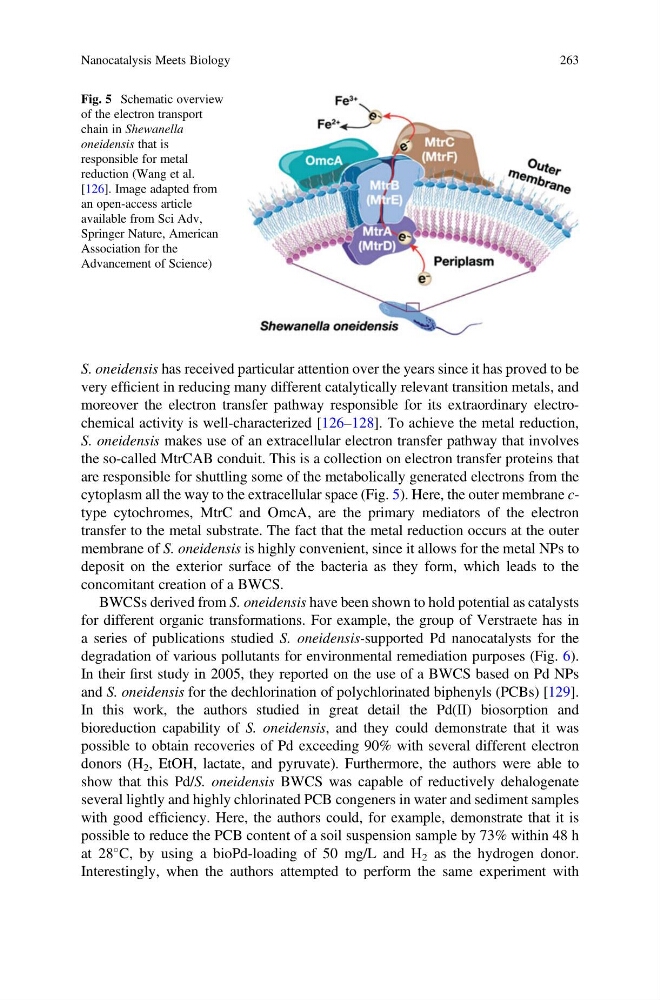
S. oneidensis makes use of an extracellular electron transfer pathway that involves
the so-called MtrCAB conduit. This is a collection on electron transfer proteins that
are responsible for shuttling some of the metabolically generated electrons from the
cytoplasm all the way to the extracellular space (Fig. 5). Here, the outer membrane ctype cytochromes, MtrC and OmcA, are the primary mediators of the electron
transfer to the metal substrate. The fact that the metal reduction occurs at the outer
membrane of S. oneidensis is highly convenient, since it allows for the metal NPs to
deposit on the exterior surface of the bacteria as they form, which leads to the
concomitant creation of a BWCS.
BWCSs derived from S. oneidensis have been shown to hold potential as catalysts
for different organic transformations. For example, the group of Verstraete has in
a series of publications studied S. oneidensis-supported Pd nanocatalysts for the
degradation of various pollutants for environmental remediation purposes (Fig. 6).
In their first study in 2005, they reported on the use of a BWCS based on Pd NPs
and S. oneidensis for the dechlorination of polychlorinated biphenyls (PCBs) [129].
In this work, the authors studied in great detail the Pd(II) biosorption and
bioreduction capability of S. oneidensis, and they could demonstrate that it was
possible to obtain recoveries of Pd exceeding 90% with several different electron
donors (H 2 , EtOH, lactate, and pyruvate). Furthermore, the authors were able to
show that this Pd/S. oneidensis BWCS was capable of reductively dehalogenate
several lightly and highly chlorinated PCB congeners in water and sediment samples
with good efficiency. Here, the authors could, for example, demonstrate that it is
possible to reduce the PCB content of a soil suspension sample by 73% within 48 h
at 28
C, by using a bioPd-loading of 50 mg/L and H 2 as the hydrogen donor.
Interestingly, when the authors attempted to perform the same experiment with
Fig. 5 Schematic overview
of the electron transport
chain in Shewanella
oneidensis that is
responsible for metal
reduction (Wang et al.
[126]. Image adapted from
an open-access article
available from Sci Adv,
Springer Nature, American
Association for the
Advancement of Science)
Nanocatalysis Meets Biology
263
very efficient in reducing many different catalytically relevant transition metals, and
moreover the electron transfer pathway responsible for its extraordinary electrochemical activity is well-characterized [126–128]. To achieve the metal reduction,
S. oneidensis makes use of an extracellular electron transfer pathway that involves
the so-called MtrCAB conduit. This is a collection on electron transfer proteins that
are responsible for shuttling some of the metabolically generated electrons from the
cytoplasm all the way to the extracellular space (Fig. 5). Here, the outer membrane ctype cytochromes, MtrC and OmcA, are the primary mediators of the electron
transfer to the metal substrate. The fact that the metal reduction occurs at the outer
membrane of S. oneidensis is highly convenient, since it allows for the metal NPs to
deposit on the exterior surface of the bacteria as they form, which leads to the
concomitant creation of a BWCS.
BWCSs derived from S. oneidensis have been shown to hold potential as catalysts
for different organic transformations. For example, the group of Verstraete has in
a series of publications studied S. oneidensis-supported Pd nanocatalysts for the
degradation of various pollutants for environmental remediation purposes (Fig. 6).
In their first study in 2005, they reported on the use of a BWCS based on Pd NPs
and S. oneidensis for the dechlorination of polychlorinated biphenyls (PCBs) [129].
In this work, the authors studied in great detail the Pd(II) biosorption and
bioreduction capability of S. oneidensis, and they could demonstrate that it was
possible to obtain recoveries of Pd exceeding 90% with several different electron
donors (H 2 , EtOH, lactate, and pyruvate). Furthermore, the authors were able to
show that this Pd/S. oneidensis BWCS was capable of reductively dehalogenate
several lightly and highly chlorinated PCB congeners in water and sediment samples
with good efficiency. Here, the authors could, for example, demonstrate that it is
possible to reduce the PCB content of a soil suspension sample by 73% within 48 h
at 28
C, by using a bioPd-loading of 50 mg/L and H 2 as the hydrogen donor.
Interestingly, when the authors attempted to perform the same experiment with
Fig. 5 Schematic overview
of the electron transport
chain in Shewanella
oneidensis that is
responsible for metal
reduction (Wang et al.
[126]. Image adapted from
an open-access article
available from Sci Adv,
Springer Nature, American
Association for the
Advancement of Science)
Nanocatalysis Meets Biology
263