

To develop a hybrid catalyst with improved recyclability, the Bäckvall group
later explored an alternative way of interfacing CalB with Pd NPs, which omitted
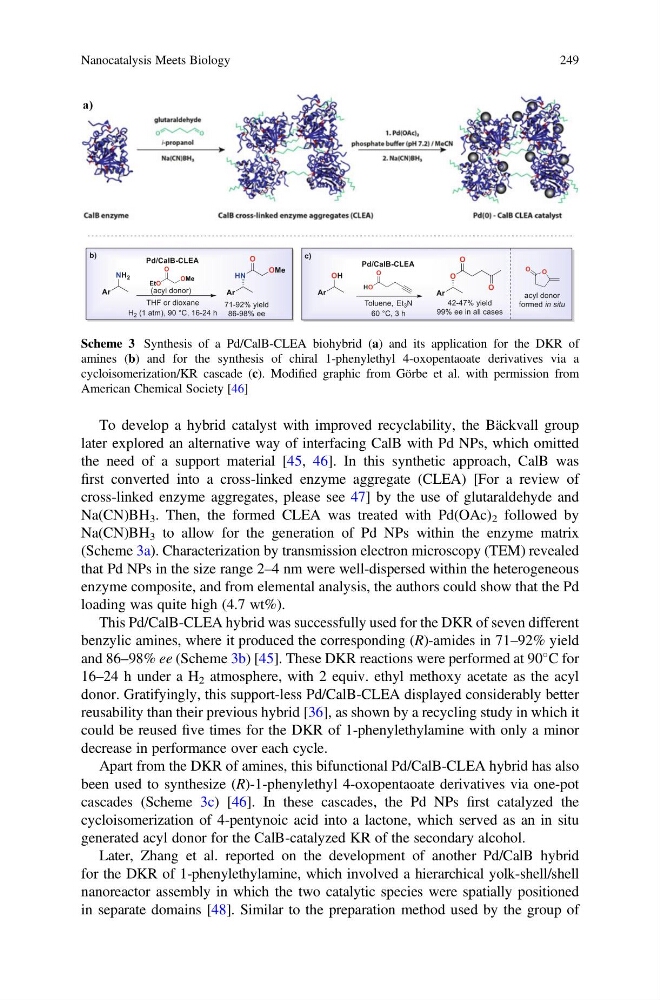
the need of a support material [45, 46]. In this synthetic approach, CalB was
first converted into a cross-linked enzyme aggregate (CLEA) [For a review of
cross-linked enzyme aggregates, please see 47] by the use of glutaraldehyde and
Na(CN)BH 3 . Then, the formed CLEA was treated with Pd(OAc) 2 followed by
Na(CN)BH 3 to allow for the generation of Pd NPs within the enzyme matrix
(Scheme 3a). Characterization by transmission electron microscopy (TEM) revealed
that Pd NPs in the size range 2–4 nm were well-dispersed within the heterogeneous
enzyme composite, and from elemental analysis, the authors could show that the Pd
loading was quite high (4.7 wt%).
This Pd/CalB-CLEA hybrid was successfully used for the DKR of seven different
benzylic amines, where it produced the corresponding (R)-amides in 71–92% yield
and 86–98% ee (Scheme 3b) [45]. These DKR reactions were performed at 90
C for
16–24 h under a H 2 atmosphere, with 2 equiv. ethyl methoxy acetate as the acyl
donor. Gratifyingly, this support-less Pd/CalB-CLEA displayed considerably better
reusability than their previous hybrid [36], as shown by a recycling study in which it
could be reused five times for the DKR of 1-phenylethylamine with only a minor
decrease in performance over each cycle.
Apart from the DKR of amines, this bifunctional Pd/CalB-CLEA hybrid has also
been used to synthesize (R)-1-phenylethyl 4-oxopentaoate derivatives via one-pot
cascades (Scheme 3c) [46]. In these cascades, the Pd NPs first catalyzed the
cycloisomerization of 4-pentynoic acid into a lactone, which served as an in situ
generated acyl donor for the CalB-catalyzed KR of the secondary alcohol.
Later, Zhang et al. reported on the development of another Pd/CalB hybrid
for the DKR of 1-phenylethylamine, which involved a hierarchical yolk-shell/shell
nanoreactor assembly in which the two catalytic species were spatially positioned
in separate domains [48]. Similar to the preparation method used by the group of
Scheme 3 Synthesis of a Pd/CalB-CLEA biohybrid (a) and its application for the DKR of
amines (b) and for the synthesis of chiral 1-phenylethyl 4-oxopentaoate derivatives via a
cycloisomerization/KR cascade (c). Modified graphic from Görbe et al. with permission from
American Chemical Society [46]
Nanocatalysis Meets Biology
249
later explored an alternative way of interfacing CalB with Pd NPs, which omitted
the need of a support material [45, 46]. In this synthetic approach, CalB was
first converted into a cross-linked enzyme aggregate (CLEA) [For a review of
cross-linked enzyme aggregates, please see 47] by the use of glutaraldehyde and
Na(CN)BH 3 . Then, the formed CLEA was treated with Pd(OAc) 2 followed by
Na(CN)BH 3 to allow for the generation of Pd NPs within the enzyme matrix
(Scheme 3a). Characterization by transmission electron microscopy (TEM) revealed
that Pd NPs in the size range 2–4 nm were well-dispersed within the heterogeneous
enzyme composite, and from elemental analysis, the authors could show that the Pd
loading was quite high (4.7 wt%).
This Pd/CalB-CLEA hybrid was successfully used for the DKR of seven different
benzylic amines, where it produced the corresponding (R)-amides in 71–92% yield
and 86–98% ee (Scheme 3b) [45]. These DKR reactions were performed at 90
C for
16–24 h under a H 2 atmosphere, with 2 equiv. ethyl methoxy acetate as the acyl
donor. Gratifyingly, this support-less Pd/CalB-CLEA displayed considerably better
reusability than their previous hybrid [36], as shown by a recycling study in which it
could be reused five times for the DKR of 1-phenylethylamine with only a minor
decrease in performance over each cycle.
Apart from the DKR of amines, this bifunctional Pd/CalB-CLEA hybrid has also
been used to synthesize (R)-1-phenylethyl 4-oxopentaoate derivatives via one-pot
cascades (Scheme 3c) [46]. In these cascades, the Pd NPs first catalyzed the
cycloisomerization of 4-pentynoic acid into a lactone, which served as an in situ
generated acyl donor for the CalB-catalyzed KR of the secondary alcohol.
Later, Zhang et al. reported on the development of another Pd/CalB hybrid
for the DKR of 1-phenylethylamine, which involved a hierarchical yolk-shell/shell
nanoreactor assembly in which the two catalytic species were spatially positioned
in separate domains [48]. Similar to the preparation method used by the group of
Scheme 3 Synthesis of a Pd/CalB-CLEA biohybrid (a) and its application for the DKR of
amines (b) and for the synthesis of chiral 1-phenylethyl 4-oxopentaoate derivatives via a
cycloisomerization/KR cascade (c). Modified graphic from Görbe et al. with permission from
American Chemical Society [46]
Nanocatalysis Meets Biology
249