

functionalized siliceous mesocellular foam (Pd(0)-AmP-MCF) and shown that
it could be used to efficiently racemize amines under a H 2 atmosphere [34].
Apart from being able to racemize amines, this versatile Pd(0) nanocatalyst has
also been used for a number of other transformations, as, for example, oxidations
[37, 38], reductions [39–41], oxidative cyclizations [42, 43], and cross-couplings
[41, 44]. The authors had noted that not all of the aminopropyl groups
on the support surface of this Pd(0)-AmP-MCF nanocatalyst was involved in
the coordination of the Pd NPs, and thus they hypothesized that these free
aminopropyl groups could be exploited for co-immobilization of CalB. The
anchoring of the enzyme to the Pd(0)-AmP-MCF nanocatalyst was achieved by
first reacting the free aminopropyl groups with a dialdehyde linker (glutaraldehyde)
and then covalently attaching the enzyme to the free aldehyde group of the linker
via a Schiff-base forming reaction.
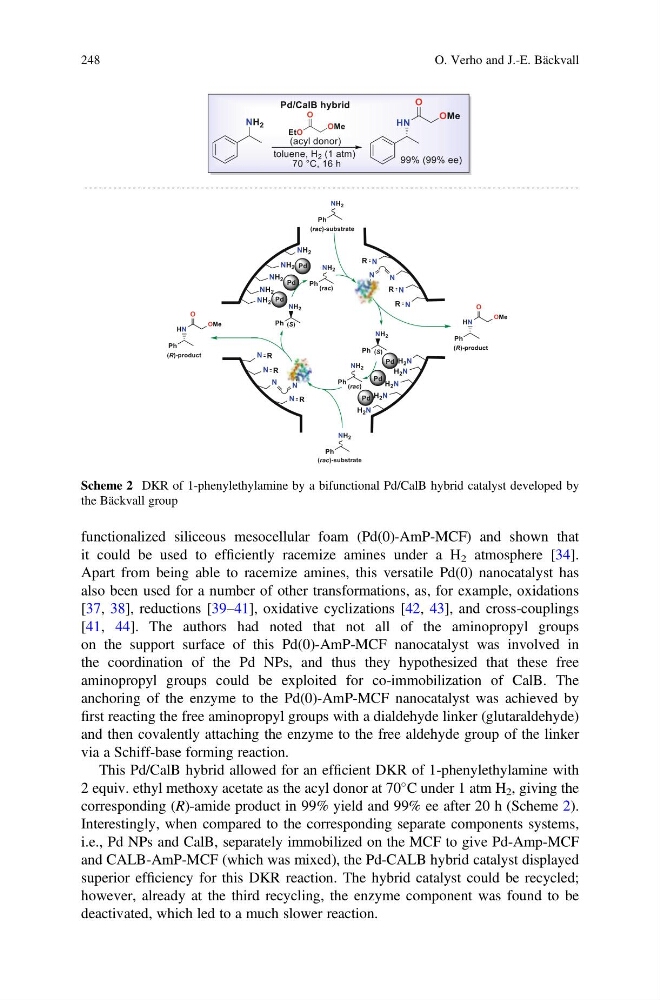
This Pd/CalB hybrid allowed for an efficient DKR of 1-phenylethylamine with
2 equiv. ethyl methoxy acetate as the acyl donor at 70
C under 1 atm H 2 , giving the
corresponding (R)-amide product in 99% yield and 99% ee after 20 h (Scheme 2).
Interestingly, when compared to the corresponding separate components systems,
i.e., Pd NPs and CalB, separately immobilized on the MCF to give Pd-Amp-MCF
and CALB-AmP-MCF (which was mixed), the Pd-CALB hybrid catalyst displayed
superior efficiency for this DKR reaction. The hybrid catalyst could be recycled;
however, already at the third recycling, the enzyme component was found to be
deactivated, which led to a much slower reaction.
Scheme 2 DKR of 1-phenylethylamine by a bifunctional Pd/CalB hybrid catalyst developed by
the Bäckvall group
248
O. Verho and J.-E. Bäckvall
it could be used to efficiently racemize amines under a H 2 atmosphere [34].
Apart from being able to racemize amines, this versatile Pd(0) nanocatalyst has
also been used for a number of other transformations, as, for example, oxidations
[37, 38], reductions [39–41], oxidative cyclizations [42, 43], and cross-couplings
[41, 44]. The authors had noted that not all of the aminopropyl groups
on the support surface of this Pd(0)-AmP-MCF nanocatalyst was involved in
the coordination of the Pd NPs, and thus they hypothesized that these free
aminopropyl groups could be exploited for co-immobilization of CalB. The
anchoring of the enzyme to the Pd(0)-AmP-MCF nanocatalyst was achieved by
first reacting the free aminopropyl groups with a dialdehyde linker (glutaraldehyde)
and then covalently attaching the enzyme to the free aldehyde group of the linker
via a Schiff-base forming reaction.
This Pd/CalB hybrid allowed for an efficient DKR of 1-phenylethylamine with
2 equiv. ethyl methoxy acetate as the acyl donor at 70
C under 1 atm H 2 , giving the
corresponding (R)-amide product in 99% yield and 99% ee after 20 h (Scheme 2).
Interestingly, when compared to the corresponding separate components systems,
i.e., Pd NPs and CalB, separately immobilized on the MCF to give Pd-Amp-MCF
and CALB-AmP-MCF (which was mixed), the Pd-CALB hybrid catalyst displayed
superior efficiency for this DKR reaction. The hybrid catalyst could be recycled;
however, already at the third recycling, the enzyme component was found to be
deactivated, which led to a much slower reaction.
Scheme 2 DKR of 1-phenylethylamine by a bifunctional Pd/CalB hybrid catalyst developed by
the Bäckvall group
248
O. Verho and J.-E. Bäckvall