

tracking of the reaction post-filtration showed the absence of an induction period,
confirming that the active catalyst had already formed prior to the filtration.
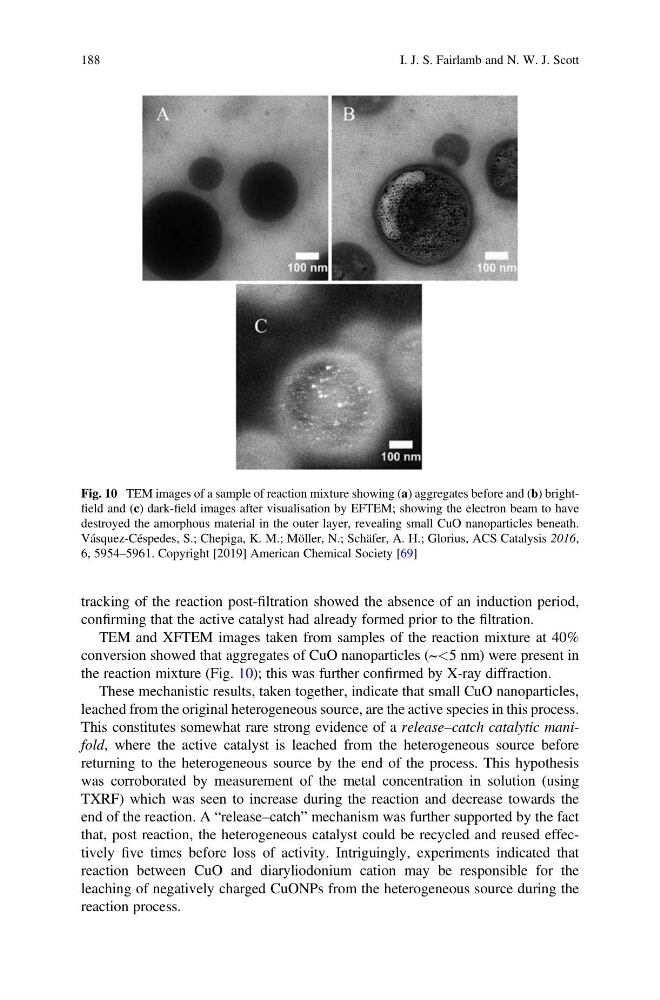
TEM and XFTEM images taken from samples of the reaction mixture at 40%
conversion showed that aggregates of CuO nanoparticles (~<5 nm) were present in
the reaction mixture (Fig. 10); this was further confirmed by X-ray diffraction.
These mechanistic results, taken together, indicate that small CuO nanoparticles,
leached from the original heterogeneous source, are the active species in this process.
This constitutes somewhat rare strong evidence of a release–catch catalytic manifold, where the active catalyst is leached from the heterogeneous source before
returning to the heterogeneous source by the end of the process. This hypothesis
was corroborated by measurement of the metal concentration in solution (using
TXRF) which was seen to increase during the reaction and decrease towards the
end of the reaction. A “release–catch” mechanism was further supported by the fact
that, post reaction, the heterogeneous catalyst could be recycled and reused effectively five times before loss of activity. Intriguingly, experiments indicated that
reaction between CuO and diaryliodonium cation may be responsible for the
leaching of negatively charged CuONPs from the heterogeneous source during the
reaction process.
Fig. 10 TEM images of a sample of reaction mixture showing (a) aggregates before and (b) brightfield and (c) dark-field images after visualisation by EFTEM; showing the electron beam to have
destroyed the amorphous material in the outer layer, revealing small CuO nanoparticles beneath.
Vásquez-Céspedes, S.; Chepiga, K. M.; Möller, N.; Schäfer, A. H.; Glorius, ACS Catalysis 2016,
6, 5954–5961. Copyright [2019] American Chemical Society [69]
188
I. J. S. Fairlamb and N. W. J. Scott
confirming that the active catalyst had already formed prior to the filtration.
TEM and XFTEM images taken from samples of the reaction mixture at 40%
conversion showed that aggregates of CuO nanoparticles (~<5 nm) were present in
the reaction mixture (Fig. 10); this was further confirmed by X-ray diffraction.
These mechanistic results, taken together, indicate that small CuO nanoparticles,
leached from the original heterogeneous source, are the active species in this process.
This constitutes somewhat rare strong evidence of a release–catch catalytic manifold, where the active catalyst is leached from the heterogeneous source before
returning to the heterogeneous source by the end of the process. This hypothesis
was corroborated by measurement of the metal concentration in solution (using
TXRF) which was seen to increase during the reaction and decrease towards the
end of the reaction. A “release–catch” mechanism was further supported by the fact
that, post reaction, the heterogeneous catalyst could be recycled and reused effectively five times before loss of activity. Intriguingly, experiments indicated that
reaction between CuO and diaryliodonium cation may be responsible for the
leaching of negatively charged CuONPs from the heterogeneous source during the
reaction process.
Fig. 10 TEM images of a sample of reaction mixture showing (a) aggregates before and (b) brightfield and (c) dark-field images after visualisation by EFTEM; showing the electron beam to have
destroyed the amorphous material in the outer layer, revealing small CuO nanoparticles beneath.
Vásquez-Céspedes, S.; Chepiga, K. M.; Möller, N.; Schäfer, A. H.; Glorius, ACS Catalysis 2016,
6, 5954–5961. Copyright [2019] American Chemical Society [69]
188
I. J. S. Fairlamb and N. W. J. Scott