

species, generated from a heterogeneous source, being the catalytically active
species. Employing the conditions detailed in Scheme 7, a variety of electron-rich
heterocycles could be arylated, using diaryliodonium salts as an arylating source, to
bring about highly site-selective, direct arylation of some common heterocycles.
The aromatic heterocycles reported were electron-rich thiophenes, furans and
benzofurans, as well as indoles (both Me-protected and unprotected). Both electronwithdrawing and electron-donating para- and meta-substituted diaryliodonium salts
were well tolerated; however yields were higher with electron-poor aryl groups.
The CuO/Fe 3 O 4 , composed of earth-abundant materials, could be easily prepared
by heating CuCl 2 with Fe 3 O 4 under basic conditions, albeit in a low 17% yield. The
superparamagnetic nature of the Fe 3 O 4 support allowed for the use of a magnet to
remove the spent catalyst from the post-reaction mixture.
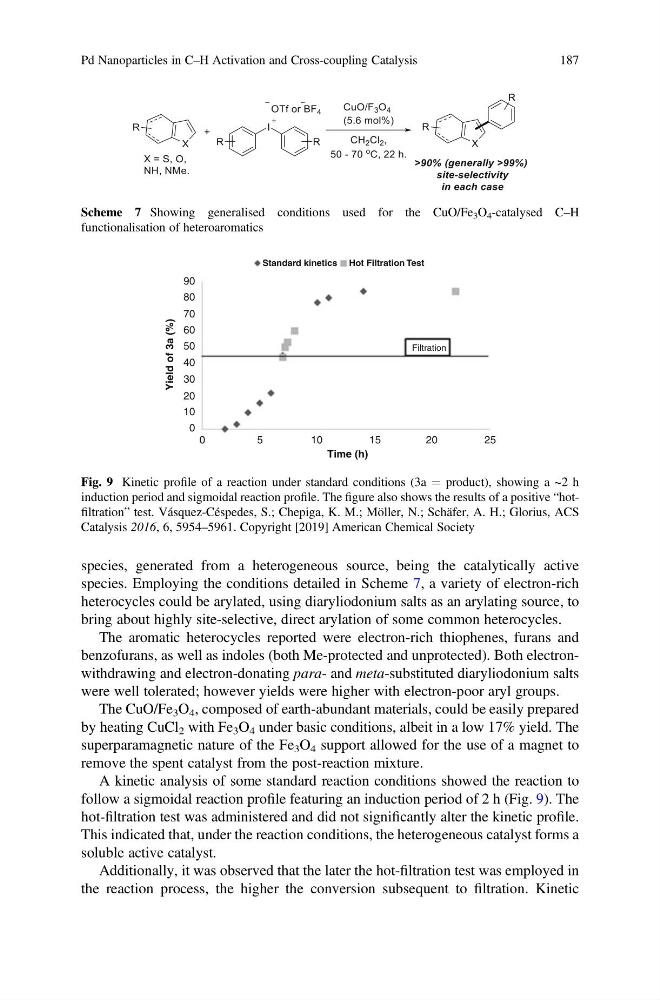
A kinetic analysis of some standard reaction conditions showed the reaction to
follow a sigmoidal reaction profile featuring an induction period of 2 h (Fig. 9). The
hot-filtration test was administered and did not significantly alter the kinetic profile.
This indicated that, under the reaction conditions, the heterogeneous catalyst forms a
soluble active catalyst.
Additionally, it was observed that the later the hot-filtration test was employed in
the reaction process, the higher the conversion subsequent to filtration. Kinetic
Scheme 7 Showing generalised conditions used for the CuO/Fe 3 O 4 -catalysed C–H
functionalisation of heteroaromatics
Standard kinetics Hot Filtration Test
Filtration
90
80
70
60
50
40
30
20
10
0
Time (h)
0
5
10
15
20
25
Yield of 3a (%)
Fig. 9 Kinetic profile of a reaction under standard conditions (3a ¼ product), showing a ~2 h
induction period and sigmoidal reaction profile. The figure also shows the results of a positive “hotfiltration” test. Vásquez-Céspedes, S.; Chepiga, K. M.; Möller, N.; Schäfer, A. H.; Glorius, ACS
Catalysis 2016, 6, 5954–5961. Copyright [2019] American Chemical Society
Pd Nanoparticles in C–H Activation and Cross-coupling Catalysis
187
species. Employing the conditions detailed in Scheme 7, a variety of electron-rich
heterocycles could be arylated, using diaryliodonium salts as an arylating source, to
bring about highly site-selective, direct arylation of some common heterocycles.
The aromatic heterocycles reported were electron-rich thiophenes, furans and
benzofurans, as well as indoles (both Me-protected and unprotected). Both electronwithdrawing and electron-donating para- and meta-substituted diaryliodonium salts
were well tolerated; however yields were higher with electron-poor aryl groups.
The CuO/Fe 3 O 4 , composed of earth-abundant materials, could be easily prepared
by heating CuCl 2 with Fe 3 O 4 under basic conditions, albeit in a low 17% yield. The
superparamagnetic nature of the Fe 3 O 4 support allowed for the use of a magnet to
remove the spent catalyst from the post-reaction mixture.
A kinetic analysis of some standard reaction conditions showed the reaction to
follow a sigmoidal reaction profile featuring an induction period of 2 h (Fig. 9). The
hot-filtration test was administered and did not significantly alter the kinetic profile.
This indicated that, under the reaction conditions, the heterogeneous catalyst forms a
soluble active catalyst.
Additionally, it was observed that the later the hot-filtration test was employed in
the reaction process, the higher the conversion subsequent to filtration. Kinetic
Scheme 7 Showing generalised conditions used for the CuO/Fe 3 O 4 -catalysed C–H
functionalisation of heteroaromatics
Standard kinetics Hot Filtration Test
Filtration
90
80
70
60
50
40
30
20
10
0
Time (h)
0
5
10
15
20
25
Yield of 3a (%)
Fig. 9 Kinetic profile of a reaction under standard conditions (3a ¼ product), showing a ~2 h
induction period and sigmoidal reaction profile. The figure also shows the results of a positive “hotfiltration” test. Vásquez-Céspedes, S.; Chepiga, K. M.; Möller, N.; Schäfer, A. H.; Glorius, ACS
Catalysis 2016, 6, 5954–5961. Copyright [2019] American Chemical Society
Pd Nanoparticles in C–H Activation and Cross-coupling Catalysis
187