

deactivation during an extended high-temperature oxidation treatment [129]. The
TiO 2 -supported PdAu bimetallic catalyst also exhibited a synergetic catalytic effect
toward CO oxidation compared to the supported Pd-only and Au-only
catalysts [130].
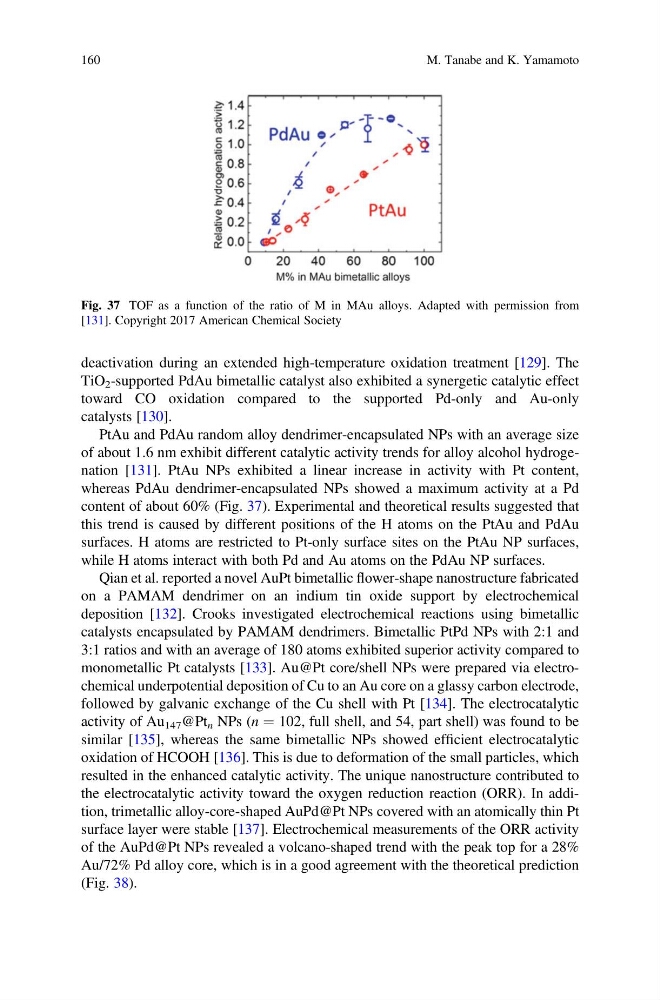
PtAu and PdAu random alloy dendrimer-encapsulated NPs with an average size
of about 1.6 nm exhibit different catalytic activity trends for alloy alcohol hydrogenation [131]. PtAu NPs exhibited a linear increase in activity with Pt content,
whereas PdAu dendrimer-encapsulated NPs showed a maximum activity at a Pd
content of about 60% (Fig. 37). Experimental and theoretical results suggested that
this trend is caused by different positions of the H atoms on the PtAu and PdAu
surfaces. H atoms are restricted to Pt-only surface sites on the PtAu NP surfaces,
while H atoms interact with both Pd and Au atoms on the PdAu NP surfaces.
Qian et al. reported a novel AuPt bimetallic flower-shape nanostructure fabricated
on a PAMAM dendrimer on an indium tin oxide support by electrochemical
deposition [132]. Crooks investigated electrochemical reactions using bimetallic
catalysts encapsulated by PAMAM dendrimers. Bimetallic PtPd NPs with 2:1 and
3:1 ratios and with an average of 180 atoms exhibited superior activity compared to
monometallic Pt catalysts [133]. Au@Pt core/shell NPs were prepared via electrochemical underpotential deposition of Cu to an Au core on a glassy carbon electrode,
followed by galvanic exchange of the Cu shell with Pt [134]. The electrocatalytic
activity of Au 147 @Pt n NPs (n ¼ 102, full shell, and 54, part shell) was found to be
similar [135], whereas the same bimetallic NPs showed efficient electrocatalytic
oxidation of HCOOH [136]. This is due to deformation of the small particles, which
resulted in the enhanced catalytic activity. The unique nanostructure contributed to
the electrocatalytic activity toward the oxygen reduction reaction (ORR). In addition, trimetallic alloy-core-shaped AuPd@Pt NPs covered with an atomically thin Pt
surface layer were stable [137]. Electrochemical measurements of the ORR activity
of the AuPd@Pt NPs revealed a volcano-shaped trend with the peak top for a 28%
Au/72% Pd alloy core, which is in a good agreement with the theoretical prediction
(Fig. 38).
Fig. 37 TOF as a function of the ratio of M in MAu alloys. Adapted with permission from
[131]. Copyright 2017 American Chemical Society
160
M. Tanabe and K. Yamamoto
TiO 2 -supported PdAu bimetallic catalyst also exhibited a synergetic catalytic effect
toward CO oxidation compared to the supported Pd-only and Au-only
catalysts [130].
PtAu and PdAu random alloy dendrimer-encapsulated NPs with an average size
of about 1.6 nm exhibit different catalytic activity trends for alloy alcohol hydrogenation [131]. PtAu NPs exhibited a linear increase in activity with Pt content,
whereas PdAu dendrimer-encapsulated NPs showed a maximum activity at a Pd
content of about 60% (Fig. 37). Experimental and theoretical results suggested that
this trend is caused by different positions of the H atoms on the PtAu and PdAu
surfaces. H atoms are restricted to Pt-only surface sites on the PtAu NP surfaces,
while H atoms interact with both Pd and Au atoms on the PdAu NP surfaces.
Qian et al. reported a novel AuPt bimetallic flower-shape nanostructure fabricated
on a PAMAM dendrimer on an indium tin oxide support by electrochemical
deposition [132]. Crooks investigated electrochemical reactions using bimetallic
catalysts encapsulated by PAMAM dendrimers. Bimetallic PtPd NPs with 2:1 and
3:1 ratios and with an average of 180 atoms exhibited superior activity compared to
monometallic Pt catalysts [133]. Au@Pt core/shell NPs were prepared via electrochemical underpotential deposition of Cu to an Au core on a glassy carbon electrode,
followed by galvanic exchange of the Cu shell with Pt [134]. The electrocatalytic
activity of Au 147 @Pt n NPs (n ¼ 102, full shell, and 54, part shell) was found to be
similar [135], whereas the same bimetallic NPs showed efficient electrocatalytic
oxidation of HCOOH [136]. This is due to deformation of the small particles, which
resulted in the enhanced catalytic activity. The unique nanostructure contributed to
the electrocatalytic activity toward the oxygen reduction reaction (ORR). In addition, trimetallic alloy-core-shaped AuPd@Pt NPs covered with an atomically thin Pt
surface layer were stable [137]. Electrochemical measurements of the ORR activity
of the AuPd@Pt NPs revealed a volcano-shaped trend with the peak top for a 28%
Au/72% Pd alloy core, which is in a good agreement with the theoretical prediction
(Fig. 38).
Fig. 37 TOF as a function of the ratio of M in MAu alloys. Adapted with permission from
[131]. Copyright 2017 American Chemical Society
160
M. Tanabe and K. Yamamoto