

attributed to the diffusion of 4-nitrophnenol in the different sizes of two dendrimers.
Three different metal NPs (Ag, Pt, and Pd) within PPI dendrimers were also
conducted, resulting in the Pd-dendrimer nanocomposite which is the highest catalytic reduction [68].
Kaneda et al. investigated the catalytic properties of Pd NPs encapsulated within a
fifth-generation PPI dendrimer functionalized with triethoxybenzamide on the termini. The dendrimer-encapsulated Pd NPs with a diameter of 2–3 nm are unique
catalysts for substrate-specific hydrogenation of polar olefins, due to the strong
interactions between the substrates and amino groups of the dendrimer [69]. The
Pd n NPs encapsulated within the PPI dendrimers (G5-Pd
0
n ) [70], prepared from the
ratio of Pd complex to dendrimer, also exhibited catalytic activity for hydrogenation
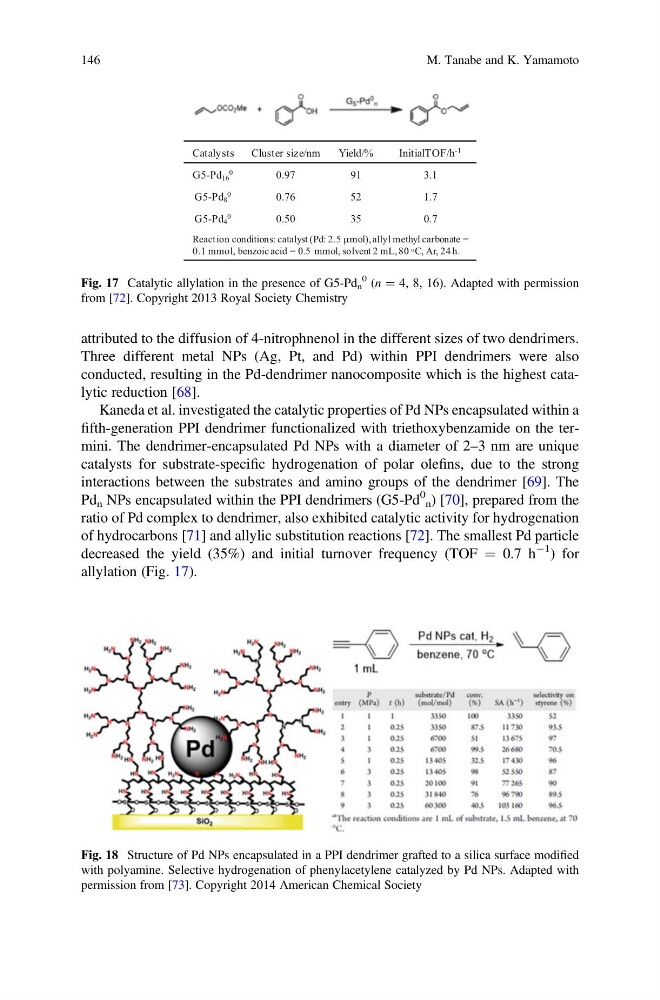
of hydrocarbons [71] and allylic substitution reactions [72]. The smallest Pd particle
decreased the yield (35%) and initial turnover frequency (TOF ¼ 0.7 h
À1 ) for
allylation (Fig. 17).
Catalysts
Cluster size/nm
Yield/%
InitialTOF/h
-1
G5-Pd 16
0
0.97
91
3.1
G5-Pd 8
0
0.76
52
1.7
G5-Pd 4
0
0.50
35
0.7
Reaction conditions: catalyst (Pd: 2.5 µmol), allyl methyl carbonate =
0.1 mmol, benzoic acid = 0.5 mmol, solvent 2 mL, 80 o C, Ar, 24 h.
Fig. 17 Catalytic allylation in the presence of G5-Pd n
0 (n ¼ 4, 8, 16). Adapted with permission
from [72]. Copyright 2013 Royal Society Chemistry
Fig. 18 Structure of Pd NPs encapsulated in a PPI dendrimer grafted to a silica surface modified
with polyamine. Selective hydrogenation of phenylacetylene catalyzed by Pd NPs. Adapted with
permission from [73]. Copyright 2014 American Chemical Society
146
M. Tanabe and K. Yamamoto
Three different metal NPs (Ag, Pt, and Pd) within PPI dendrimers were also
conducted, resulting in the Pd-dendrimer nanocomposite which is the highest catalytic reduction [68].
Kaneda et al. investigated the catalytic properties of Pd NPs encapsulated within a
fifth-generation PPI dendrimer functionalized with triethoxybenzamide on the termini. The dendrimer-encapsulated Pd NPs with a diameter of 2–3 nm are unique
catalysts for substrate-specific hydrogenation of polar olefins, due to the strong
interactions between the substrates and amino groups of the dendrimer [69]. The
Pd n NPs encapsulated within the PPI dendrimers (G5-Pd
0
n ) [70], prepared from the
ratio of Pd complex to dendrimer, also exhibited catalytic activity for hydrogenation
of hydrocarbons [71] and allylic substitution reactions [72]. The smallest Pd particle
decreased the yield (35%) and initial turnover frequency (TOF ¼ 0.7 h
À1 ) for
allylation (Fig. 17).
Catalysts
Cluster size/nm
Yield/%
InitialTOF/h
-1
G5-Pd 16
0
0.97
91
3.1
G5-Pd 8
0
0.76
52
1.7
G5-Pd 4
0
0.50
35
0.7
Reaction conditions: catalyst (Pd: 2.5 µmol), allyl methyl carbonate =
0.1 mmol, benzoic acid = 0.5 mmol, solvent 2 mL, 80 o C, Ar, 24 h.
Fig. 17 Catalytic allylation in the presence of G5-Pd n
0 (n ¼ 4, 8, 16). Adapted with permission
from [72]. Copyright 2013 Royal Society Chemistry
Fig. 18 Structure of Pd NPs encapsulated in a PPI dendrimer grafted to a silica surface modified
with polyamine. Selective hydrogenation of phenylacetylene catalyzed by Pd NPs. Adapted with
permission from [73]. Copyright 2014 American Chemical Society
146
M. Tanabe and K. Yamamoto