

to be stable at high temperature up to 470
C [63]. In contrast, thermal stability of
PAMAM dendrimer is limited, because the retro-Michael reaction occurs at temperature beyond 100
C. As a result, PPI dendrimer allows the NPs to be used as hightemperature catalysts.
The first example of C-C coupling reactions using Pd NPs involved PPI
dendrimers having perfluorinated polyether chains on their periphery to dissolve
the dendrimers in a fluorocarbon/hydrocarbon solvent mixture [64]. The Pd NPs
were effective for Mizorogi-Heck coupling in organic solvents. Although the Pd
catalysts could be recovered fully after each reaction, catalytic activity decreased
significantly with recovery/catalysis cycles. The PPI dendrimers functionalized by
alkyl groups are soluble for organic solvents [65]. The Pd NPs within the PPI
dendrimer are catalytically active for hydrogenation of 1-hexene, but they are less
stable than those prepared by other routes.
Esumi et al. compared the catalytic activity of Au NPs within two different
PAMAM and PPI dendrimers with surface amino groups in the reduction of
4-nitrophenol in an aqueous solution [66]. The diameters of Au NPs within two
kinds of dendrimers, prepared using laser irradiation, are not different to each other
to form the dendrimer-Au nanocomposites. A distinct difference in the catalytic
activity was observed that the Au NPs within PPI dendrimers show higher activity
for the chemical reduction of nitrophenol than those covered by PAMAM
dendrimers (Fig. 16) [67]. This result was suggested that the rate constant is
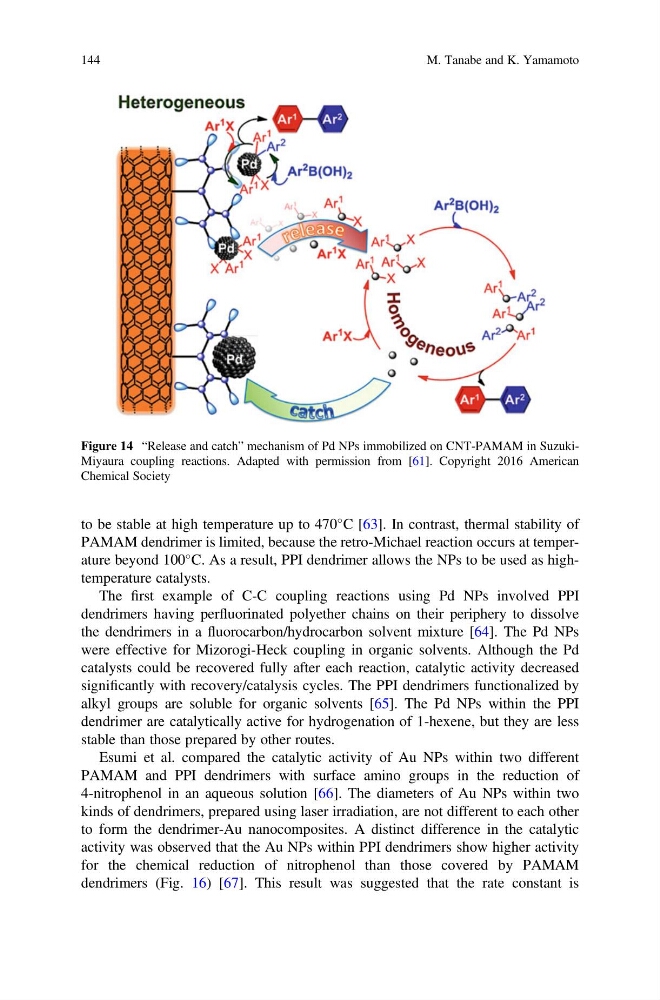
Figure 14 “Release and catch” mechanism of Pd NPs immobilized on CNT-PAMAM in SuzukiMiyaura coupling reactions. Adapted with permission from [61]. Copyright 2016 American
Chemical Society
144
M. Tanabe and K. Yamamoto
C [63]. In contrast, thermal stability of
PAMAM dendrimer is limited, because the retro-Michael reaction occurs at temperature beyond 100
C. As a result, PPI dendrimer allows the NPs to be used as hightemperature catalysts.
The first example of C-C coupling reactions using Pd NPs involved PPI
dendrimers having perfluorinated polyether chains on their periphery to dissolve
the dendrimers in a fluorocarbon/hydrocarbon solvent mixture [64]. The Pd NPs
were effective for Mizorogi-Heck coupling in organic solvents. Although the Pd
catalysts could be recovered fully after each reaction, catalytic activity decreased
significantly with recovery/catalysis cycles. The PPI dendrimers functionalized by
alkyl groups are soluble for organic solvents [65]. The Pd NPs within the PPI
dendrimer are catalytically active for hydrogenation of 1-hexene, but they are less
stable than those prepared by other routes.
Esumi et al. compared the catalytic activity of Au NPs within two different
PAMAM and PPI dendrimers with surface amino groups in the reduction of
4-nitrophenol in an aqueous solution [66]. The diameters of Au NPs within two
kinds of dendrimers, prepared using laser irradiation, are not different to each other
to form the dendrimer-Au nanocomposites. A distinct difference in the catalytic
activity was observed that the Au NPs within PPI dendrimers show higher activity
for the chemical reduction of nitrophenol than those covered by PAMAM
dendrimers (Fig. 16) [67]. This result was suggested that the rate constant is
Figure 14 “Release and catch” mechanism of Pd NPs immobilized on CNT-PAMAM in SuzukiMiyaura coupling reactions. Adapted with permission from [61]. Copyright 2016 American
Chemical Society
144
M. Tanabe and K. Yamamoto