

composed of Pt(II) and Pt(IV) chlorides and metallic Pt(0) as a mixture [55], were
suitable for hydroalkoxylation via π-bond activation (Pt and Pd) [56, 57] and cascade
cyclopropanation reactions and multistep formation of dihydropyrans
(Au) [58, 59]. They also demonstrated advantages to use a flow reactor in the
heterogeneous system to establish cascade reactions with the precise control of
different temperatures and separation of the catalysts from reaction medium.
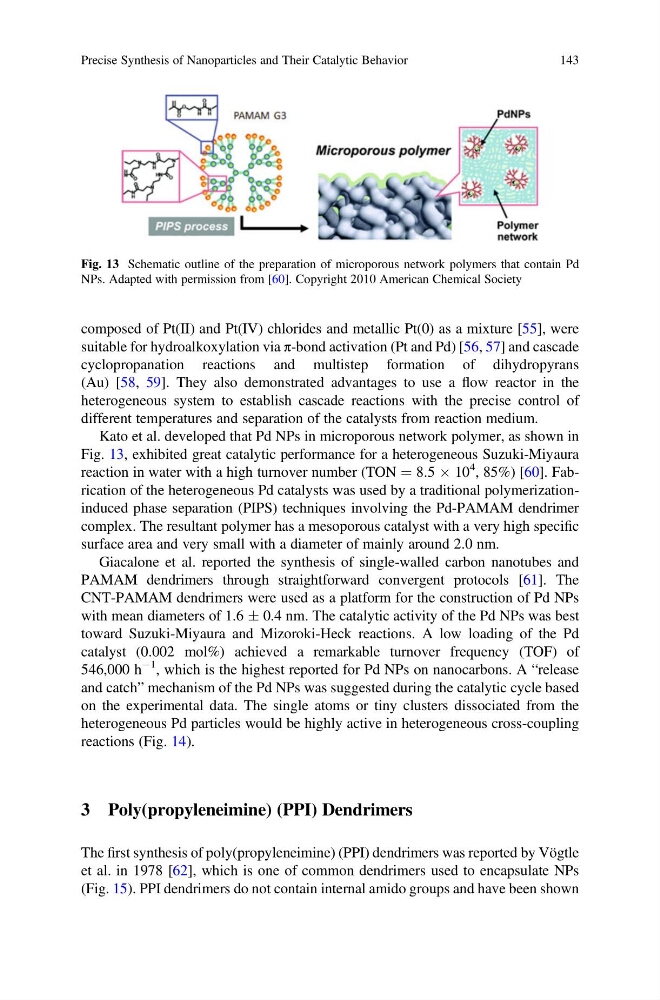
Kato et al. developed that Pd NPs in microporous network polymer, as shown in
Fig. 13, exhibited great catalytic performance for a heterogeneous Suzuki-Miyaura
reaction in water with a high turnover number (TON ¼ 8.5 Â 10
4 , 85%) [60]. Fabrication of the heterogeneous Pd catalysts was used by a traditional polymerizationinduced phase separation (PIPS) techniques involving the Pd-PAMAM dendrimer
complex. The resultant polymer has a mesoporous catalyst with a very high specific
surface area and very small with a diameter of mainly around 2.0 nm.
Giacalone et al. reported the synthesis of single-walled carbon nanotubes and
PAMAM dendrimers through straightforward convergent protocols [61]. The
CNT-PAMAM dendrimers were used as a platform for the construction of Pd NPs
with mean diameters of 1.6 Æ 0.4 nm. The catalytic activity of the Pd NPs was best
toward Suzuki-Miyaura and Mizoroki-Heck reactions. A low loading of the Pd
catalyst (0.002 mol%) achieved a remarkable turnover frequency (TOF) of
546,000 h
À1 , which is the highest reported for Pd NPs on nanocarbons. A “release
and catch” mechanism of the Pd NPs was suggested during the catalytic cycle based
on the experimental data. The single atoms or tiny clusters dissociated from the
heterogeneous Pd particles would be highly active in heterogeneous cross-coupling
reactions (Fig. 14).
3 Poly(propyleneimine) (PPI) Dendrimers
The first synthesis of poly(propyleneimine) (PPI) dendrimers was reported by Vögtle
et al. in 1978 [62], which is one of common dendrimers used to encapsulate NPs
(Fig. 15). PPI dendrimers do not contain internal amido groups and have been shown
Fig. 13 Schematic outline of the preparation of microporous network polymers that contain Pd
NPs. Adapted with permission from [60]. Copyright 2010 American Chemical Society
Precise Synthesis of Nanoparticles and Their Catalytic Behavior
143
suitable for hydroalkoxylation via π-bond activation (Pt and Pd) [56, 57] and cascade
cyclopropanation reactions and multistep formation of dihydropyrans
(Au) [58, 59]. They also demonstrated advantages to use a flow reactor in the
heterogeneous system to establish cascade reactions with the precise control of
different temperatures and separation of the catalysts from reaction medium.
Kato et al. developed that Pd NPs in microporous network polymer, as shown in
Fig. 13, exhibited great catalytic performance for a heterogeneous Suzuki-Miyaura
reaction in water with a high turnover number (TON ¼ 8.5 Â 10
4 , 85%) [60]. Fabrication of the heterogeneous Pd catalysts was used by a traditional polymerizationinduced phase separation (PIPS) techniques involving the Pd-PAMAM dendrimer
complex. The resultant polymer has a mesoporous catalyst with a very high specific
surface area and very small with a diameter of mainly around 2.0 nm.
Giacalone et al. reported the synthesis of single-walled carbon nanotubes and
PAMAM dendrimers through straightforward convergent protocols [61]. The
CNT-PAMAM dendrimers were used as a platform for the construction of Pd NPs
with mean diameters of 1.6 Æ 0.4 nm. The catalytic activity of the Pd NPs was best
toward Suzuki-Miyaura and Mizoroki-Heck reactions. A low loading of the Pd
catalyst (0.002 mol%) achieved a remarkable turnover frequency (TOF) of
546,000 h
À1 , which is the highest reported for Pd NPs on nanocarbons. A “release
and catch” mechanism of the Pd NPs was suggested during the catalytic cycle based
on the experimental data. The single atoms or tiny clusters dissociated from the
heterogeneous Pd particles would be highly active in heterogeneous cross-coupling
reactions (Fig. 14).
3 Poly(propyleneimine) (PPI) Dendrimers
The first synthesis of poly(propyleneimine) (PPI) dendrimers was reported by Vögtle
et al. in 1978 [62], which is one of common dendrimers used to encapsulate NPs
(Fig. 15). PPI dendrimers do not contain internal amido groups and have been shown
Fig. 13 Schematic outline of the preparation of microporous network polymers that contain Pd
NPs. Adapted with permission from [60]. Copyright 2010 American Chemical Society
Precise Synthesis of Nanoparticles and Their Catalytic Behavior
143