

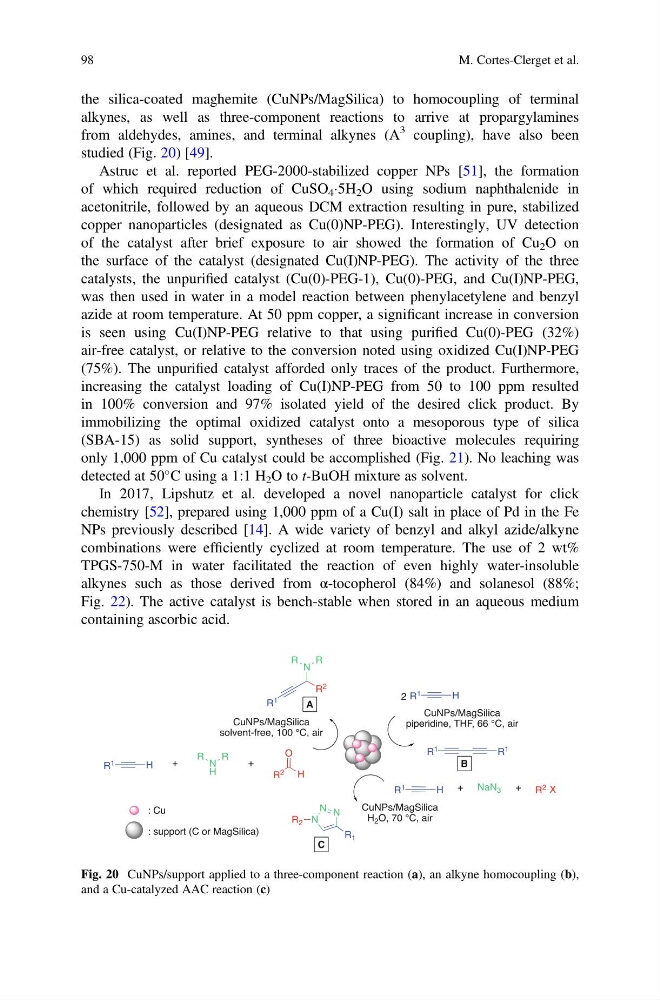
the silica-coated maghemite (CuNPs/MagSilica) to homocoupling of terminal
alkynes, as well as three-component reactions to arrive at propargylamines
from aldehydes, amines, and terminal alkynes (A
3 coupling), have also been
studied (Fig. 20) [49].
Astruc et al. reported PEG-2000-stabilized copper NPs [51], the formation
of which required reduction of CuSO 4 Á5H 2 O using sodium naphthalenide in
acetonitrile, followed by an aqueous DCM extraction resulting in pure, stabilized
copper nanoparticles (designated as Cu(0)NP-PEG). Interestingly, UV detection
of the catalyst after brief exposure to air showed the formation of Cu 2 O on
the surface of the catalyst (designated Cu(I)NP-PEG). The activity of the three
catalysts, the unpurified catalyst (Cu(0)-PEG-1), Cu(0)-PEG, and Cu(I)NP-PEG,
was then used in water in a model reaction between phenylacetylene and benzyl
azide at room temperature. At 50 ppm copper, a significant increase in conversion
is seen using Cu(I)NP-PEG relative to that using purified Cu(0)-PEG (32%)
air-free catalyst, or relative to the conversion noted using oxidized Cu(I)NP-PEG
(75%). The unpurified catalyst afforded only traces of the product. Furthermore,
increasing the catalyst loading of Cu(I)NP-PEG from 50 to 100 ppm resulted
in 100% conversion and 97% isolated yield of the desired click product. By
immobilizing the optimal oxidized catalyst onto a mesoporous type of silica
(SBA-15) as solid support, syntheses of three bioactive molecules requiring
only 1,000 ppm of Cu catalyst could be accomplished (Fig. 21). No leaching was
detected at 50
C using a 1:1 H 2 O to t-BuOH mixture as solvent.
In 2017, Lipshutz et al. developed a novel nanoparticle catalyst for click
chemistry [52], prepared using 1,000 ppm of a Cu(I) salt in place of Pd in the Fe
NPs previously described [14]. A wide variety of benzyl and alkyl azide/alkyne
combinations were efficiently cyclized at room temperature. The use of 2 wt%
TPGS-750-M in water facilitated the reaction of even highly water-insoluble
alkynes such as those derived from α-tocopherol (84%) and solanesol (88%;
Fig. 22). The active catalyst is bench-stable when stored in an aqueous medium
containing ascorbic acid.
Fig. 20 CuNPs/support applied to a three-component reaction (a), an alkyne homocoupling (b),
and a Cu-catalyzed AAC reaction (c)
98
M. Cortes-Clerget et al.
alkynes, as well as three-component reactions to arrive at propargylamines
from aldehydes, amines, and terminal alkynes (A
3 coupling), have also been
studied (Fig. 20) [49].
Astruc et al. reported PEG-2000-stabilized copper NPs [51], the formation
of which required reduction of CuSO 4 Á5H 2 O using sodium naphthalenide in
acetonitrile, followed by an aqueous DCM extraction resulting in pure, stabilized
copper nanoparticles (designated as Cu(0)NP-PEG). Interestingly, UV detection
of the catalyst after brief exposure to air showed the formation of Cu 2 O on
the surface of the catalyst (designated Cu(I)NP-PEG). The activity of the three
catalysts, the unpurified catalyst (Cu(0)-PEG-1), Cu(0)-PEG, and Cu(I)NP-PEG,
was then used in water in a model reaction between phenylacetylene and benzyl
azide at room temperature. At 50 ppm copper, a significant increase in conversion
is seen using Cu(I)NP-PEG relative to that using purified Cu(0)-PEG (32%)
air-free catalyst, or relative to the conversion noted using oxidized Cu(I)NP-PEG
(75%). The unpurified catalyst afforded only traces of the product. Furthermore,
increasing the catalyst loading of Cu(I)NP-PEG from 50 to 100 ppm resulted
in 100% conversion and 97% isolated yield of the desired click product. By
immobilizing the optimal oxidized catalyst onto a mesoporous type of silica
(SBA-15) as solid support, syntheses of three bioactive molecules requiring
only 1,000 ppm of Cu catalyst could be accomplished (Fig. 21). No leaching was
detected at 50
C using a 1:1 H 2 O to t-BuOH mixture as solvent.
In 2017, Lipshutz et al. developed a novel nanoparticle catalyst for click
chemistry [52], prepared using 1,000 ppm of a Cu(I) salt in place of Pd in the Fe
NPs previously described [14]. A wide variety of benzyl and alkyl azide/alkyne
combinations were efficiently cyclized at room temperature. The use of 2 wt%
TPGS-750-M in water facilitated the reaction of even highly water-insoluble
alkynes such as those derived from α-tocopherol (84%) and solanesol (88%;
Fig. 22). The active catalyst is bench-stable when stored in an aqueous medium
containing ascorbic acid.
Fig. 20 CuNPs/support applied to a three-component reaction (a), an alkyne homocoupling (b),
and a Cu-catalyzed AAC reaction (c)
98
M. Cortes-Clerget et al.