

4 Experimental Data
33
in the freezer) and the organic layer was rapidly separated and collected in an Erlenmeyer flask cooled in a dry ice-acetone bath. Methylamine (2 M in THF, 2.5
mL, 5 mmol) was added while stirring, whereupon the organic layer became a
white suspension. The suspension was stirred for 30 min at 0 °C. Then, the mixture
was washed with a 1 M solution of HCl, water and a solution of saturated NaCl,
dried with MgSO4 and concentrated under reduced pressure. Purification by column chromatography on silica gel (EtOAc:heptane = 1:20–1:4) yielded the product as a white solid (92 mg, 21%).
[50]
1
H NMR (400 MHz, CDCl3): δ = 9.49 (dd, , J = 2.5, 0.5 Hz, 1H
8
), 8.71 (dd,
J = 8.5, 2.5 Hz, 1H
10
), 8.22 (dd, J = 8.5, 0.5 Hz, 1H
11
), 4.86 (bs, 1H
NH
), 2.85 (d, J
= 5.2 Hz, 3H
6
) ppm;
13
C NMR (175 MHz, CDCl3): δ = 161.8 (C
Ar
), 145.6 (CH
Ar
),
145.4 (C
Ar
), 133.6 (CH
Ar
), 123.0 (CH
Ar
), 30.2 (CH
6
) ppm; IR (neat):
= 3283,
3099, 1600, 1567, 1531, 1355, 1334, 1176, 1104, 1016, 840, 750, 612 cm
-1
;
HRMS (ESI): m/z calculated for [M+Na]
+
(C6H7N3O4SNa) 240.0045, found
240.0049.
General procedure C for the synthesis of -functionalised amides 2.1a–y and
2.2a,n
To a solution of amide (0.2 mmol) in DCM (2 mL) was added 2-iodopyridine (46.8
µL, 0.44 mmol). The reaction mixture was cooled to 0 °C before triflic anhydride
(37 µL, 0.22 mmol) was added. After stirring for 15 min, lutidine N-oxide (22.4
µL, 0.2 mmol) was added and the reaction was stirred for a further 5 min at 0 °C.
Then, a solution of the sodium amide generated from addition of the amine, amide
or alcohol (0.6 mmol) to a suspension of NaH (0.6 mmol) in DMF (3 mL) was
added. The reaction mixture was stirred at room temperature for 1 h before being
quenched with a saturated solution of NH4Cl. The layers were separated and the
aqueous layer was extracted with DCM. The combined organic layers were
washed with brine before being dried over MgSO4. The solvent was removed under reduced pressure.
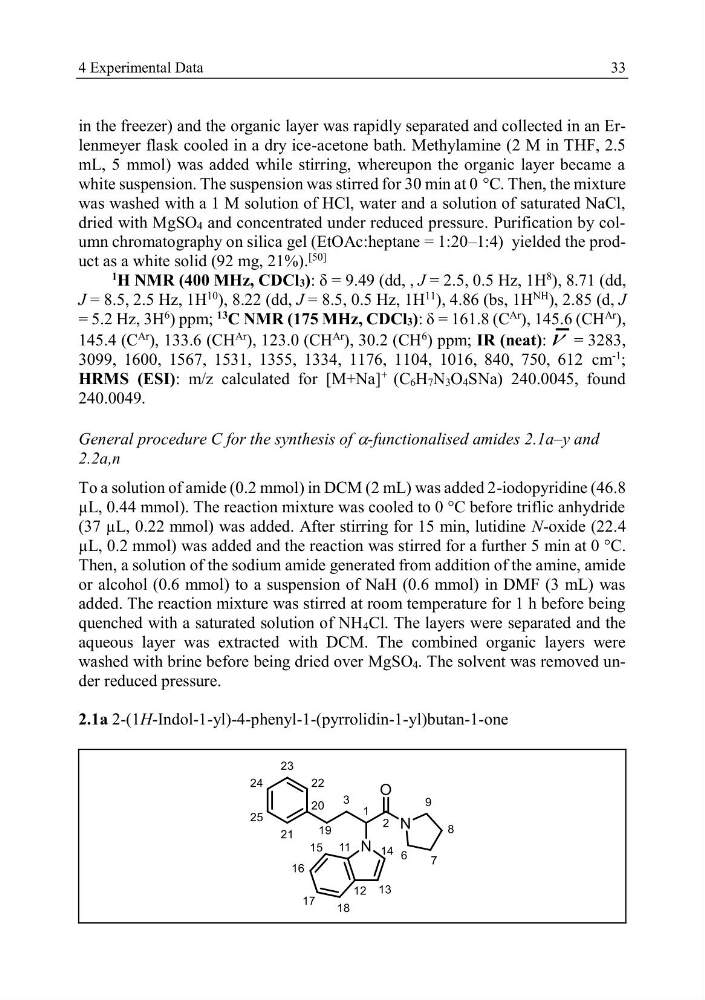
2.1a 2-(1H-Indol-1-yl)-4-phenyl-1-(pyrrolidin-1-yl)butan-1-one
33
in the freezer) and the organic layer was rapidly separated and collected in an Erlenmeyer flask cooled in a dry ice-acetone bath. Methylamine (2 M in THF, 2.5
mL, 5 mmol) was added while stirring, whereupon the organic layer became a
white suspension. The suspension was stirred for 30 min at 0 °C. Then, the mixture
was washed with a 1 M solution of HCl, water and a solution of saturated NaCl,
dried with MgSO4 and concentrated under reduced pressure. Purification by column chromatography on silica gel (EtOAc:heptane = 1:20–1:4) yielded the product as a white solid (92 mg, 21%).
[50]
1
H NMR (400 MHz, CDCl3): δ = 9.49 (dd, , J = 2.5, 0.5 Hz, 1H
8
), 8.71 (dd,
J = 8.5, 2.5 Hz, 1H
10
), 8.22 (dd, J = 8.5, 0.5 Hz, 1H
11
), 4.86 (bs, 1H
NH
), 2.85 (d, J
= 5.2 Hz, 3H
6
) ppm;
13
C NMR (175 MHz, CDCl3): δ = 161.8 (C
Ar
), 145.6 (CH
Ar
),
145.4 (C
Ar
), 133.6 (CH
Ar
), 123.0 (CH
Ar
), 30.2 (CH
6
) ppm; IR (neat):
= 3283,
3099, 1600, 1567, 1531, 1355, 1334, 1176, 1104, 1016, 840, 750, 612 cm
-1
;
HRMS (ESI): m/z calculated for [M+Na]
+
(C6H7N3O4SNa) 240.0045, found
240.0049.
General procedure C for the synthesis of -functionalised amides 2.1a–y and
2.2a,n
To a solution of amide (0.2 mmol) in DCM (2 mL) was added 2-iodopyridine (46.8
µL, 0.44 mmol). The reaction mixture was cooled to 0 °C before triflic anhydride
(37 µL, 0.22 mmol) was added. After stirring for 15 min, lutidine N-oxide (22.4
µL, 0.2 mmol) was added and the reaction was stirred for a further 5 min at 0 °C.
Then, a solution of the sodium amide generated from addition of the amine, amide
or alcohol (0.6 mmol) to a suspension of NaH (0.6 mmol) in DMF (3 mL) was
added. The reaction mixture was stirred at room temperature for 1 h before being
quenched with a saturated solution of NH4Cl. The layers were separated and the
aqueous layer was extracted with DCM. The combined organic layers were
washed with brine before being dried over MgSO4. The solvent was removed under reduced pressure.
2.1a 2-(1H-Indol-1-yl)-4-phenyl-1-(pyrrolidin-1-yl)butan-1-one