

1.2 Amide Activation
7
In the same study, one special case was encountered. The use of a substrate
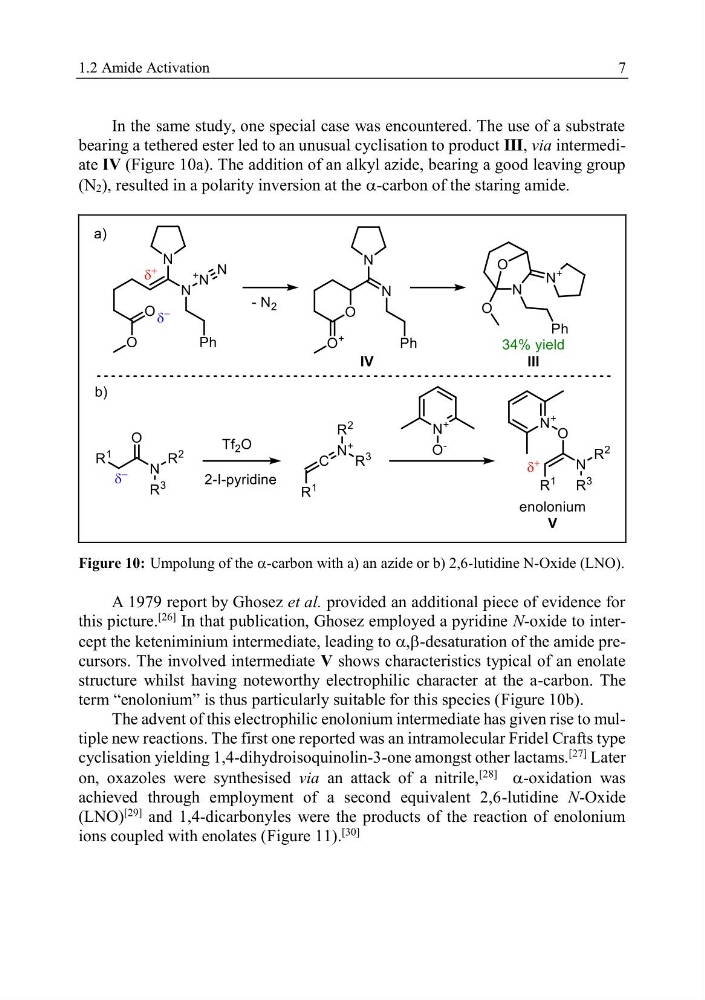
bearing a tethered ester led to an unusual cyclisation to product III, via intermediate IV (Figure 10a). The addition of an alkyl azide, bearing a good leaving group
(N2), resulted in a polarity inversion at the -carbon of the staring amide.
Figure 10: Umpolung of the -carbon with a) an azide or b) 2,6-lutidine N-Oxide (LNO).
A 1979 report by Ghosez et al. provided an additional piece of evidence for
this picture.
[26]
In that publication, Ghosez employed a pyridine N-oxide to intercept the keteniminium intermediate, leading to ,-desaturation of the amide precursors. The involved intermediate V shows characteristics typical of an enolate
structure whilst having noteworthy electrophilic character at the a-carbon. The
term “enolonium” is thus particularly suitable for this species (Figure 10b).
The advent of this electrophilic enolonium intermediate has given rise to multiple new reactions. The first one reported was an intramolecular Fridel Crafts type
cyclisation yielding 1,4-dihydroisoquinolin-3-one amongst other lactams.
[27]
Later
on, oxazoles were synthesised via an attack of a nitrile,
[28]
-oxidation was
achieved through employment of a second equivalent 2,6-lutidine N-Oxide
(LNO)
[29]
and 1,4-dicarbonyles were the products of the reaction of enolonium
ions coupled with enolates (Figure 11).
[30]
7
In the same study, one special case was encountered. The use of a substrate
bearing a tethered ester led to an unusual cyclisation to product III, via intermediate IV (Figure 10a). The addition of an alkyl azide, bearing a good leaving group
(N2), resulted in a polarity inversion at the -carbon of the staring amide.
Figure 10: Umpolung of the -carbon with a) an azide or b) 2,6-lutidine N-Oxide (LNO).
A 1979 report by Ghosez et al. provided an additional piece of evidence for
this picture.
[26]
In that publication, Ghosez employed a pyridine N-oxide to intercept the keteniminium intermediate, leading to ,-desaturation of the amide precursors. The involved intermediate V shows characteristics typical of an enolate
structure whilst having noteworthy electrophilic character at the a-carbon. The
term “enolonium” is thus particularly suitable for this species (Figure 10b).
The advent of this electrophilic enolonium intermediate has given rise to multiple new reactions. The first one reported was an intramolecular Fridel Crafts type
cyclisation yielding 1,4-dihydroisoquinolin-3-one amongst other lactams.
[27]
Later
on, oxazoles were synthesised via an attack of a nitrile,
[28]
-oxidation was
achieved through employment of a second equivalent 2,6-lutidine N-Oxide
(LNO)
[29]
and 1,4-dicarbonyles were the products of the reaction of enolonium
ions coupled with enolates (Figure 11).
[30]