

tetrahedral units does not alter the interactions of the framework with paraffin
molecules [44].
2.2 Models for the Adsorbates
Adsorbates can be modeled using full atom models or united atom models. The
former are models in which all the atoms in a molecule are explicitly described by
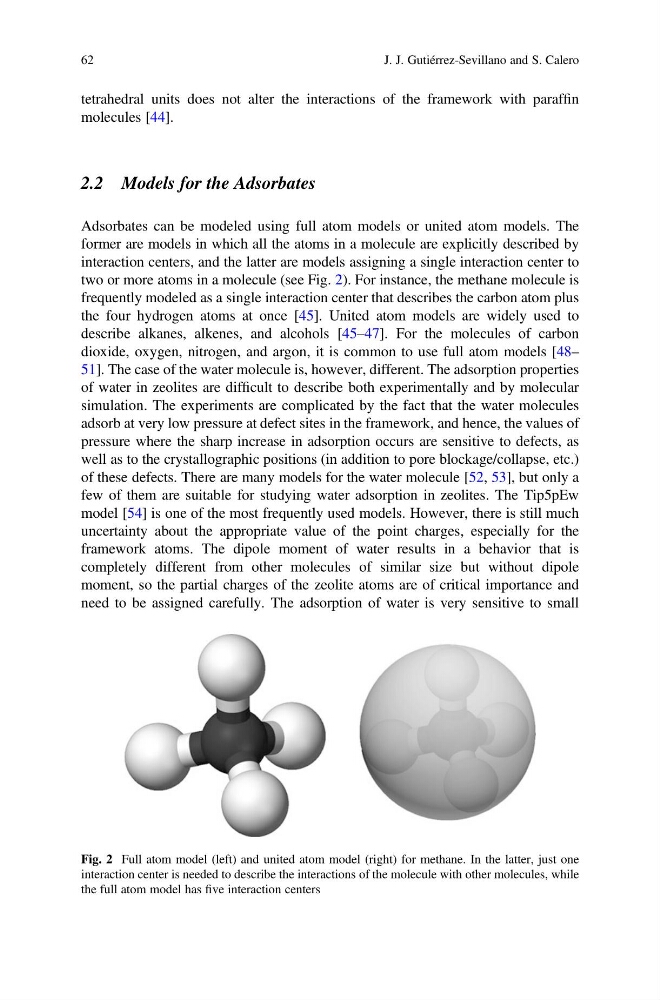
interaction centers, and the latter are models assigning a single interaction center to
two or more atoms in a molecule (see Fig. 2). For instance, the methane molecule is
frequently modeled as a single interaction center that describes the carbon atom plus
the four hydrogen atoms at once [45]. United atom models are widely used to
describe alkanes, alkenes, and alcohols [45–47]. For the molecules of carbon
dioxide, oxygen, nitrogen, and argon, it is common to use full atom models [48–
51]. The case of the water molecule is, however, different. The adsorption properties
of water in zeolites are difficult to describe both experimentally and by molecular
simulation. The experiments are complicated by the fact that the water molecules
adsorb at very low pressure at defect sites in the framework, and hence, the values of
pressure where the sharp increase in adsorption occurs are sensitive to defects, as
well as to the crystallographic positions (in addition to pore blockage/collapse, etc.)
of these defects. There are many models for the water molecule [52, 53], but only a
few of them are suitable for studying water adsorption in zeolites. The Tip5pEw
model [54] is one of the most frequently used models. However, there is still much
uncertainty about the appropriate value of the point charges, especially for the
framework atoms. The dipole moment of water results in a behavior that is
completely different from other molecules of similar size but without dipole
moment, so the partial charges of the zeolite atoms are of critical importance and
need to be assigned carefully. The adsorption of water is very sensitive to small
Fig. 2 Full atom model (left) and united atom model (right) for methane. In the latter, just one
interaction center is needed to describe the interactions of the molecule with other molecules, while
the full atom model has five interaction centers
62
J. J. Gutiérrez-Sevillano and S. Calero
molecules [44].
2.2 Models for the Adsorbates
Adsorbates can be modeled using full atom models or united atom models. The
former are models in which all the atoms in a molecule are explicitly described by
interaction centers, and the latter are models assigning a single interaction center to
two or more atoms in a molecule (see Fig. 2). For instance, the methane molecule is
frequently modeled as a single interaction center that describes the carbon atom plus
the four hydrogen atoms at once [45]. United atom models are widely used to
describe alkanes, alkenes, and alcohols [45–47]. For the molecules of carbon
dioxide, oxygen, nitrogen, and argon, it is common to use full atom models [48–
51]. The case of the water molecule is, however, different. The adsorption properties
of water in zeolites are difficult to describe both experimentally and by molecular
simulation. The experiments are complicated by the fact that the water molecules
adsorb at very low pressure at defect sites in the framework, and hence, the values of
pressure where the sharp increase in adsorption occurs are sensitive to defects, as
well as to the crystallographic positions (in addition to pore blockage/collapse, etc.)
of these defects. There are many models for the water molecule [52, 53], but only a
few of them are suitable for studying water adsorption in zeolites. The Tip5pEw
model [54] is one of the most frequently used models. However, there is still much
uncertainty about the appropriate value of the point charges, especially for the
framework atoms. The dipole moment of water results in a behavior that is
completely different from other molecules of similar size but without dipole
moment, so the partial charges of the zeolite atoms are of critical importance and
need to be assigned carefully. The adsorption of water is very sensitive to small
Fig. 2 Full atom model (left) and united atom model (right) for methane. In the latter, just one
interaction center is needed to describe the interactions of the molecule with other molecules, while
the full atom model has five interaction centers
62
J. J. Gutiérrez-Sevillano and S. Calero