

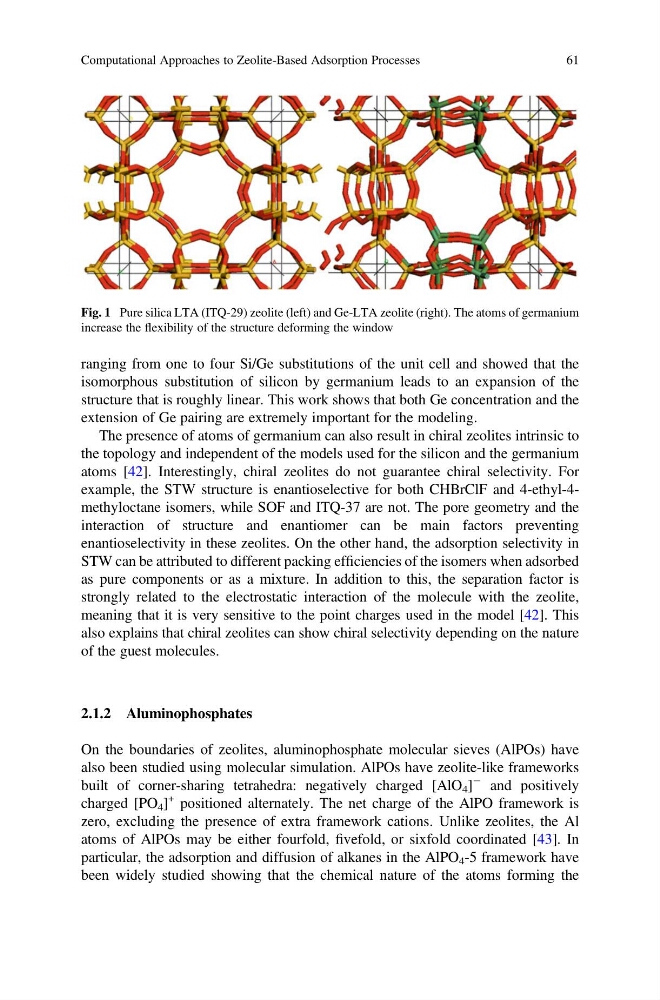
ranging from one to four Si/Ge substitutions of the unit cell and showed that the
isomorphous substitution of silicon by germanium leads to an expansion of the
structure that is roughly linear. This work shows that both Ge concentration and the
extension of Ge pairing are extremely important for the modeling.
The presence of atoms of germanium can also result in chiral zeolites intrinsic to
the topology and independent of the models used for the silicon and the germanium
atoms [42]. Interestingly, chiral zeolites do not guarantee chiral selectivity. For
example, the STW structure is enantioselective for both CHBrClF and 4-ethyl-4methyloctane isomers, while SOF and ITQ-37 are not. The pore geometry and the
interaction of structure and enantiomer can be main factors preventing
enantioselectivity in these zeolites. On the other hand, the adsorption selectivity in
STW can be attributed to different packing efficiencies of the isomers when adsorbed
as pure components or as a mixture. In addition to this, the separation factor is
strongly related to the electrostatic interaction of the molecule with the zeolite,
meaning that it is very sensitive to the point charges used in the model [42]. This
also explains that chiral zeolites can show chiral selectivity depending on the nature
of the guest molecules.
2.1.2 Aluminophosphates
On the boundaries of zeolites, aluminophosphate molecular sieves (AlPOs) have
also been studied using molecular simulation. AlPOs have zeolite-like frameworks
built of corner-sharing tetrahedra: negatively charged [AlO 4 ]
À and positively
charged [PO 4 ]
+ positioned alternately. The net charge of the AlPO framework is
zero, excluding the presence of extra framework cations. Unlike zeolites, the Al
atoms of AlPOs may be either fourfold, fivefold, or sixfold coordinated [43]. In
particular, the adsorption and diffusion of alkanes in the AlPO 4 -5 framework have
been widely studied showing that the chemical nature of the atoms forming the
Fig. 1 Pure silica LTA (ITQ-29) zeolite (left) and Ge-LTA zeolite (right). The atoms of germanium
increase the flexibility of the structure deforming the window
Computational Approaches to Zeolite-Based Adsorption Processes
61
isomorphous substitution of silicon by germanium leads to an expansion of the
structure that is roughly linear. This work shows that both Ge concentration and the
extension of Ge pairing are extremely important for the modeling.
The presence of atoms of germanium can also result in chiral zeolites intrinsic to
the topology and independent of the models used for the silicon and the germanium
atoms [42]. Interestingly, chiral zeolites do not guarantee chiral selectivity. For
example, the STW structure is enantioselective for both CHBrClF and 4-ethyl-4methyloctane isomers, while SOF and ITQ-37 are not. The pore geometry and the
interaction of structure and enantiomer can be main factors preventing
enantioselectivity in these zeolites. On the other hand, the adsorption selectivity in
STW can be attributed to different packing efficiencies of the isomers when adsorbed
as pure components or as a mixture. In addition to this, the separation factor is
strongly related to the electrostatic interaction of the molecule with the zeolite,
meaning that it is very sensitive to the point charges used in the model [42]. This
also explains that chiral zeolites can show chiral selectivity depending on the nature
of the guest molecules.
2.1.2 Aluminophosphates
On the boundaries of zeolites, aluminophosphate molecular sieves (AlPOs) have
also been studied using molecular simulation. AlPOs have zeolite-like frameworks
built of corner-sharing tetrahedra: negatively charged [AlO 4 ]
À and positively
charged [PO 4 ]
+ positioned alternately. The net charge of the AlPO framework is
zero, excluding the presence of extra framework cations. Unlike zeolites, the Al
atoms of AlPOs may be either fourfold, fivefold, or sixfold coordinated [43]. In
particular, the adsorption and diffusion of alkanes in the AlPO 4 -5 framework have
been widely studied showing that the chemical nature of the atoms forming the
Fig. 1 Pure silica LTA (ITQ-29) zeolite (left) and Ge-LTA zeolite (right). The atoms of germanium
increase the flexibility of the structure deforming the window
Computational Approaches to Zeolite-Based Adsorption Processes
61