

the forms of patents. To summarize, the fact that the know-how of the full process of
zeolite production is often in possession of the principal manufacturers intrinsically
limits the industrially available zeolites to those whose synthetic process is sufficiently robust.
In spite of the mentioned context, the large-scale production of new zeolitic
materials is far from being considered as an unrealistic possibility. Although the
existing literature is rich and diverse, there is still a need for new studies exploiting
the different materials available by the existent modification strategies or highlighting the benefits of a given new topology for an associated application. As will be
discussed later and among other improvement axes, understanding the impact of the
cationic exchange over the zeolite properties, exploring new exchange ratios to
identify the presence of potential cooperative effects, or identifying modified synthesis routes allowing to access nonexistent Si/Al ratios can have a strong impact in
order to overcome the existing manufacturing barriers. By means of such kind of
improvements, low-moderate cost new zeolitic materials can be produced taking
advantage of the cumulated years of experience in industrial production and synthesis. It is worthwhile mentioning here that apart from the acquired know-how, the
intrinsic properties of zeolites make them ideal candidates for their use in large-scale
industrial production. Zeolites are robust and thermostable due to the inorganicbased structures and are therefore useful for the usually industrial harsh conditions.
At the same time, the simple hydrothermal synthesis routes employed for the most
common industrial zeolites do not require costly templating agents. Furthermore,
some zeolitic frameworks are natural existing materials.
To advance in the development of more efficient adsorption processes, it seems
crucial to integrate from the very beginning of the screening phase of the new
materials, descriptors, and concepts associated with the industrial operation. In
other words, bridging the gap between the academic work and the final application
seems to be indispensable.
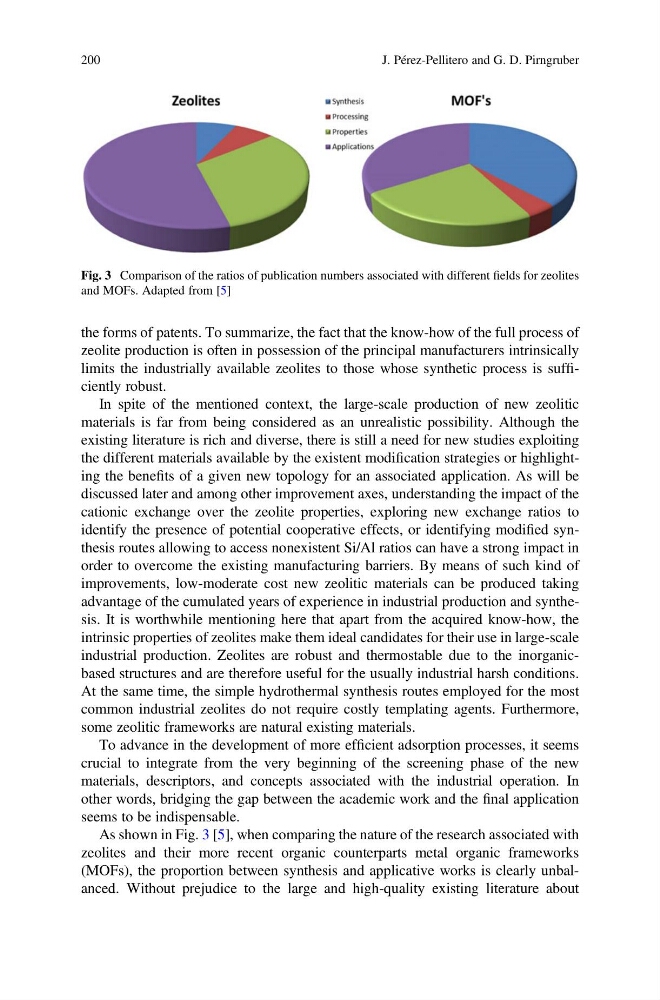
As shown in Fig. 3 [5], when comparing the nature of the research associated with
zeolites and their more recent organic counterparts metal organic frameworks
(MOFs), the proportion between synthesis and applicative works is clearly unbalanced. Without prejudice to the large and high-quality existing literature about
Fig. 3 Comparison of the ratios of publication numbers associated with different fields for zeolites
and MOFs. Adapted from [5]
200
J. Pérez-Pellitero and G. D. Pirngruber
zeolite production is often in possession of the principal manufacturers intrinsically
limits the industrially available zeolites to those whose synthetic process is sufficiently robust.
In spite of the mentioned context, the large-scale production of new zeolitic
materials is far from being considered as an unrealistic possibility. Although the
existing literature is rich and diverse, there is still a need for new studies exploiting
the different materials available by the existent modification strategies or highlighting the benefits of a given new topology for an associated application. As will be
discussed later and among other improvement axes, understanding the impact of the
cationic exchange over the zeolite properties, exploring new exchange ratios to
identify the presence of potential cooperative effects, or identifying modified synthesis routes allowing to access nonexistent Si/Al ratios can have a strong impact in
order to overcome the existing manufacturing barriers. By means of such kind of
improvements, low-moderate cost new zeolitic materials can be produced taking
advantage of the cumulated years of experience in industrial production and synthesis. It is worthwhile mentioning here that apart from the acquired know-how, the
intrinsic properties of zeolites make them ideal candidates for their use in large-scale
industrial production. Zeolites are robust and thermostable due to the inorganicbased structures and are therefore useful for the usually industrial harsh conditions.
At the same time, the simple hydrothermal synthesis routes employed for the most
common industrial zeolites do not require costly templating agents. Furthermore,
some zeolitic frameworks are natural existing materials.
To advance in the development of more efficient adsorption processes, it seems
crucial to integrate from the very beginning of the screening phase of the new
materials, descriptors, and concepts associated with the industrial operation. In
other words, bridging the gap between the academic work and the final application
seems to be indispensable.
As shown in Fig. 3 [5], when comparing the nature of the research associated with
zeolites and their more recent organic counterparts metal organic frameworks
(MOFs), the proportion between synthesis and applicative works is clearly unbalanced. Without prejudice to the large and high-quality existing literature about
Fig. 3 Comparison of the ratios of publication numbers associated with different fields for zeolites
and MOFs. Adapted from [5]
200
J. Pérez-Pellitero and G. D. Pirngruber