

Three main axes of development can be identified: (1) modification of the Si/Al
ratio, (2) cationic exchange [4], and (3) post-synthetic structure modification.
The zeolite choice is evidently related to the nature of the industrial application.
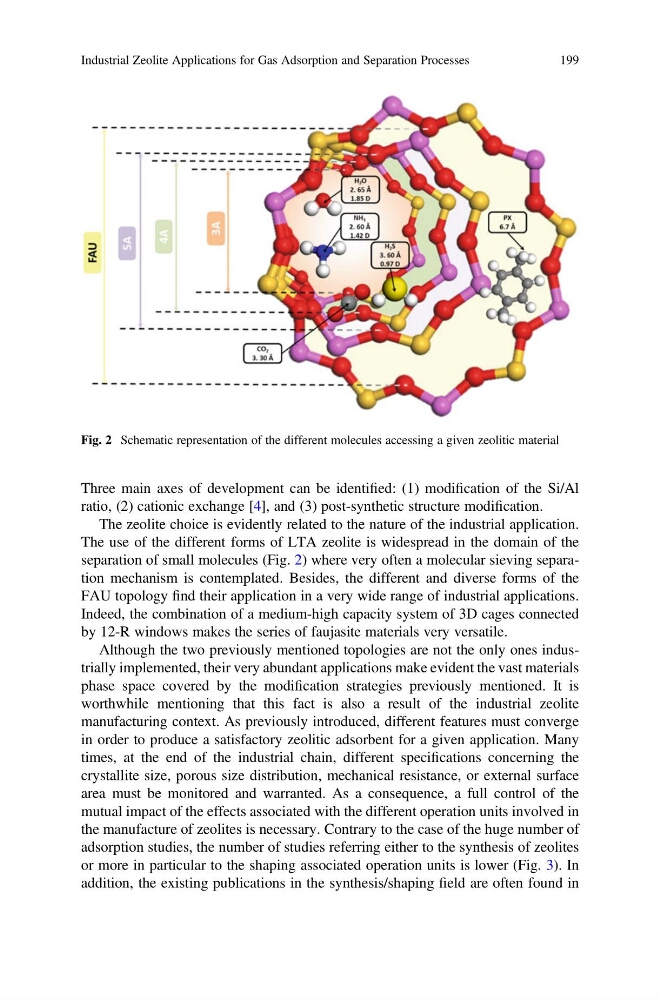
The use of the different forms of LTA zeolite is widespread in the domain of the
separation of small molecules (Fig. 2) where very often a molecular sieving separation mechanism is contemplated. Besides, the different and diverse forms of the
FAU topology find their application in a very wide range of industrial applications.
Indeed, the combination of a medium-high capacity system of 3D cages connected
by 12-R windows makes the series of faujasite materials very versatile.
Although the two previously mentioned topologies are not the only ones industrially implemented, their very abundant applications make evident the vast materials
phase space covered by the modification strategies previously mentioned. It is
worthwhile mentioning that this fact is also a result of the industrial zeolite
manufacturing context. As previously introduced, different features must converge
in order to produce a satisfactory zeolitic adsorbent for a given application. Many
times, at the end of the industrial chain, different specifications concerning the
crystallite size, porous size distribution, mechanical resistance, or external surface
area must be monitored and warranted. As a consequence, a full control of the
mutual impact of the effects associated with the different operation units involved in
the manufacture of zeolites is necessary. Contrary to the case of the huge number of
adsorption studies, the number of studies referring either to the synthesis of zeolites
or more in particular to the shaping associated operation units is lower (Fig. 3). In
addition, the existing publications in the synthesis/shaping field are often found in
Fig. 2 Schematic representation of the different molecules accessing a given zeolitic material
Industrial Zeolite Applications for Gas Adsorption and Separation Processes
199
ratio, (2) cationic exchange [4], and (3) post-synthetic structure modification.
The zeolite choice is evidently related to the nature of the industrial application.
The use of the different forms of LTA zeolite is widespread in the domain of the
separation of small molecules (Fig. 2) where very often a molecular sieving separation mechanism is contemplated. Besides, the different and diverse forms of the
FAU topology find their application in a very wide range of industrial applications.
Indeed, the combination of a medium-high capacity system of 3D cages connected
by 12-R windows makes the series of faujasite materials very versatile.
Although the two previously mentioned topologies are not the only ones industrially implemented, their very abundant applications make evident the vast materials
phase space covered by the modification strategies previously mentioned. It is
worthwhile mentioning that this fact is also a result of the industrial zeolite
manufacturing context. As previously introduced, different features must converge
in order to produce a satisfactory zeolitic adsorbent for a given application. Many
times, at the end of the industrial chain, different specifications concerning the
crystallite size, porous size distribution, mechanical resistance, or external surface
area must be monitored and warranted. As a consequence, a full control of the
mutual impact of the effects associated with the different operation units involved in
the manufacture of zeolites is necessary. Contrary to the case of the huge number of
adsorption studies, the number of studies referring either to the synthesis of zeolites
or more in particular to the shaping associated operation units is lower (Fig. 3). In
addition, the existing publications in the synthesis/shaping field are often found in
Fig. 2 Schematic representation of the different molecules accessing a given zeolitic material
Industrial Zeolite Applications for Gas Adsorption and Separation Processes
199