

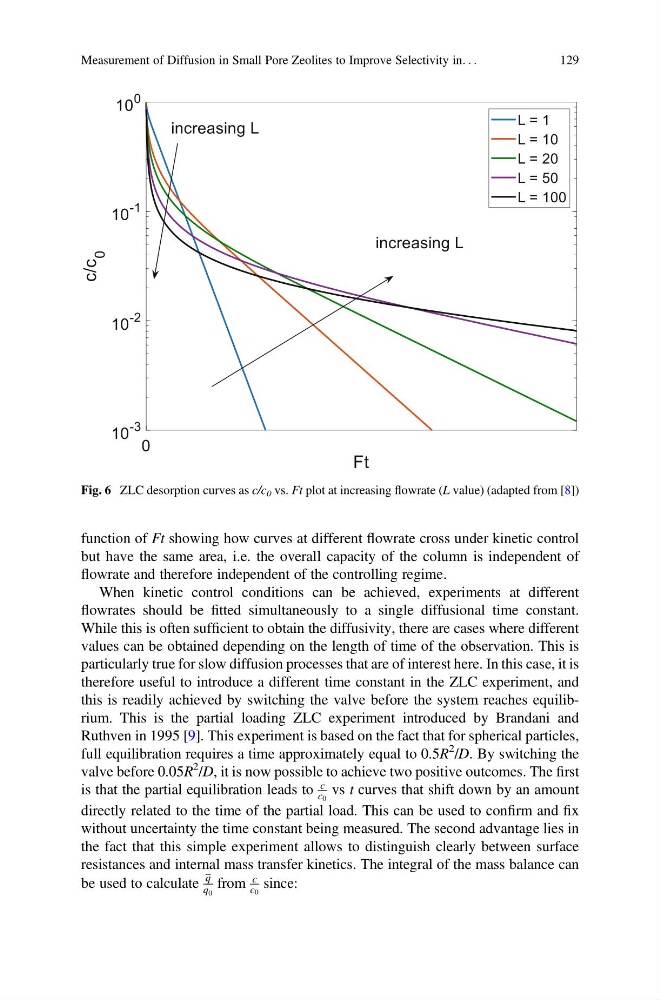
function of Ft showing how curves at different flowrate cross under kinetic control
but have the same area, i.e. the overall capacity of the column is independent of
flowrate and therefore independent of the controlling regime.
When kinetic control conditions can be achieved, experiments at different
flowrates should be fitted simultaneously to a single diffusional time constant.
While this is often sufficient to obtain the diffusivity, there are cases where different
values can be obtained depending on the length of time of the observation. This is
particularly true for slow diffusion processes that are of interest here. In this case, it is
therefore useful to introduce a different time constant in the ZLC experiment, and
this is readily achieved by switching the valve before the system reaches equilibrium. This is the partial loading ZLC experiment introduced by Brandani and
Ruthven in 1995 [9]. This experiment is based on the fact that for spherical particles,
full equilibration requires a time approximately equal to 0.5R
2 /D. By switching the
valve before 0.05R
2 /D, it is now possible to achieve two positive outcomes. The first
is that the partial equilibration leads to
c
c 0
vs t curves that shift down by an amount
directly related to the time of the partial load. This can be used to confirm and fix
without uncertainty the time constant being measured. The second advantage lies in
the fact that this simple experiment allows to distinguish clearly between surface
resistances and internal mass transfer kinetics. The integral of the mass balance can
be used to calculate
q
q 0
from
c
c 0
since:
Fig. 6 ZLC desorption curves as c/c 0 vs. Ft plot at increasing flowrate (L value) (adapted from [8])
Measurement of Diffusion in Small Pore Zeolites to Improve Selectivity in. . .
129
but have the same area, i.e. the overall capacity of the column is independent of
flowrate and therefore independent of the controlling regime.
When kinetic control conditions can be achieved, experiments at different
flowrates should be fitted simultaneously to a single diffusional time constant.
While this is often sufficient to obtain the diffusivity, there are cases where different
values can be obtained depending on the length of time of the observation. This is
particularly true for slow diffusion processes that are of interest here. In this case, it is
therefore useful to introduce a different time constant in the ZLC experiment, and
this is readily achieved by switching the valve before the system reaches equilibrium. This is the partial loading ZLC experiment introduced by Brandani and
Ruthven in 1995 [9]. This experiment is based on the fact that for spherical particles,
full equilibration requires a time approximately equal to 0.5R
2 /D. By switching the
valve before 0.05R
2 /D, it is now possible to achieve two positive outcomes. The first
is that the partial equilibration leads to
c
c 0
vs t curves that shift down by an amount
directly related to the time of the partial load. This can be used to confirm and fix
without uncertainty the time constant being measured. The second advantage lies in
the fact that this simple experiment allows to distinguish clearly between surface
resistances and internal mass transfer kinetics. The integral of the mass balance can
be used to calculate
q
q 0
from
c
c 0
since:
Fig. 6 ZLC desorption curves as c/c 0 vs. Ft plot at increasing flowrate (L value) (adapted from [8])
Measurement of Diffusion in Small Pore Zeolites to Improve Selectivity in. . .
129