

stability, zeolites are among the most promising adsorbents for the recovery of
bio-alcohols. The use of zeolites for alcohol recovery is not limited to adsorptive
separations; many studies have been published considering zeolite membranes for
the separation of alcohols and water. However, in this contribution, we will focus on
adsorption-based separations. For the interested reader, we refer to the some recent
reviews considering zeolite membranes for alcohol recovery [131–133].
ZSM-5 and its all-silica analogue silicalite-1 are by far the most studied zeolites
for the recovery of bio-alcohols. They crystallize according to the MFI framework
topology that possesses two types of interconnected channels: straight and sinusoidal
with a different size and shape [135]. A lot of attention has also been given to smaller
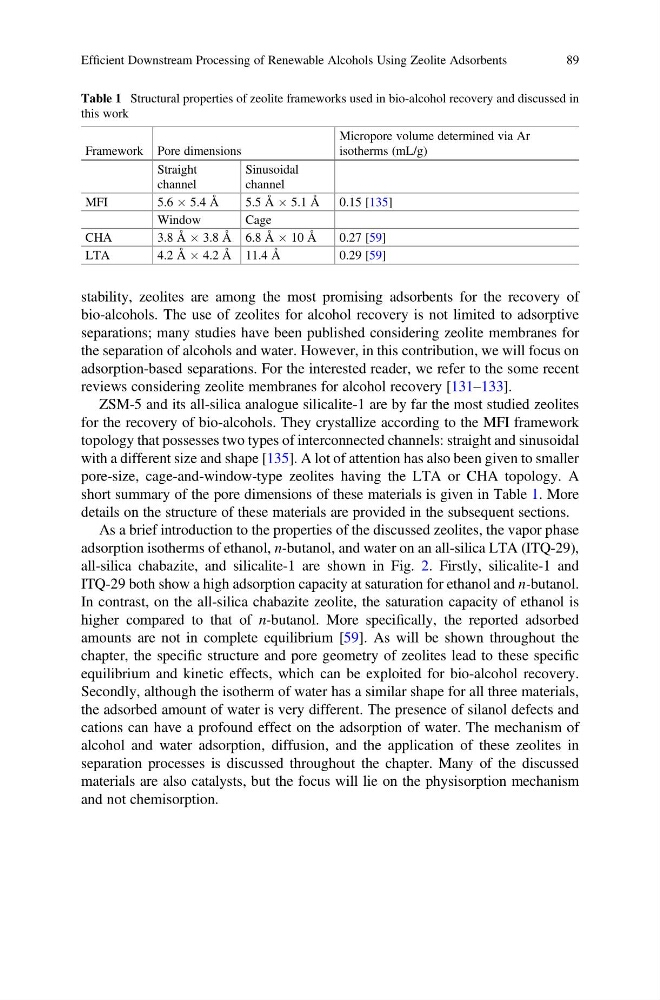
pore-size, cage-and-window-type zeolites having the LTA or CHA topology. A
short summary of the pore dimensions of these materials is given in Table 1. More
details on the structure of these materials are provided in the subsequent sections.
As a brief introduction to the properties of the discussed zeolites, the vapor phase
adsorption isotherms of ethanol, n-butanol, and water on an all-silica LTA (ITQ-29),
all-silica chabazite, and silicalite-1 are shown in Fig. 2. Firstly, silicalite-1 and
ITQ-29 both show a high adsorption capacity at saturation for ethanol and n-butanol.
In contrast, on the all-silica chabazite zeolite, the saturation capacity of ethanol is
higher compared to that of n-butanol. More specifically, the reported adsorbed
amounts are not in complete equilibrium [59]. As will be shown throughout the
chapter, the specific structure and pore geometry of zeolites lead to these specific
equilibrium and kinetic effects, which can be exploited for bio-alcohol recovery.
Secondly, although the isotherm of water has a similar shape for all three materials,
the adsorbed amount of water is very different. The presence of silanol defects and
cations can have a profound effect on the adsorption of water. The mechanism of
alcohol and water adsorption, diffusion, and the application of these zeolites in
separation processes is discussed throughout the chapter. Many of the discussed
materials are also catalysts, but the focus will lie on the physisorption mechanism
and not chemisorption.
Table 1 Structural properties of zeolite frameworks used in bio-alcohol recovery and discussed in
this work
Framework Pore dimensions
Micropore volume determined via Ar
isotherms (mL/g)
Straight
channel
Sinusoidal
channel
MFI
5.6 Â 5.4 Å
5.5 Å Â 5.1 Å
0.15 [135]
Window
Cage
CHA
3.8 Å Â 3.8 Å 6.8 Å Â 10 Å
0.27 [59]
LTA
4.2 Å Â 4.2 Å 11.4 Å
0.29 [59]
Efficient Downstream Processing of Renewable Alcohols Using Zeolite Adsorbents
89
bio-alcohols. The use of zeolites for alcohol recovery is not limited to adsorptive
separations; many studies have been published considering zeolite membranes for
the separation of alcohols and water. However, in this contribution, we will focus on
adsorption-based separations. For the interested reader, we refer to the some recent
reviews considering zeolite membranes for alcohol recovery [131–133].
ZSM-5 and its all-silica analogue silicalite-1 are by far the most studied zeolites
for the recovery of bio-alcohols. They crystallize according to the MFI framework
topology that possesses two types of interconnected channels: straight and sinusoidal
with a different size and shape [135]. A lot of attention has also been given to smaller
pore-size, cage-and-window-type zeolites having the LTA or CHA topology. A
short summary of the pore dimensions of these materials is given in Table 1. More
details on the structure of these materials are provided in the subsequent sections.
As a brief introduction to the properties of the discussed zeolites, the vapor phase
adsorption isotherms of ethanol, n-butanol, and water on an all-silica LTA (ITQ-29),
all-silica chabazite, and silicalite-1 are shown in Fig. 2. Firstly, silicalite-1 and
ITQ-29 both show a high adsorption capacity at saturation for ethanol and n-butanol.
In contrast, on the all-silica chabazite zeolite, the saturation capacity of ethanol is
higher compared to that of n-butanol. More specifically, the reported adsorbed
amounts are not in complete equilibrium [59]. As will be shown throughout the
chapter, the specific structure and pore geometry of zeolites lead to these specific
equilibrium and kinetic effects, which can be exploited for bio-alcohol recovery.
Secondly, although the isotherm of water has a similar shape for all three materials,
the adsorbed amount of water is very different. The presence of silanol defects and
cations can have a profound effect on the adsorption of water. The mechanism of
alcohol and water adsorption, diffusion, and the application of these zeolites in
separation processes is discussed throughout the chapter. Many of the discussed
materials are also catalysts, but the focus will lie on the physisorption mechanism
and not chemisorption.
Table 1 Structural properties of zeolite frameworks used in bio-alcohol recovery and discussed in
this work
Framework Pore dimensions
Micropore volume determined via Ar
isotherms (mL/g)
Straight
channel
Sinusoidal
channel
MFI
5.6 Â 5.4 Å
5.5 Å Â 5.1 Å
0.15 [135]
Window
Cage
CHA
3.8 Å Â 3.8 Å 6.8 Å Â 10 Å
0.27 [59]
LTA
4.2 Å Â 4.2 Å 11.4 Å
0.29 [59]
Efficient Downstream Processing of Renewable Alcohols Using Zeolite Adsorbents
89