

distilled toward the azeotrope [44, 64–66]. Subsequently, in a decanter, the butanolrich and water-rich phases are separated. The water-rich phase is recycled toward the
distillation column, while the n-butanol-rich phase is sent to a final tower, where it is
purified [44, 64–66].
Adsorptive separations can be implemented as an alternative for these complex
and energy-demanding distillation steps. In a first (conventional) strategy, n-butanol
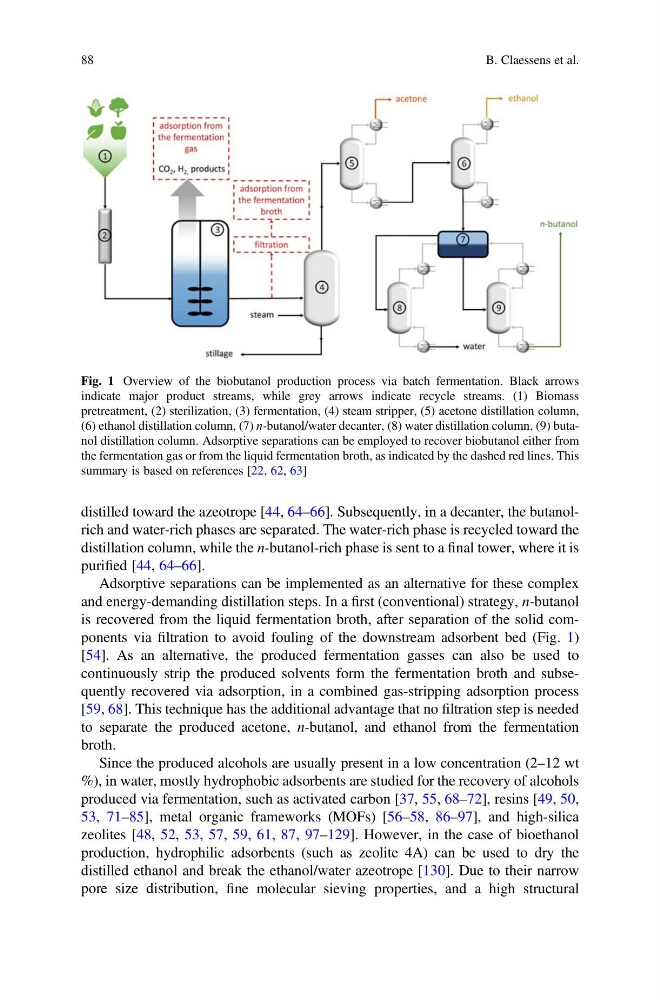
is recovered from the liquid fermentation broth, after separation of the solid components via filtration to avoid fouling of the downstream adsorbent bed (Fig. 1)
[54]. As an alternative, the produced fermentation gasses can also be used to
continuously strip the produced solvents form the fermentation broth and subsequently recovered via adsorption, in a combined gas-stripping adsorption process
[59, 68]. This technique has the additional advantage that no filtration step is needed
to separate the produced acetone, n-butanol, and ethanol from the fermentation
broth.
Since the produced alcohols are usually present in a low concentration (2–12 wt
%), in water, mostly hydrophobic adsorbents are studied for the recovery of alcohols
produced via fermentation, such as activated carbon [37, 55, 68–72], resins [49, 50,
53, 71–85], metal organic frameworks (MOFs) [56–58, 86–97], and high-silica
zeolites [48, 52, 53, 57, 59, 61, 87, 97–129]. However, in the case of bioethanol
production, hydrophilic adsorbents (such as zeolite 4A) can be used to dry the
distilled ethanol and break the ethanol/water azeotrope [130]. Due to their narrow
pore size distribution, fine molecular sieving properties, and a high structural
Fig. 1 Overview of the biobutanol production process via batch fermentation. Black arrows
indicate major product streams, while grey arrows indicate recycle streams. (1) Biomass
pretreatment, (2) sterilization, (3) fermentation, (4) steam stripper, (5) acetone distillation column,
(6) ethanol distillation column, (7) n-butanol/water decanter, (8) water distillation column, (9) butanol distillation column. Adsorptive separations can be employed to recover biobutanol either from
the fermentation gas or from the liquid fermentation broth, as indicated by the dashed red lines. This
summary is based on references [22, 62, 63]
88
B. Claessens et al.
distillation column, while the n-butanol-rich phase is sent to a final tower, where it is
purified [44, 64–66].
Adsorptive separations can be implemented as an alternative for these complex
and energy-demanding distillation steps. In a first (conventional) strategy, n-butanol
is recovered from the liquid fermentation broth, after separation of the solid components via filtration to avoid fouling of the downstream adsorbent bed (Fig. 1)
[54]. As an alternative, the produced fermentation gasses can also be used to
continuously strip the produced solvents form the fermentation broth and subsequently recovered via adsorption, in a combined gas-stripping adsorption process
[59, 68]. This technique has the additional advantage that no filtration step is needed
to separate the produced acetone, n-butanol, and ethanol from the fermentation
broth.
Since the produced alcohols are usually present in a low concentration (2–12 wt
%), in water, mostly hydrophobic adsorbents are studied for the recovery of alcohols
produced via fermentation, such as activated carbon [37, 55, 68–72], resins [49, 50,
53, 71–85], metal organic frameworks (MOFs) [56–58, 86–97], and high-silica
zeolites [48, 52, 53, 57, 59, 61, 87, 97–129]. However, in the case of bioethanol
production, hydrophilic adsorbents (such as zeolite 4A) can be used to dry the
distilled ethanol and break the ethanol/water azeotrope [130]. Due to their narrow
pore size distribution, fine molecular sieving properties, and a high structural
Fig. 1 Overview of the biobutanol production process via batch fermentation. Black arrows
indicate major product streams, while grey arrows indicate recycle streams. (1) Biomass
pretreatment, (2) sterilization, (3) fermentation, (4) steam stripper, (5) acetone distillation column,
(6) ethanol distillation column, (7) n-butanol/water decanter, (8) water distillation column, (9) butanol distillation column. Adsorptive separations can be employed to recover biobutanol either from
the fermentation gas or from the liquid fermentation broth, as indicated by the dashed red lines. This
summary is based on references [22, 62, 63]
88
B. Claessens et al.