

extract and raffinate streams, with the purities higher than the process specifications,
making effective use of the total adsorptive capacity of the adsorbent and minimizing
the consumption of desorbent.
The SMB technology is also intended as a chromatographic separation with
origins in the TMB approach. So, the underlying chromatographic assumptions are
also applied to the SMB technology, namely, the existence of two mass separating
agents – the adsorbent or stationary phase and the desorbent or the mobile phase. In
both TMB and SMB, the mixture is eluted in the mobile phase, which transports the
mixture through the stationary phase, in a countercurrent movement. The various
components of the mixture travel at different velocities, due to the different affinities
with the adsorbent, promoting their separation. In TMB, there is a real movement of
the solid and fluid phases countercurrently, while in SMB, this movement is
simulated using valves operating synchronously. In consequence, SMB is a continuous chromatographic process in which separation of the components takes place by
countercurrent contacting of the two phases.
SMB technology constitutes a rather complex separation process, which requires
a deep understanding to make its use efficient. The significant advantages of
countercurrent contact between the stationary (solid) and mobile (fluid) phases of
the SMB technology are higher productivity, lower desorbent consumption, and an
increase in separation performance. This allows obtaining high-purity products with
high recovery, even if the stationary phase efficiency is low (selectivity close to
unity). The SMB technology can be adapted for a specific separation, leading to a
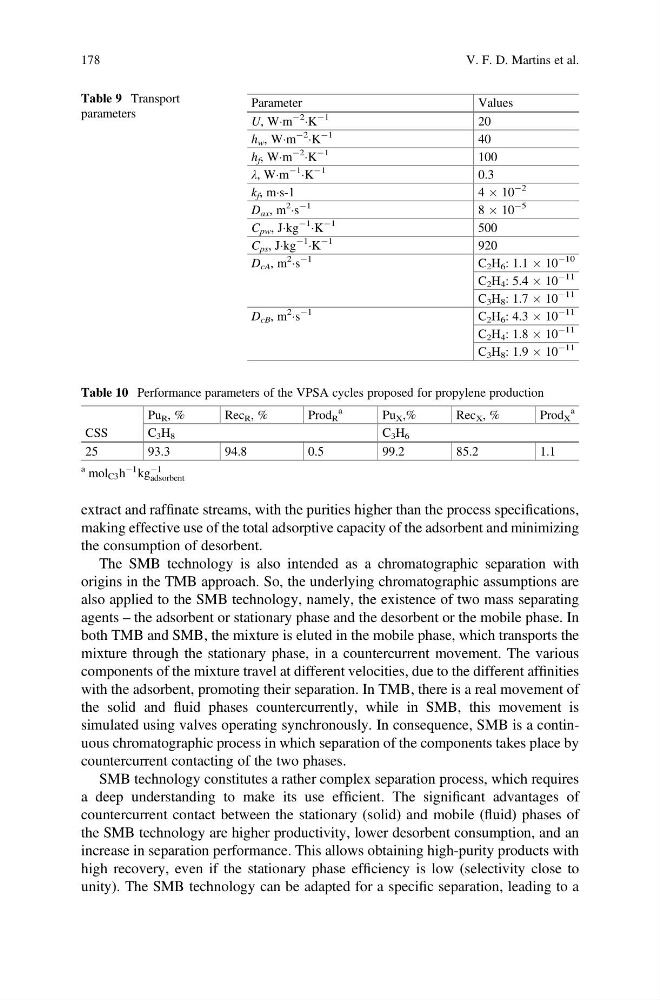
Table 9 Transport
parameters
Parameter
Values
U, WÁm
À2
ÁK
À1
20
h w , WÁm
À2
ÁK
À1
40
h f , WÁm
À2
ÁK
À1
100
λ, WÁm
À1
ÁK
À1
0.3
k f , mÁs-1
4 Â 10
À2
D ax , m
2
Ás
À1
8 Â 10
À5
C pw , JÁkg
À1
ÁK
À1
500
C ps , JÁkg
À1
ÁK
À1
920
D cA , m
2
Ás
À1
C 2 H 6 : 1.1 Â 10
À10
C 2 H 4 : 5.4 Â 10
À11
C 3 H 8 : 1.7 Â 10
À11
D cB , m
2
Ás
À1
C 2 H 6 : 4.3 Â 10
À11
C 2 H 4 : 1.8 Â 10
À11
C 3 H 8 : 1.9 Â 10
À11
Table 10 Performance parameters of the VPSA cycles proposed for propylene production
CSS
Pu R , %
Rec R , %
Prod R
a
Pu X ,%
Rec X , %
Prod X
a
C 3 H 8
C 3 H 6
25
93.3
94.8
0.5
99.2
85.2
1.1
a mol C3 h
À1 kg
À1
adsorbent
178
V. F. D. Martins et al.
making effective use of the total adsorptive capacity of the adsorbent and minimizing
the consumption of desorbent.
The SMB technology is also intended as a chromatographic separation with
origins in the TMB approach. So, the underlying chromatographic assumptions are
also applied to the SMB technology, namely, the existence of two mass separating
agents – the adsorbent or stationary phase and the desorbent or the mobile phase. In
both TMB and SMB, the mixture is eluted in the mobile phase, which transports the
mixture through the stationary phase, in a countercurrent movement. The various
components of the mixture travel at different velocities, due to the different affinities
with the adsorbent, promoting their separation. In TMB, there is a real movement of
the solid and fluid phases countercurrently, while in SMB, this movement is
simulated using valves operating synchronously. In consequence, SMB is a continuous chromatographic process in which separation of the components takes place by
countercurrent contacting of the two phases.
SMB technology constitutes a rather complex separation process, which requires
a deep understanding to make its use efficient. The significant advantages of
countercurrent contact between the stationary (solid) and mobile (fluid) phases of
the SMB technology are higher productivity, lower desorbent consumption, and an
increase in separation performance. This allows obtaining high-purity products with
high recovery, even if the stationary phase efficiency is low (selectivity close to
unity). The SMB technology can be adapted for a specific separation, leading to a
Table 9 Transport
parameters
Parameter
Values
U, WÁm
À2
ÁK
À1
20
h w , WÁm
À2
ÁK
À1
40
h f , WÁm
À2
ÁK
À1
100
λ, WÁm
À1
ÁK
À1
0.3
k f , mÁs-1
4 Â 10
À2
D ax , m
2
Ás
À1
8 Â 10
À5
C pw , JÁkg
À1
ÁK
À1
500
C ps , JÁkg
À1
ÁK
À1
920
D cA , m
2
Ás
À1
C 2 H 6 : 1.1 Â 10
À10
C 2 H 4 : 5.4 Â 10
À11
C 3 H 8 : 1.7 Â 10
À11
D cB , m
2
Ás
À1
C 2 H 6 : 4.3 Â 10
À11
C 2 H 4 : 1.8 Â 10
À11
C 3 H 8 : 1.9 Â 10
À11
Table 10 Performance parameters of the VPSA cycles proposed for propylene production
CSS
Pu R , %
Rec R , %
Prod R
a
Pu X ,%
Rec X , %
Prod X
a
C 3 H 8
C 3 H 6
25
93.3
94.8
0.5
99.2
85.2
1.1
a mol C3 h
À1 kg
À1
adsorbent
178
V. F. D. Martins et al.