

relevant for a real process separation, a breakthrough experiment was designed using
an extended version of the ZLC column to test the performance of the samples to
separate CO 2 from CH 4 in dry conditions [20]. The experimental apparatus is the
same, but a longer bulkhead union is used in place of a normal union.
This extended version of the ZLC was used with the main advantage of allowing
to run a breakthrough experiment while still using a small amount of sample
(~30 mg). This allows to visualise directly the separation efficiency of the different
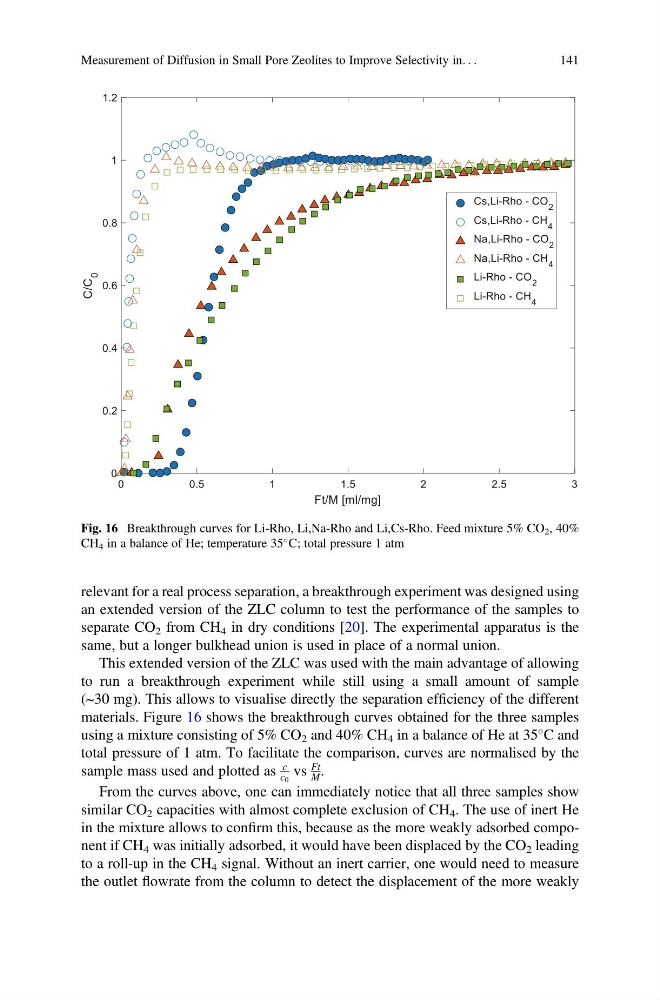
materials. Figure 16 shows the breakthrough curves obtained for the three samples
using a mixture consisting of 5% CO 2 and 40% CH 4 in a balance of He at 35
C and
total pressure of 1 atm. To facilitate the comparison, curves are normalised by the
sample mass used and plotted as
c
c 0
vs
Ft
M .
From the curves above, one can immediately notice that all three samples show
similar CO 2 capacities with almost complete exclusion of CH 4 . The use of inert He
in the mixture allows to confirm this, because as the more weakly adsorbed component if CH 4 was initially adsorbed, it would have been displaced by the CO 2 leading
to a roll-up in the CH 4 signal. Without an inert carrier, one would need to measure
the outlet flowrate from the column to detect the displacement of the more weakly
Fig. 16 Breakthrough curves for Li-Rho, Li,Na-Rho and Li,Cs-Rho. Feed mixture 5% CO 2 , 40%
CH 4 in a balance of He; temperature 35
C; total pressure 1 atm
Measurement of Diffusion in Small Pore Zeolites to Improve Selectivity in. . .
141
an extended version of the ZLC column to test the performance of the samples to
separate CO 2 from CH 4 in dry conditions [20]. The experimental apparatus is the
same, but a longer bulkhead union is used in place of a normal union.
This extended version of the ZLC was used with the main advantage of allowing
to run a breakthrough experiment while still using a small amount of sample
(~30 mg). This allows to visualise directly the separation efficiency of the different
materials. Figure 16 shows the breakthrough curves obtained for the three samples
using a mixture consisting of 5% CO 2 and 40% CH 4 in a balance of He at 35
C and
total pressure of 1 atm. To facilitate the comparison, curves are normalised by the
sample mass used and plotted as
c
c 0
vs
Ft
M .
From the curves above, one can immediately notice that all three samples show
similar CO 2 capacities with almost complete exclusion of CH 4 . The use of inert He
in the mixture allows to confirm this, because as the more weakly adsorbed component if CH 4 was initially adsorbed, it would have been displaced by the CO 2 leading
to a roll-up in the CH 4 signal. Without an inert carrier, one would need to measure
the outlet flowrate from the column to detect the displacement of the more weakly
Fig. 16 Breakthrough curves for Li-Rho, Li,Na-Rho and Li,Cs-Rho. Feed mixture 5% CO 2 , 40%
CH 4 in a balance of He; temperature 35
C; total pressure 1 atm
Measurement of Diffusion in Small Pore Zeolites to Improve Selectivity in. . .
141