

same time constant extracted from the analysis of the ZLC desorption curves. At
equilibrium a flat concentration profile is achieved across the crystal; as the desorption starts and progresses, the adsorbed phase concentration decreases first close to
the surface of the particle, and then the profile progressively moves towards the
centre of the crystal.
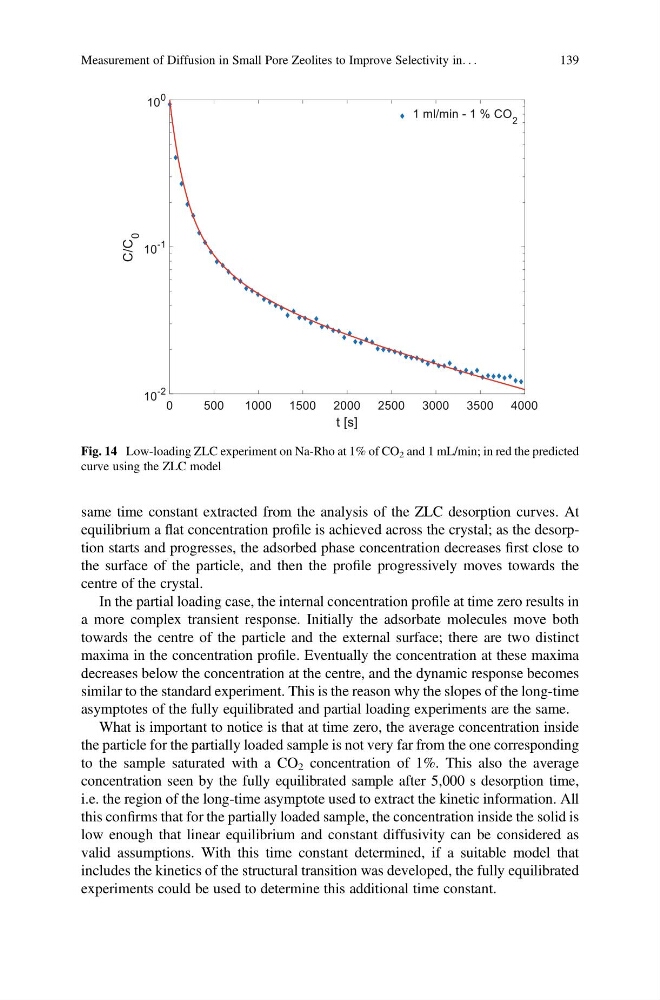
In the partial loading case, the internal concentration profile at time zero results in
a more complex transient response. Initially the adsorbate molecules move both
towards the centre of the particle and the external surface; there are two distinct
maxima in the concentration profile. Eventually the concentration at these maxima
decreases below the concentration at the centre, and the dynamic response becomes
similar to the standard experiment. This is the reason why the slopes of the long-time
asymptotes of the fully equilibrated and partial loading experiments are the same.
What is important to notice is that at time zero, the average concentration inside
the particle for the partially loaded sample is not very far from the one corresponding
to the sample saturated with a CO 2 concentration of 1%. This also the average
concentration seen by the fully equilibrated sample after 5,000 s desorption time,
i.e. the region of the long-time asymptote used to extract the kinetic information. All
this confirms that for the partially loaded sample, the concentration inside the solid is
low enough that linear equilibrium and constant diffusivity can be considered as
valid assumptions. With this time constant determined, if a suitable model that
includes the kinetics of the structural transition was developed, the fully equilibrated
experiments could be used to determine this additional time constant.
Fig. 14 Low-loading ZLC experiment on Na-Rho at 1% of CO 2 and 1 mL/min; in red the predicted
curve using the ZLC model
Measurement of Diffusion in Small Pore Zeolites to Improve Selectivity in. . .
139
equilibrium a flat concentration profile is achieved across the crystal; as the desorption starts and progresses, the adsorbed phase concentration decreases first close to
the surface of the particle, and then the profile progressively moves towards the
centre of the crystal.
In the partial loading case, the internal concentration profile at time zero results in
a more complex transient response. Initially the adsorbate molecules move both
towards the centre of the particle and the external surface; there are two distinct
maxima in the concentration profile. Eventually the concentration at these maxima
decreases below the concentration at the centre, and the dynamic response becomes
similar to the standard experiment. This is the reason why the slopes of the long-time
asymptotes of the fully equilibrated and partial loading experiments are the same.
What is important to notice is that at time zero, the average concentration inside
the particle for the partially loaded sample is not very far from the one corresponding
to the sample saturated with a CO 2 concentration of 1%. This also the average
concentration seen by the fully equilibrated sample after 5,000 s desorption time,
i.e. the region of the long-time asymptote used to extract the kinetic information. All
this confirms that for the partially loaded sample, the concentration inside the solid is
low enough that linear equilibrium and constant diffusivity can be considered as
valid assumptions. With this time constant determined, if a suitable model that
includes the kinetics of the structural transition was developed, the fully equilibrated
experiments could be used to determine this additional time constant.
Fig. 14 Low-loading ZLC experiment on Na-Rho at 1% of CO 2 and 1 mL/min; in red the predicted
curve using the ZLC model
Measurement of Diffusion in Small Pore Zeolites to Improve Selectivity in. . .
139