

3 The ZLC Technique: Theory
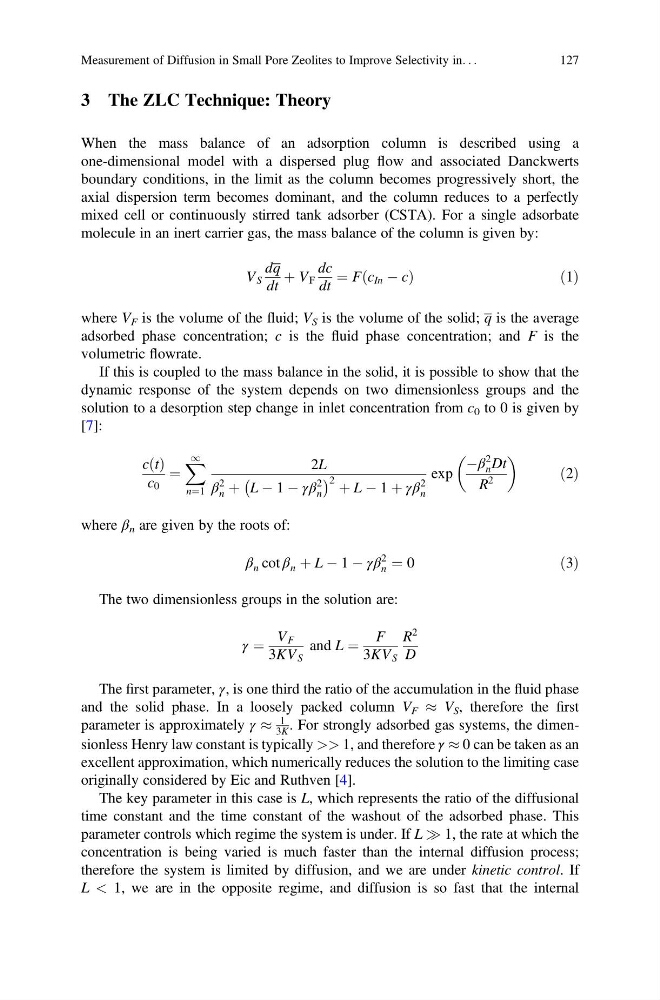
When the mass balance of an adsorption column is described using a
one-dimensional model with a dispersed plug flow and associated Danckwerts
boundary conditions, in the limit as the column becomes progressively short, the
axial dispersion term becomes dominant, and the column reduces to a perfectly
mixed cell or continuously stirred tank adsorber (CSTA). For a single adsorbate
molecule in an inert carrier gas, the mass balance of the column is given by:
V S
dq
dt
þ V F
dc
dt
¼ F c In À c
ð
Þ
ð1Þ
where V F is the volume of the fluid; V S is the volume of the solid; q is the average
adsorbed phase concentration; c is the fluid phase concentration; and F is the
volumetric flowrate.
If this is coupled to the mass balance in the solid, it is possible to show that the
dynamic response of the system depends on two dimensionless groups and the
solution to a desorption step change in inlet concentration from c 0 to 0 is given by
[7]:
c t
ð Þ
c 0
¼
X 1
n¼1
2L
β
2
n þ L À 1 À γβ
2
n
À
Á 2 þ L À 1 þ γβ
2
n
exp
Àβ
2
n Dt
R
2
ð2Þ
where β n are given by the roots of:
β n cot β n þ L À 1 À γβ
2
n ¼ 0
ð3Þ
The two dimensionless groups in the solution are:
γ ¼
V F
3KV S
and L ¼
F
3KV S
R
2
D
The first parameter, γ, is one third the ratio of the accumulation in the fluid phase
and the solid phase. In a loosely packed column V F % V S , therefore the first
parameter is approximately γ %
1
3K . For strongly adsorbed gas systems, the dimensionless Henry law constant is typically >> 1, and therefore γ % 0 can be taken as an
excellent approximation, which numerically reduces the solution to the limiting case
originally considered by Eic and Ruthven [4].
The key parameter in this case is L, which represents the ratio of the diffusional
time constant and the time constant of the washout of the adsorbed phase. This
parameter controls which regime the system is under. If L ) 1, the rate at which the
concentration is being varied is much faster than the internal diffusion process;
therefore the system is limited by diffusion, and we are under kinetic control. If
L < 1, we are in the opposite regime, and diffusion is so fast that the internal
Measurement of Diffusion in Small Pore Zeolites to Improve Selectivity in. . .
127
When the mass balance of an adsorption column is described using a
one-dimensional model with a dispersed plug flow and associated Danckwerts
boundary conditions, in the limit as the column becomes progressively short, the
axial dispersion term becomes dominant, and the column reduces to a perfectly
mixed cell or continuously stirred tank adsorber (CSTA). For a single adsorbate
molecule in an inert carrier gas, the mass balance of the column is given by:
V S
dq
dt
þ V F
dc
dt
¼ F c In À c
ð
Þ
ð1Þ
where V F is the volume of the fluid; V S is the volume of the solid; q is the average
adsorbed phase concentration; c is the fluid phase concentration; and F is the
volumetric flowrate.
If this is coupled to the mass balance in the solid, it is possible to show that the
dynamic response of the system depends on two dimensionless groups and the
solution to a desorption step change in inlet concentration from c 0 to 0 is given by
[7]:
c t
ð Þ
c 0
¼
X 1
n¼1
2L
β
2
n þ L À 1 À γβ
2
n
À
Á 2 þ L À 1 þ γβ
2
n
exp
Àβ
2
n Dt
R
2
ð2Þ
where β n are given by the roots of:
β n cot β n þ L À 1 À γβ
2
n ¼ 0
ð3Þ
The two dimensionless groups in the solution are:
γ ¼
V F
3KV S
and L ¼
F
3KV S
R
2
D
The first parameter, γ, is one third the ratio of the accumulation in the fluid phase
and the solid phase. In a loosely packed column V F % V S , therefore the first
parameter is approximately γ %
1
3K . For strongly adsorbed gas systems, the dimensionless Henry law constant is typically >> 1, and therefore γ % 0 can be taken as an
excellent approximation, which numerically reduces the solution to the limiting case
originally considered by Eic and Ruthven [4].
The key parameter in this case is L, which represents the ratio of the diffusional
time constant and the time constant of the washout of the adsorbed phase. This
parameter controls which regime the system is under. If L ) 1, the rate at which the
concentration is being varied is much faster than the internal diffusion process;
therefore the system is limited by diffusion, and we are under kinetic control. If
L < 1, we are in the opposite regime, and diffusion is so fast that the internal
Measurement of Diffusion in Small Pore Zeolites to Improve Selectivity in. . .
127