

giving ACs the lowest gas component selectivity when compared to zeolites and
MOFs. One advantage of ACs is that they can be produced from a wide variety of
raw materials containing a high percentage of carbon, which results in a cheaper
material. Similar to zeolites, their production process requires the conversion of raw
materials into ACs using chemical processes, thermal ones, or both. In contrast to
zeolites, however, the high temperature processes required to produce ACs often
necessitate an inert environment to prevent combustion of the carbon source. ACs
can also be functionalized by the incorporation of heteroatoms into their network or
by the binding of specific functional groups to the carbon structure, which can
increase the gas separation performance. Analogous to zeolites and MOFs, therefore,
ACs exhibit specific advantages and disadvantages as adsorbents. Since practical
applications always have specific operating conditions, i.e., temperature, pressure,
water concentration, gas composition, etc., it is necessary to consider appropriate
adsorbents according to the practical conditions employed.
3 Small-Pore Zeolites for CO 2 Adsorption
CO 2 is critical among the greenhouse gases and is considered responsible for about
60% of the current anthropogenic global warming [15]. To combat this predicament,
therefore, many proposals have been put forward to develop CO 2 capture and
sequestration technologies. In particular, because liquid amine scrubbing is still
expensive [16], the cost-efficient solid-state adsorption-driven capture of CO 2
from flue gas and natural gas using various classes of porous materials has been
intensively investigated as a potential replacement for this current industrially
applied CO 2 absorption process. Of all materials applied in CO 2 adsorption [17],
zeolites stand out: they are long-term stable, easy to regenerate, and resistant to
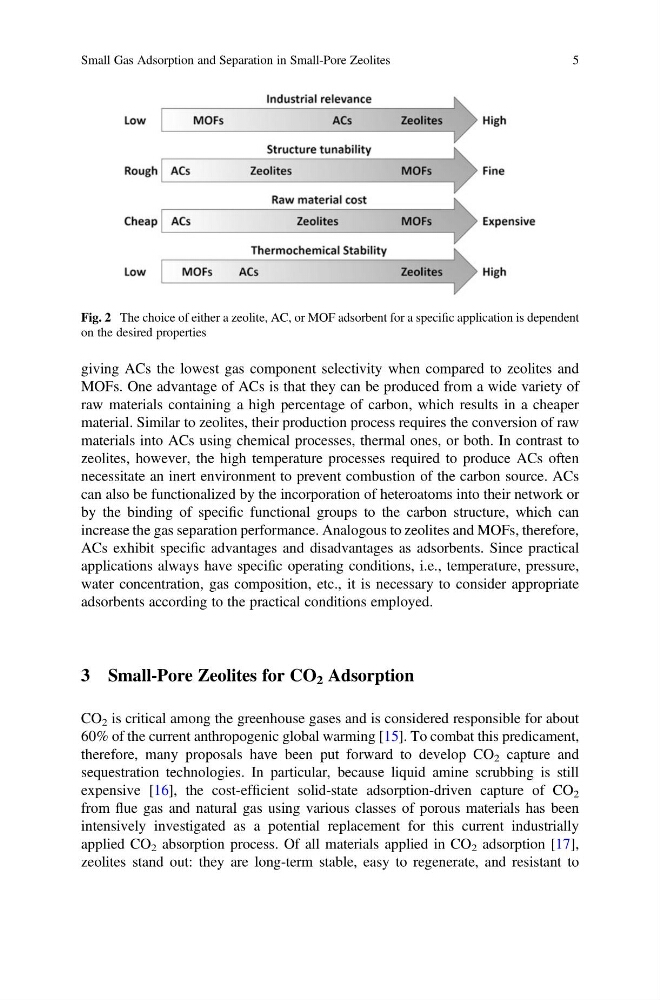
Fig. 2 The choice of either a zeolite, AC, or MOF adsorbent for a specific application is dependent
on the desired properties
Small Gas Adsorption and Separation in Small-Pore Zeolites
5
MOFs. One advantage of ACs is that they can be produced from a wide variety of
raw materials containing a high percentage of carbon, which results in a cheaper
material. Similar to zeolites, their production process requires the conversion of raw
materials into ACs using chemical processes, thermal ones, or both. In contrast to
zeolites, however, the high temperature processes required to produce ACs often
necessitate an inert environment to prevent combustion of the carbon source. ACs
can also be functionalized by the incorporation of heteroatoms into their network or
by the binding of specific functional groups to the carbon structure, which can
increase the gas separation performance. Analogous to zeolites and MOFs, therefore,
ACs exhibit specific advantages and disadvantages as adsorbents. Since practical
applications always have specific operating conditions, i.e., temperature, pressure,
water concentration, gas composition, etc., it is necessary to consider appropriate
adsorbents according to the practical conditions employed.
3 Small-Pore Zeolites for CO 2 Adsorption
CO 2 is critical among the greenhouse gases and is considered responsible for about
60% of the current anthropogenic global warming [15]. To combat this predicament,
therefore, many proposals have been put forward to develop CO 2 capture and
sequestration technologies. In particular, because liquid amine scrubbing is still
expensive [16], the cost-efficient solid-state adsorption-driven capture of CO 2
from flue gas and natural gas using various classes of porous materials has been
intensively investigated as a potential replacement for this current industrially
applied CO 2 absorption process. Of all materials applied in CO 2 adsorption [17],
zeolites stand out: they are long-term stable, easy to regenerate, and resistant to
Fig. 2 The choice of either a zeolite, AC, or MOF adsorbent for a specific application is dependent
on the desired properties
Small Gas Adsorption and Separation in Small-Pore Zeolites
5