

their adsorption properties according to probable practical applications like selective
CO 2 adsorption (Sect. 3), hydrocarbon separation (Sect. 4), and adsorption of other
small gases (Sect. 5). Finally, we discuss the limitations of small-pore materials and
their future prospects. It is our hope that this chapter will aid both beginner and
advanced readers understand the core concepts behind small gas adsorption and
separation on zeolites and zeotypes.
2 Comparison Between Zeolites and Other Microporous
Materials as Adsorbents
In addition to zeolites, there are a variety of nanoporous materials that have been
studied for gas adsorption and separation, e.g., MOFs, covalent organic frameworks,
ACs, graphene-based materials, carbon fibers, etc. Among these adsorbents, zeolites,
MOFs, and ACs are probably the most well-known. Here, we will very briefly
compare the general adsorption properties and synthetic methods of MOFs and
ACs to those of zeolites (Fig. 2). MOFs consist of an inorganic metal node
(or metal-containing cluster) and organic linkers (ligands which typically interact
with two or more nodes) that interact in a 3D manner to form porous crystalline
materials [11, 12]. The synthesis of MOFs is usually carried out at rather milder and
easily controllable conditions than those of zeolites. In consequence, a desired
structure can be rationally synthesized by selectively modifying/choosing the size
and shape of ligands and metals. This is different from the synthesis of zeolites
where the novel framework topologies and/or compositions are still largely found in
a trial-and-error manner. On the other hand, the adsorbents used in industrial
applications must exhibit robust thermochemical stability. However, MOFs normally have lower stability than zeolites. In fact, the thermal stability of MOFs is
usually limited to 623–673 K. Moreover, they are sensitive to moisture and/or high
pressure.
ACs can be defined as a crude form of graphite with a random or amorphous
structure and are generally highly porous over a broad range of pore sizes. So a
single sample can have a distribution of pore sizes over the range 0.7–30 Å [13, 14],
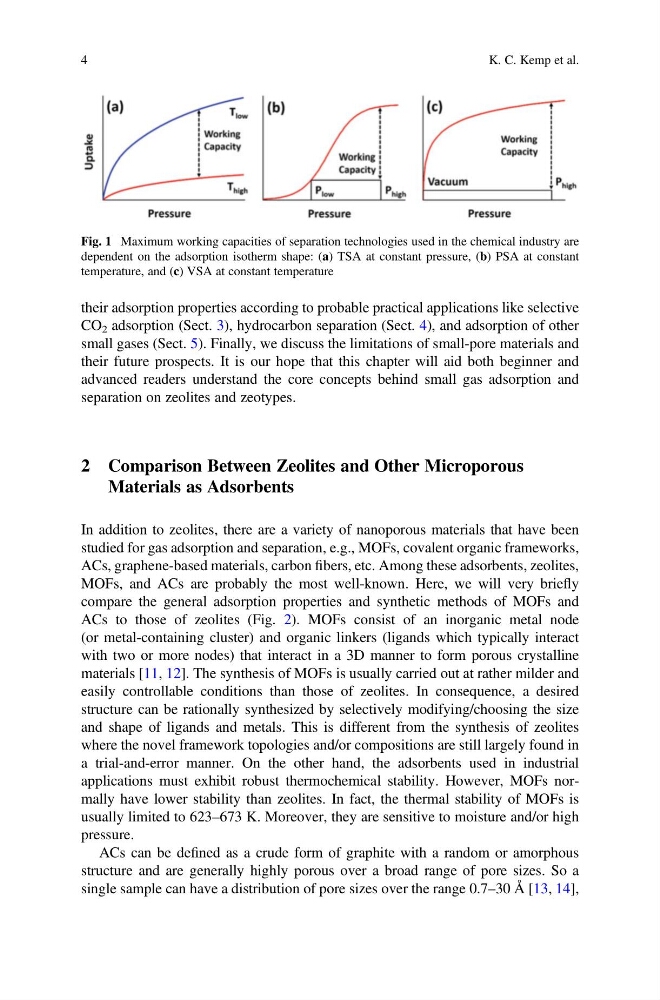
Fig. 1 Maximum working capacities of separation technologies used in the chemical industry are
dependent on the adsorption isotherm shape: (a) TSA at constant pressure, (b) PSA at constant
temperature, and (c) VSA at constant temperature
4
K. C. Kemp et al.
CO 2 adsorption (Sect. 3), hydrocarbon separation (Sect. 4), and adsorption of other
small gases (Sect. 5). Finally, we discuss the limitations of small-pore materials and
their future prospects. It is our hope that this chapter will aid both beginner and
advanced readers understand the core concepts behind small gas adsorption and
separation on zeolites and zeotypes.
2 Comparison Between Zeolites and Other Microporous
Materials as Adsorbents
In addition to zeolites, there are a variety of nanoporous materials that have been
studied for gas adsorption and separation, e.g., MOFs, covalent organic frameworks,
ACs, graphene-based materials, carbon fibers, etc. Among these adsorbents, zeolites,
MOFs, and ACs are probably the most well-known. Here, we will very briefly
compare the general adsorption properties and synthetic methods of MOFs and
ACs to those of zeolites (Fig. 2). MOFs consist of an inorganic metal node
(or metal-containing cluster) and organic linkers (ligands which typically interact
with two or more nodes) that interact in a 3D manner to form porous crystalline
materials [11, 12]. The synthesis of MOFs is usually carried out at rather milder and
easily controllable conditions than those of zeolites. In consequence, a desired
structure can be rationally synthesized by selectively modifying/choosing the size
and shape of ligands and metals. This is different from the synthesis of zeolites
where the novel framework topologies and/or compositions are still largely found in
a trial-and-error manner. On the other hand, the adsorbents used in industrial
applications must exhibit robust thermochemical stability. However, MOFs normally have lower stability than zeolites. In fact, the thermal stability of MOFs is
usually limited to 623–673 K. Moreover, they are sensitive to moisture and/or high
pressure.
ACs can be defined as a crude form of graphite with a random or amorphous
structure and are generally highly porous over a broad range of pore sizes. So a
single sample can have a distribution of pore sizes over the range 0.7–30 Å [13, 14],
Fig. 1 Maximum working capacities of separation technologies used in the chemical industry are
dependent on the adsorption isotherm shape: (a) TSA at constant pressure, (b) PSA at constant
temperature, and (c) VSA at constant temperature
4
K. C. Kemp et al.