

of n-butanol on CHA, shown in Fig. 7b, is not completely equilibrated, even after an
equilibration time of 420 min per point. Hence, hydrophobic LTA zeolites appear to
be well-suited for the adsorption of n-butanol, while CHA frameworks appear to be
more suited for ethanol recovery.
3.3 Kinetics: Co-diffusion and Crystal Diversity
To investigate the slow diffusion of higher chain alcohols into the CHA framework
(vide supra), Cousin-Saint-Remi et al. performed liquid phase batch uptake measurement of n-alcohols on SAPO-34 [184]. Transport diffusion coefficients were
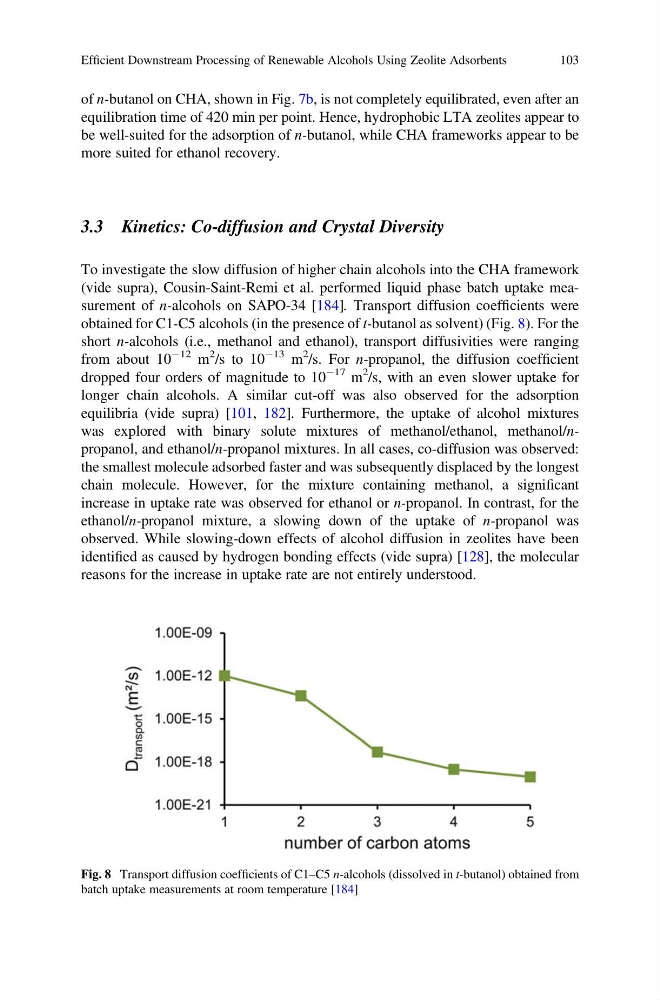
obtained for C1-C5 alcohols (in the presence of t-butanol as solvent) (Fig. 8). For the
short n-alcohols (i.e., methanol and ethanol), transport diffusivities were ranging
from about 10
À12 m
2 /s to 10
À13 m
2 /s. For n-propanol, the diffusion coefficient
dropped four orders of magnitude to 10
À17 m
2
/s, with an even slower uptake for
longer chain alcohols. A similar cut-off was also observed for the adsorption
equilibria (vide supra) [101, 182]. Furthermore, the uptake of alcohol mixtures
was explored with binary solute mixtures of methanol/ethanol, methanol/npropanol, and ethanol/n-propanol mixtures. In all cases, co-diffusion was observed:
the smallest molecule adsorbed faster and was subsequently displaced by the longest
chain molecule. However, for the mixture containing methanol, a significant
increase in uptake rate was observed for ethanol or n-propanol. In contrast, for the
ethanol/n-propanol mixture, a slowing down of the uptake of n-propanol was
observed. While slowing-down effects of alcohol diffusion in zeolites have been
identified as caused by hydrogen bonding effects (vide supra) [128], the molecular
reasons for the increase in uptake rate are not entirely understood.
Fig. 8 Transport diffusion coefficients of C1–C5 n-alcohols (dissolved in t-butanol) obtained from
batch uptake measurements at room temperature [184]
Efficient Downstream Processing of Renewable Alcohols Using Zeolite Adsorbents
103
equilibration time of 420 min per point. Hence, hydrophobic LTA zeolites appear to
be well-suited for the adsorption of n-butanol, while CHA frameworks appear to be
more suited for ethanol recovery.
3.3 Kinetics: Co-diffusion and Crystal Diversity
To investigate the slow diffusion of higher chain alcohols into the CHA framework
(vide supra), Cousin-Saint-Remi et al. performed liquid phase batch uptake measurement of n-alcohols on SAPO-34 [184]. Transport diffusion coefficients were
obtained for C1-C5 alcohols (in the presence of t-butanol as solvent) (Fig. 8). For the
short n-alcohols (i.e., methanol and ethanol), transport diffusivities were ranging
from about 10
À12 m
2 /s to 10
À13 m
2 /s. For n-propanol, the diffusion coefficient
dropped four orders of magnitude to 10
À17 m
2
/s, with an even slower uptake for
longer chain alcohols. A similar cut-off was also observed for the adsorption
equilibria (vide supra) [101, 182]. Furthermore, the uptake of alcohol mixtures
was explored with binary solute mixtures of methanol/ethanol, methanol/npropanol, and ethanol/n-propanol mixtures. In all cases, co-diffusion was observed:
the smallest molecule adsorbed faster and was subsequently displaced by the longest
chain molecule. However, for the mixture containing methanol, a significant
increase in uptake rate was observed for ethanol or n-propanol. In contrast, for the
ethanol/n-propanol mixture, a slowing down of the uptake of n-propanol was
observed. While slowing-down effects of alcohol diffusion in zeolites have been
identified as caused by hydrogen bonding effects (vide supra) [128], the molecular
reasons for the increase in uptake rate are not entirely understood.
Fig. 8 Transport diffusion coefficients of C1–C5 n-alcohols (dissolved in t-butanol) obtained from
batch uptake measurements at room temperature [184]
Efficient Downstream Processing of Renewable Alcohols Using Zeolite Adsorbents
103