

CaA material. A more detailed experimental study of the adsorption of alcohols and
water on ITQ-29 was performed by Van der Perre et al. [59]. The measured water,
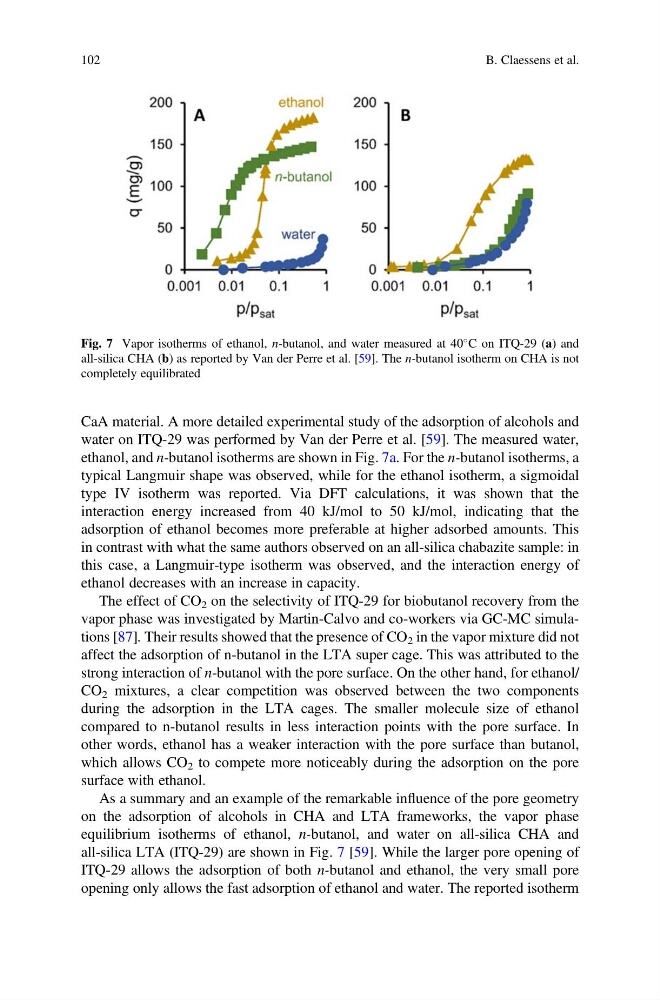
ethanol, and n-butanol isotherms are shown in Fig. 7a. For the n-butanol isotherms, a
typical Langmuir shape was observed, while for the ethanol isotherm, a sigmoidal
type IV isotherm was reported. Via DFT calculations, it was shown that the
interaction energy increased from 40 kJ/mol to 50 kJ/mol, indicating that the
adsorption of ethanol becomes more preferable at higher adsorbed amounts. This
in contrast with what the same authors observed on an all-silica chabazite sample: in
this case, a Langmuir-type isotherm was observed, and the interaction energy of
ethanol decreases with an increase in capacity.
The effect of CO 2 on the selectivity of ITQ-29 for biobutanol recovery from the
vapor phase was investigated by Martin-Calvo and co-workers via GC-MC simulations [87]. Their results showed that the presence of CO 2 in the vapor mixture did not
affect the adsorption of n-butanol in the LTA super cage. This was attributed to the
strong interaction of n-butanol with the pore surface. On the other hand, for ethanol/
CO 2 mixtures, a clear competition was observed between the two components
during the adsorption in the LTA cages. The smaller molecule size of ethanol
compared to n-butanol results in less interaction points with the pore surface. In
other words, ethanol has a weaker interaction with the pore surface than butanol,
which allows CO 2 to compete more noticeably during the adsorption on the pore
surface with ethanol.
As a summary and an example of the remarkable influence of the pore geometry
on the adsorption of alcohols in CHA and LTA frameworks, the vapor phase
equilibrium isotherms of ethanol, n-butanol, and water on all-silica CHA and
all-silica LTA (ITQ-29) are shown in Fig. 7 [59]. While the larger pore opening of
ITQ-29 allows the adsorption of both n-butanol and ethanol, the very small pore
opening only allows the fast adsorption of ethanol and water. The reported isotherm
Fig. 7 Vapor isotherms of ethanol, n-butanol, and water measured at 40
C on ITQ-29 (a) and
all-silica CHA (b) as reported by Van der Perre et al. [59]. The n-butanol isotherm on CHA is not
completely equilibrated
102
B. Claessens et al.
water on ITQ-29 was performed by Van der Perre et al. [59]. The measured water,
ethanol, and n-butanol isotherms are shown in Fig. 7a. For the n-butanol isotherms, a
typical Langmuir shape was observed, while for the ethanol isotherm, a sigmoidal
type IV isotherm was reported. Via DFT calculations, it was shown that the
interaction energy increased from 40 kJ/mol to 50 kJ/mol, indicating that the
adsorption of ethanol becomes more preferable at higher adsorbed amounts. This
in contrast with what the same authors observed on an all-silica chabazite sample: in
this case, a Langmuir-type isotherm was observed, and the interaction energy of
ethanol decreases with an increase in capacity.
The effect of CO 2 on the selectivity of ITQ-29 for biobutanol recovery from the
vapor phase was investigated by Martin-Calvo and co-workers via GC-MC simulations [87]. Their results showed that the presence of CO 2 in the vapor mixture did not
affect the adsorption of n-butanol in the LTA super cage. This was attributed to the
strong interaction of n-butanol with the pore surface. On the other hand, for ethanol/
CO 2 mixtures, a clear competition was observed between the two components
during the adsorption in the LTA cages. The smaller molecule size of ethanol
compared to n-butanol results in less interaction points with the pore surface. In
other words, ethanol has a weaker interaction with the pore surface than butanol,
which allows CO 2 to compete more noticeably during the adsorption on the pore
surface with ethanol.
As a summary and an example of the remarkable influence of the pore geometry
on the adsorption of alcohols in CHA and LTA frameworks, the vapor phase
equilibrium isotherms of ethanol, n-butanol, and water on all-silica CHA and
all-silica LTA (ITQ-29) are shown in Fig. 7 [59]. While the larger pore opening of
ITQ-29 allows the adsorption of both n-butanol and ethanol, the very small pore
opening only allows the fast adsorption of ethanol and water. The reported isotherm
Fig. 7 Vapor isotherms of ethanol, n-butanol, and water measured at 40
C on ITQ-29 (a) and
all-silica CHA (b) as reported by Van der Perre et al. [59]. The n-butanol isotherm on CHA is not
completely equilibrated
102
B. Claessens et al.