

72
N. M. Jais et al.
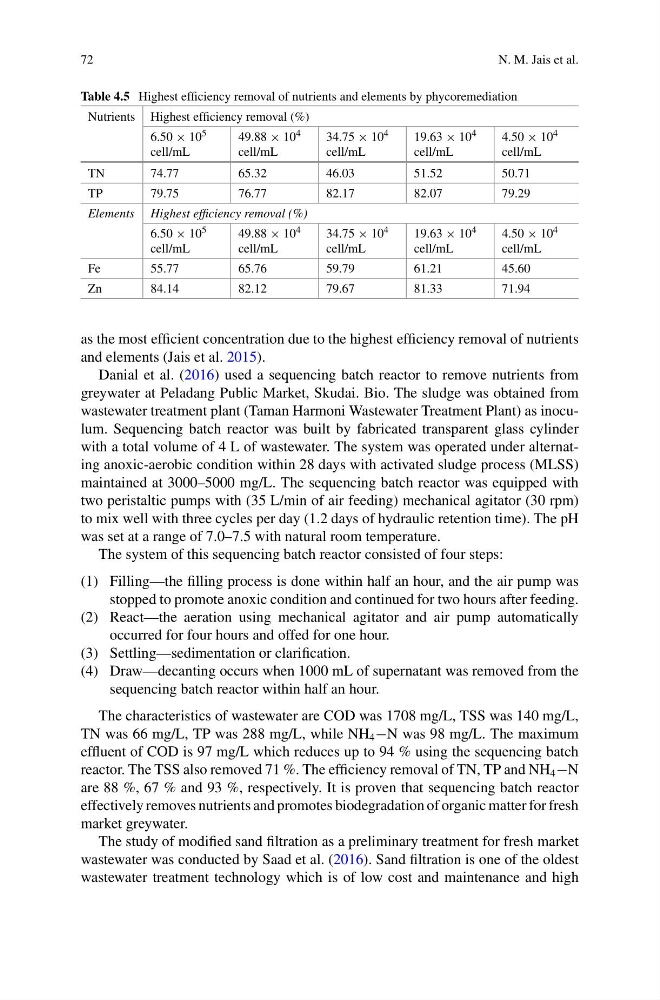
Table 4.5 Highest efficiency removal of nutrients and elements by phycoremediation
Nutrients Highest efficiency removal (%)
6.50 × 10 5
cell/mL
49.88 × 10 4
cell/mL
34.75 × 10 4
cell/mL
19.63 × 10 4
cell/mL
4.50 × 10 4
cell/mL
TN
74.77
65.32
46.03
51.52
50.71
TP
79.75
76.77
82.17
82.07
79.29
Elements Highest efficiency removal (%)
6.50 × 10 5
cell/mL
49.88 × 10 4
cell/mL
34.75 × 10 4
cell/mL
19.63 × 10 4
cell/mL
4.50 × 10 4
cell/mL
Fe
55.77
65.76
59.79
61.21
45.60
Zn
84.14
82.12
79.67
81.33
71.94
as the most efficient concentration due to the highest efficiency removal of nutrients
and elements (Jais et al. 2015).
Danial et al. (2016) used a sequencing batch reactor to remove nutrients from
greywater at Peladang Public Market, Skudai. Bio. The sludge was obtained from
wastewater treatment plant (Taman Harmoni Wastewater Treatment Plant) as inoculum. Sequencing batch reactor was built by fabricated transparent glass cylinder
with a total volume of 4 L of wastewater. The system was operated under alternating anoxic-aerobic condition within 28 days with activated sludge process (MLSS)
maintained at 3000–5000 mg/L. The sequencing batch reactor was equipped with
two peristaltic pumps with (35 L/min of air feeding) mechanical agitator (30 rpm)
to mix well with three cycles per day (1.2 days of hydraulic retention time). The pH
was set at a range of 7.0–7.5 with natural room temperature.
The system of this sequencing batch reactor consisted of four steps:
(1) Filling—the filling process is done within half an hour, and the air pump was
stopped to promote anoxic condition and continued for two hours after feeding.
(2) React—the aeration using mechanical agitator and air pump automatically
occurred for four hours and offed for one hour.
(3) Settling—sedimentation or clarification.
(4) Draw—decanting occurs when 1000 mL of supernatant was removed from the
sequencing batch reactor within half an hour.
The characteristics of wastewater are COD was 1708 mg/L, TSS was 140 mg/L,
TN was 66 mg/L, TP was 288 mg/L, while NH 4 −N was 98 mg/L. The maximum
effluent of COD is 97 mg/L which reduces up to 94 % using the sequencing batch
reactor. The TSS also removed 71 %. The efficiency removal of TN, TP and NH 4 −N
are 88 %, 67 % and 93 %, respectively. It is proven that sequencing batch reactor
effectively removes nutrients and promotes biodegradation of organic matter for fresh
market greywater.
The study of modified sand filtration as a preliminary treatment for fresh market
wastewater was conducted by Saad et al. (2016). Sand filtration is one of the oldest
wastewater treatment technology which is of low cost and maintenance and high
N. M. Jais et al.
Table 4.5 Highest efficiency removal of nutrients and elements by phycoremediation
Nutrients Highest efficiency removal (%)
6.50 × 10 5
cell/mL
49.88 × 10 4
cell/mL
34.75 × 10 4
cell/mL
19.63 × 10 4
cell/mL
4.50 × 10 4
cell/mL
TN
74.77
65.32
46.03
51.52
50.71
TP
79.75
76.77
82.17
82.07
79.29
Elements Highest efficiency removal (%)
6.50 × 10 5
cell/mL
49.88 × 10 4
cell/mL
34.75 × 10 4
cell/mL
19.63 × 10 4
cell/mL
4.50 × 10 4
cell/mL
Fe
55.77
65.76
59.79
61.21
45.60
Zn
84.14
82.12
79.67
81.33
71.94
as the most efficient concentration due to the highest efficiency removal of nutrients
and elements (Jais et al. 2015).
Danial et al. (2016) used a sequencing batch reactor to remove nutrients from
greywater at Peladang Public Market, Skudai. Bio. The sludge was obtained from
wastewater treatment plant (Taman Harmoni Wastewater Treatment Plant) as inoculum. Sequencing batch reactor was built by fabricated transparent glass cylinder
with a total volume of 4 L of wastewater. The system was operated under alternating anoxic-aerobic condition within 28 days with activated sludge process (MLSS)
maintained at 3000–5000 mg/L. The sequencing batch reactor was equipped with
two peristaltic pumps with (35 L/min of air feeding) mechanical agitator (30 rpm)
to mix well with three cycles per day (1.2 days of hydraulic retention time). The pH
was set at a range of 7.0–7.5 with natural room temperature.
The system of this sequencing batch reactor consisted of four steps:
(1) Filling—the filling process is done within half an hour, and the air pump was
stopped to promote anoxic condition and continued for two hours after feeding.
(2) React—the aeration using mechanical agitator and air pump automatically
occurred for four hours and offed for one hour.
(3) Settling—sedimentation or clarification.
(4) Draw—decanting occurs when 1000 mL of supernatant was removed from the
sequencing batch reactor within half an hour.
The characteristics of wastewater are COD was 1708 mg/L, TSS was 140 mg/L,
TN was 66 mg/L, TP was 288 mg/L, while NH 4 −N was 98 mg/L. The maximum
effluent of COD is 97 mg/L which reduces up to 94 % using the sequencing batch
reactor. The TSS also removed 71 %. The efficiency removal of TN, TP and NH 4 −N
are 88 %, 67 % and 93 %, respectively. It is proven that sequencing batch reactor
effectively removes nutrients and promotes biodegradation of organic matter for fresh
market greywater.
The study of modified sand filtration as a preliminary treatment for fresh market
wastewater was conducted by Saad et al. (2016). Sand filtration is one of the oldest
wastewater treatment technology which is of low cost and maintenance and high