

156
M. Darwish et al.
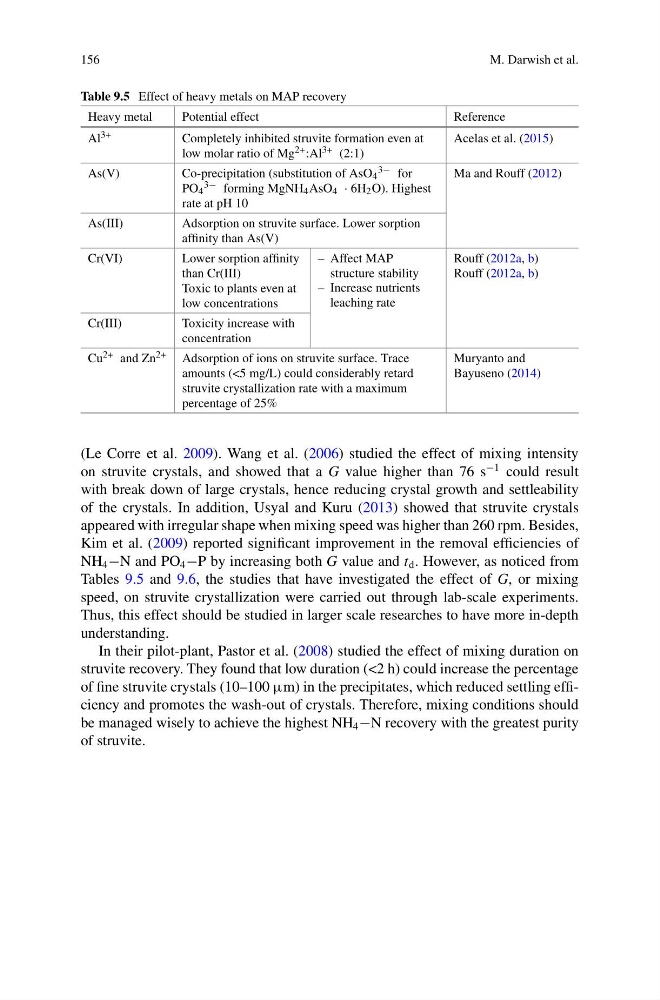
Table 9.5 Effect of heavy metals on MAP recovery
Heavy metal
Potential effect
Reference
Al 3+
Completely inhibited struvite formation even at
low molar ratio of Mg 2+ :Al 3+ (2:1)
Acelas et al. (2015)
As(V)
Co-precipitation (substitution of AsO 4
3− for
PO 4
3− forming MgNH 4 AsO 4 · 6H 2 O). Highest
rate at pH 10
Ma and Rouff (2012)
As(III)
Adsorption on struvite surface. Lower sorption
affinity than As(V)
Cr(VI)
Lower sorption affinity
than Cr(III)
Toxic to plants even at
low concentrations
– Affect MAP
structure stability
– Increase nutrients
leaching rate
Rouff (2012a, b)
Rouff (2012a, b)
Cr(III)
Toxicity increase with
concentration
Cu 2+ and Zn 2+ Adsorption of ions on struvite surface. Trace
amounts (<5 mg/L) could considerably retard
struvite crystallization rate with a maximum
percentage of 25%
Muryanto and
Bayuseno (2014)
(Le Corre et al. 2009). Wang et al. (2006) studied the effect of mixing intensity
on struvite crystals, and showed that a G value higher than 76 s
−1 could result
with break down of large crystals, hence reducing crystal growth and settleability
of the crystals. In addition, Usyal and Kuru (2013) showed that struvite crystals
appeared with irregular shape when mixing speed was higher than 260 rpm. Besides,
Kim et al. (2009) reported significant improvement in the removal efficiencies of
NH 4 −N and PO 4 −P by increasing both G value and t d . However, as noticed from
Tables 9.5 and 9.6, the studies that have investigated the effect of G, or mixing
speed, on struvite crystallization were carried out through lab-scale experiments.
Thus, this effect should be studied in larger scale researches to have more in-depth
understanding.
In their pilot-plant, Pastor et al. (2008) studied the effect of mixing duration on
struvite recovery. They found that low duration (<2 h) could increase the percentage
of fine struvite crystals (10–100 µm) in the precipitates, which reduced settling efficiency and promotes the wash-out of crystals. Therefore, mixing conditions should
be managed wisely to achieve the highest NH 4 −N recovery with the greatest purity
of struvite.
M. Darwish et al.
Table 9.5 Effect of heavy metals on MAP recovery
Heavy metal
Potential effect
Reference
Al 3+
Completely inhibited struvite formation even at
low molar ratio of Mg 2+ :Al 3+ (2:1)
Acelas et al. (2015)
As(V)
Co-precipitation (substitution of AsO 4
3− for
PO 4
3− forming MgNH 4 AsO 4 · 6H 2 O). Highest
rate at pH 10
Ma and Rouff (2012)
As(III)
Adsorption on struvite surface. Lower sorption
affinity than As(V)
Cr(VI)
Lower sorption affinity
than Cr(III)
Toxic to plants even at
low concentrations
– Affect MAP
structure stability
– Increase nutrients
leaching rate
Rouff (2012a, b)
Rouff (2012a, b)
Cr(III)
Toxicity increase with
concentration
Cu 2+ and Zn 2+ Adsorption of ions on struvite surface. Trace
amounts (<5 mg/L) could considerably retard
struvite crystallization rate with a maximum
percentage of 25%
Muryanto and
Bayuseno (2014)
(Le Corre et al. 2009). Wang et al. (2006) studied the effect of mixing intensity
on struvite crystals, and showed that a G value higher than 76 s
−1 could result
with break down of large crystals, hence reducing crystal growth and settleability
of the crystals. In addition, Usyal and Kuru (2013) showed that struvite crystals
appeared with irregular shape when mixing speed was higher than 260 rpm. Besides,
Kim et al. (2009) reported significant improvement in the removal efficiencies of
NH 4 −N and PO 4 −P by increasing both G value and t d . However, as noticed from
Tables 9.5 and 9.6, the studies that have investigated the effect of G, or mixing
speed, on struvite crystallization were carried out through lab-scale experiments.
Thus, this effect should be studied in larger scale researches to have more in-depth
understanding.
In their pilot-plant, Pastor et al. (2008) studied the effect of mixing duration on
struvite recovery. They found that low duration (<2 h) could increase the percentage
of fine struvite crystals (10–100 µm) in the precipitates, which reduced settling efficiency and promotes the wash-out of crystals. Therefore, mixing conditions should
be managed wisely to achieve the highest NH 4 −N recovery with the greatest purity
of struvite.