

8 Biofilter Aquaponic System for Nutrients …
127
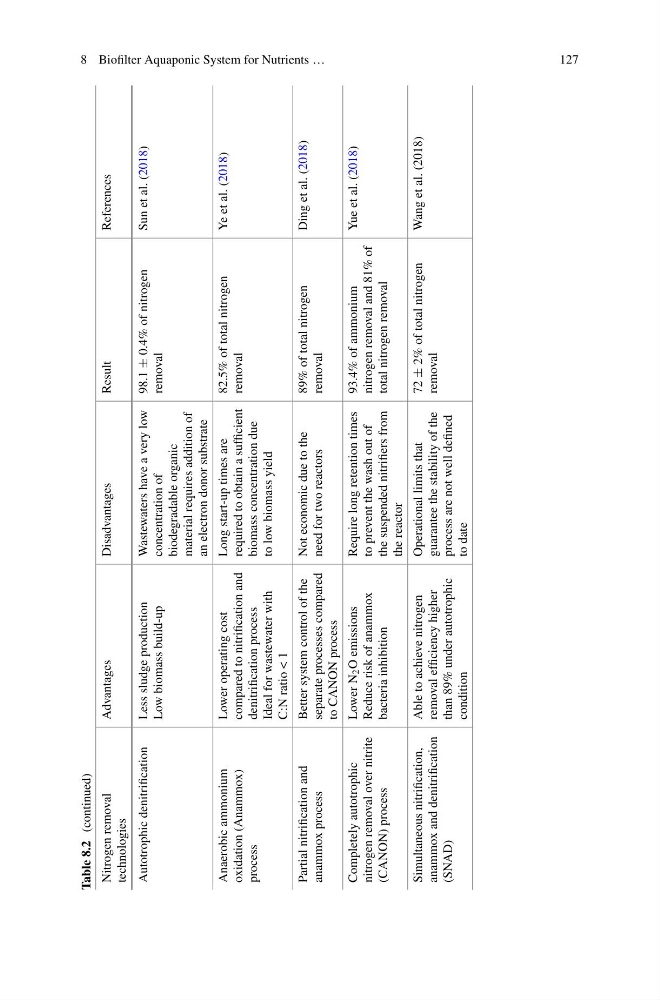
Table 8.2
(continued)
Nitrogen removal
technologies
Advantages
Disadvantages
Result
References
Autotrophic denitrification
Less sludge production
Low biomass build-up
Wastewaters have a very low
concentration of
biodegradable organic
material requires addition of
an electron donor substrate
98.1
± 0.4% of nitrogen
removal
Sun et al. (2018)
Anaerobic ammonium
oxidation (Anammox)
process
Lower operating cost
compared to nitrification and
denitrification process
Ideal for wastewater with
C:N ratio < 1
Long start-up times are
required to obtain a sufficient
biomass concentration due
to low biomass yield
82.5% of total nitrogen
removal
Ye et al. (2018)
Partial nitrification and
anammox process
Better system control of the
separate processes compared
to CANON process
Not economic due to the
need for two reactors
89% of total nitrogen
removal
Ding et al. (2018)
Completely autotrophic
nitrogen removal over nitrite
(CANON) process
Lower N
2 O emissions
Reduce risk of anammox
bacteria inhibition
Require long retention times
to prevent the wash out of
the suspended nitrifiers from
the reactor
93.4% of ammonium
nitrogen removal and 81% of
total nitrogen removal
Yue et al. (2018)
Simultaneous nitrification,
anammox and denitrification
(SNAD)
Able to achieve nitrogen
removal efficiency higher
than 89% under autotrophic
condition
Operational limits that
guarantee the stability of the
process are not well defined
to date
72
± 2% of total nitrogen
removal
Wang et al. (2018)
127
Table 8.2
(continued)
Nitrogen removal
technologies
Advantages
Disadvantages
Result
References
Autotrophic denitrification
Less sludge production
Low biomass build-up
Wastewaters have a very low
concentration of
biodegradable organic
material requires addition of
an electron donor substrate
98.1
± 0.4% of nitrogen
removal
Sun et al. (2018)
Anaerobic ammonium
oxidation (Anammox)
process
Lower operating cost
compared to nitrification and
denitrification process
Ideal for wastewater with
C:N ratio < 1
Long start-up times are
required to obtain a sufficient
biomass concentration due
to low biomass yield
82.5% of total nitrogen
removal
Ye et al. (2018)
Partial nitrification and
anammox process
Better system control of the
separate processes compared
to CANON process
Not economic due to the
need for two reactors
89% of total nitrogen
removal
Ding et al. (2018)
Completely autotrophic
nitrogen removal over nitrite
(CANON) process
Lower N
2 O emissions
Reduce risk of anammox
bacteria inhibition
Require long retention times
to prevent the wash out of
the suspended nitrifiers from
the reactor
93.4% of ammonium
nitrogen removal and 81% of
total nitrogen removal
Yue et al. (2018)
Simultaneous nitrification,
anammox and denitrification
(SNAD)
Able to achieve nitrogen
removal efficiency higher
than 89% under autotrophic
condition
Operational limits that
guarantee the stability of the
process are not well defined
to date
72
± 2% of total nitrogen
removal
Wang et al. (2018)