

108
B. R. Baker et al.
and base), coagulants, flocculants, and attach growth. A gradual approach to wastewater treatment usually gained better results in the most economical way. The primary
treatment removes suspended solids, colloidal materials, large particle, and settleable
solids. Solids and colloids in the treatment of seafood wastewater should be removed
fast using low-cost technologies to avoid dissolution thus having more cost-effective
means (Chowdhury et al. 2010; Oyanedel-Craver et al. 2009; Sarti et al. 2016).
7.3.1 Primary Treatment
Seafood processing wastewater contains large amounts of insoluble suspended solids,
which must be removed from waste effluents through chemical and physical treatments. Before the implementation of other treatments, primary treatment to remove
waste components is desirable because a major consideration in designing a treatment system is that the solids should be removed as quickly as possible. Delaying
the treatment will cause difficulty in solids removal or by-product recovery. This
is because the longer detention time will increase BOD 5 and COD level making it
hard for the aquatic life to survive and react with the pollutants. Like other primary
treatment processes, seafood processing wastewater uses screening, sedimentation,
flow equalization, and dissolved air flotation as primary treatment. Those unit operations will generally remove up to 85% TSS, and reduced 65% BOD 5 and COD from
wastewater (Chowdhury et al. 2010; ODNR et al. 2010).
Literature revealed that flow through screen is the simplest way, with openings of
approximately 1 mm. Screening is achieved by the removal of relatively large solids
(≥0.7 mm). The use of this treatment approach in food processing plants made it
possible to reduce the amount of solid materials in the discharge effluents quickly.
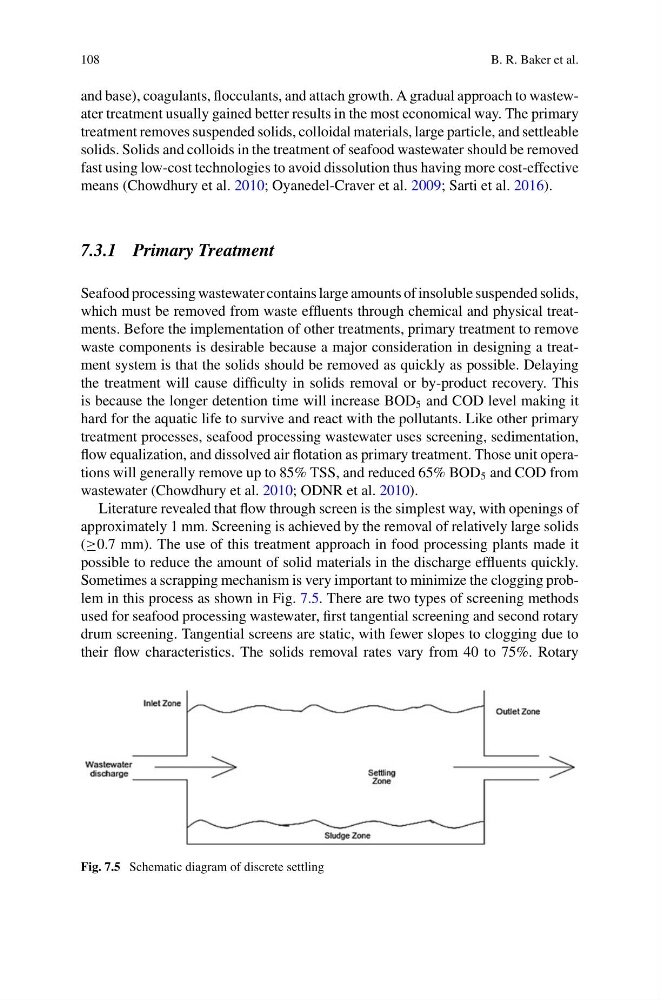
Sometimes a scrapping mechanism is very important to minimize the clogging problem in this process as shown in Fig. 7.5. There are two types of screening methods
used for seafood processing wastewater, first tangential screening and second rotary
drum screening. Tangential screens are static, with fewer slopes to clogging due to
their flow characteristics. The solids removal rates vary from 40 to 75%. Rotary
Fig. 7.5 Schematic diagram of discrete settling
B. R. Baker et al.
and base), coagulants, flocculants, and attach growth. A gradual approach to wastewater treatment usually gained better results in the most economical way. The primary
treatment removes suspended solids, colloidal materials, large particle, and settleable
solids. Solids and colloids in the treatment of seafood wastewater should be removed
fast using low-cost technologies to avoid dissolution thus having more cost-effective
means (Chowdhury et al. 2010; Oyanedel-Craver et al. 2009; Sarti et al. 2016).
7.3.1 Primary Treatment
Seafood processing wastewater contains large amounts of insoluble suspended solids,
which must be removed from waste effluents through chemical and physical treatments. Before the implementation of other treatments, primary treatment to remove
waste components is desirable because a major consideration in designing a treatment system is that the solids should be removed as quickly as possible. Delaying
the treatment will cause difficulty in solids removal or by-product recovery. This
is because the longer detention time will increase BOD 5 and COD level making it
hard for the aquatic life to survive and react with the pollutants. Like other primary
treatment processes, seafood processing wastewater uses screening, sedimentation,
flow equalization, and dissolved air flotation as primary treatment. Those unit operations will generally remove up to 85% TSS, and reduced 65% BOD 5 and COD from
wastewater (Chowdhury et al. 2010; ODNR et al. 2010).
Literature revealed that flow through screen is the simplest way, with openings of
approximately 1 mm. Screening is achieved by the removal of relatively large solids
(≥0.7 mm). The use of this treatment approach in food processing plants made it
possible to reduce the amount of solid materials in the discharge effluents quickly.
Sometimes a scrapping mechanism is very important to minimize the clogging problem in this process as shown in Fig. 7.5. There are two types of screening methods
used for seafood processing wastewater, first tangential screening and second rotary
drum screening. Tangential screens are static, with fewer slopes to clogging due to
their flow characteristics. The solids removal rates vary from 40 to 75%. Rotary
Fig. 7.5 Schematic diagram of discrete settling