

3.5 Carbenic Nitrile Imines
83
1,1-cycloadditions, using NIs has been pursued by many researchers, and was first
proposed as early as 1972 [229].
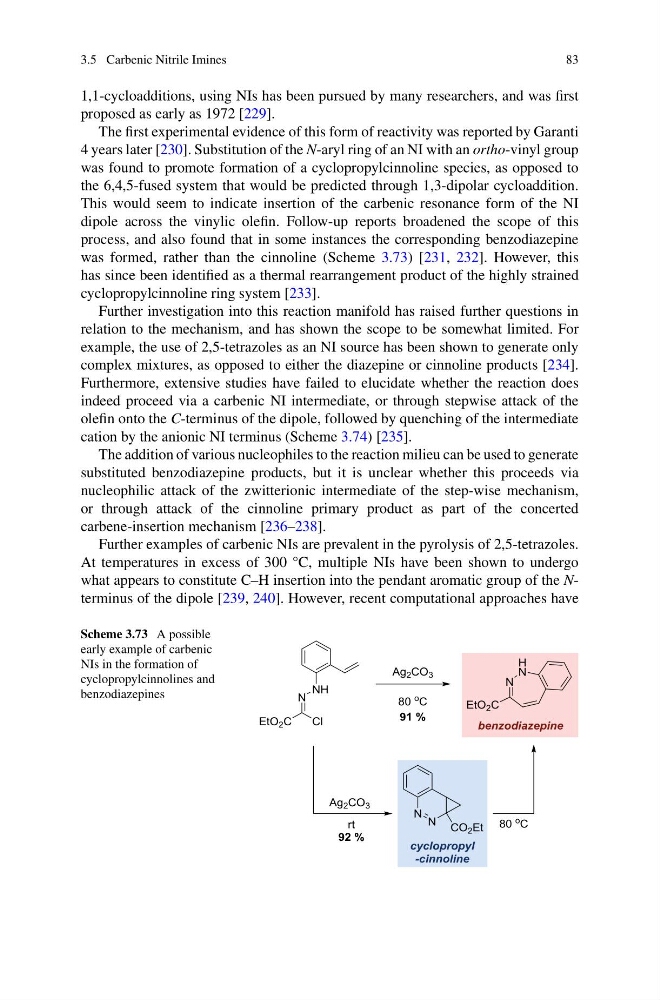
The first experimental evidence of this form of reactivity was reported by Garanti
4 years later [230]. Substitution of the N-aryl ring of an NI with an ortho-vinyl group
was found to promote formation of a cyclopropylcinnoline species, as opposed to
the 6,4,5-fused system that would be predicted through 1,3-dipolar cycloaddition.
This would seem to indicate insertion of the carbenic resonance form of the NI
dipole across the vinylic olefin. Follow-up reports broadened the scope of this
process, and also found that in some instances the corresponding benzodiazepine
was formed, rather than the cinnoline (Scheme 3.73) [231, 232]. However, this
has since been identified as a thermal rearrangement product of the highly strained
cyclopropylcinnoline ring system [233].
Further investigation into this reaction manifold has raised further questions in
relation to the mechanism, and has shown the scope to be somewhat limited. For
example, the use of 2,5-tetrazoles as an NI source has been shown to generate only
complex mixtures, as opposed to either the diazepine or cinnoline products [234].
Furthermore, extensive studies have failed to elucidate whether the reaction does
indeed proceed via a carbenic NI intermediate, or through stepwise attack of the
olefin onto the C-terminus of the dipole, followed by quenching of the intermediate
cation by the anionic NI terminus (Scheme 3.74) [235].
The addition of various nucleophiles to the reaction milieu can be used to generate
substituted benzodiazepine products, but it is unclear whether this proceeds via
nucleophilic attack of the zwitterionic intermediate of the step-wise mechanism,
or through attack of the cinnoline primary product as part of the concerted
carbene-insertion mechanism [236–238].
Further examples of carbenic NIs are prevalent in the pyrolysis of 2,5-tetrazoles.
At temperatures in excess of 300 °C, multiple NIs have been shown to undergo
what appears to constitute C–H insertion into the pendant aromatic group of the Nterminus of the dipole [239, 240]. However, recent computational approaches have
Scheme 3.73 A possible
early example of carbenic
NIs in the formation of
cyclopropylcinnolines and
benzodiazepines
NH
N
EtO 2 C
Cl
Ag 2 CO 3
80
o C
91 %
benzodiazepine
H
N
N
EtO 2 C
N N CO 2 Et
Ag 2 CO 3
rt
92 %
cyclopropyl
-cinnoline
80
o C
83
1,1-cycloadditions, using NIs has been pursued by many researchers, and was first
proposed as early as 1972 [229].
The first experimental evidence of this form of reactivity was reported by Garanti
4 years later [230]. Substitution of the N-aryl ring of an NI with an ortho-vinyl group
was found to promote formation of a cyclopropylcinnoline species, as opposed to
the 6,4,5-fused system that would be predicted through 1,3-dipolar cycloaddition.
This would seem to indicate insertion of the carbenic resonance form of the NI
dipole across the vinylic olefin. Follow-up reports broadened the scope of this
process, and also found that in some instances the corresponding benzodiazepine
was formed, rather than the cinnoline (Scheme 3.73) [231, 232]. However, this
has since been identified as a thermal rearrangement product of the highly strained
cyclopropylcinnoline ring system [233].
Further investigation into this reaction manifold has raised further questions in
relation to the mechanism, and has shown the scope to be somewhat limited. For
example, the use of 2,5-tetrazoles as an NI source has been shown to generate only
complex mixtures, as opposed to either the diazepine or cinnoline products [234].
Furthermore, extensive studies have failed to elucidate whether the reaction does
indeed proceed via a carbenic NI intermediate, or through stepwise attack of the
olefin onto the C-terminus of the dipole, followed by quenching of the intermediate
cation by the anionic NI terminus (Scheme 3.74) [235].
The addition of various nucleophiles to the reaction milieu can be used to generate
substituted benzodiazepine products, but it is unclear whether this proceeds via
nucleophilic attack of the zwitterionic intermediate of the step-wise mechanism,
or through attack of the cinnoline primary product as part of the concerted
carbene-insertion mechanism [236–238].
Further examples of carbenic NIs are prevalent in the pyrolysis of 2,5-tetrazoles.
At temperatures in excess of 300 °C, multiple NIs have been shown to undergo
what appears to constitute C–H insertion into the pendant aromatic group of the Nterminus of the dipole [239, 240]. However, recent computational approaches have
Scheme 3.73 A possible
early example of carbenic
NIs in the formation of
cyclopropylcinnolines and
benzodiazepines
NH
N
EtO 2 C
Cl
Ag 2 CO 3
80
o C
91 %
benzodiazepine
H
N
N
EtO 2 C
N N CO 2 Et
Ag 2 CO 3
rt
92 %
cyclopropyl
-cinnoline
80
o C