

3.4 Intramolecular Rearrangements
81
215, 217, 218].
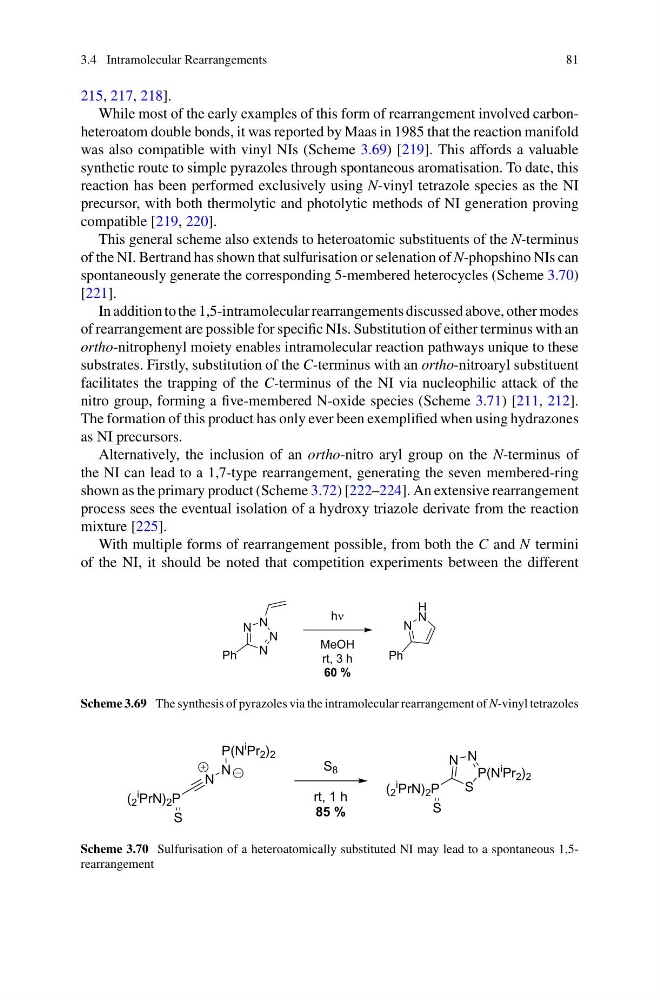
While most of the early examples of this form of rearrangement involved carbonheteroatom double bonds, it was reported by Maas in 1985 that the reaction manifold
was also compatible with vinyl NIs (Scheme 3.69) [219]. This affords a valuable
synthetic route to simple pyrazoles through spontaneous aromatisation. To date, this
reaction has been performed exclusively using N-vinyl tetrazole species as the NI
precursor, with both thermolytic and photolytic methods of NI generation proving
compatible [219, 220].
This general scheme also extends to heteroatomic substituents of the N-terminus
of the NI. Bertrand has shown that sulfurisation or selenation of N-phopshino NIs can
spontaneously generate the corresponding 5-membered heterocycles (Scheme 3.70)
[221].
In addition to the 1,5-intramolecular rearrangements discussed above, other modes
of rearrangement are possible for specific NIs. Substitution of either terminus with an
ortho-nitrophenyl moiety enables intramolecular reaction pathways unique to these
substrates. Firstly, substitution of the C-terminus with an ortho-nitroaryl substituent
facilitates the trapping of the C-terminus of the NI via nucleophilic attack of the
nitro group, forming a five-membered N-oxide species (Scheme 3.71) [211, 212].
The formation of this product has only ever been exemplified when using hydrazones
as NI precursors.
Alternatively, the inclusion of an ortho-nitro aryl group on the N-terminus of
the NI can lead to a 1,7-type rearrangement, generating the seven membered-ring
shown as the primary product (Scheme 3.72) [222–224]. An extensive rearrangement
process sees the eventual isolation of a hydroxy triazole derivate from the reaction
mixture [225].
With multiple forms of rearrangement possible, from both the C and N termini
of the NI, it should be noted that competition experiments between the different
MeOH
rt, 3 h
60 %
h
N
N
N
N
Ph
N
H
N
Ph
Scheme 3.69 The synthesis of pyrazoles via the intramolecular rearrangement of N-vinyl tetrazoles
( 2
i PrN) 2 P
S
N
N
P(N
i Pr 2 ) 2
( 2
i PrN) 2 P
S
N N
P(N
i Pr 2 ) 2
S
S 8
rt, 1 h
85 %
Scheme 3.70 Sulfurisation of a heteroatomically substituted NI may lead to a spontaneous 1,5rearrangement
81
215, 217, 218].
While most of the early examples of this form of rearrangement involved carbonheteroatom double bonds, it was reported by Maas in 1985 that the reaction manifold
was also compatible with vinyl NIs (Scheme 3.69) [219]. This affords a valuable
synthetic route to simple pyrazoles through spontaneous aromatisation. To date, this
reaction has been performed exclusively using N-vinyl tetrazole species as the NI
precursor, with both thermolytic and photolytic methods of NI generation proving
compatible [219, 220].
This general scheme also extends to heteroatomic substituents of the N-terminus
of the NI. Bertrand has shown that sulfurisation or selenation of N-phopshino NIs can
spontaneously generate the corresponding 5-membered heterocycles (Scheme 3.70)
[221].
In addition to the 1,5-intramolecular rearrangements discussed above, other modes
of rearrangement are possible for specific NIs. Substitution of either terminus with an
ortho-nitrophenyl moiety enables intramolecular reaction pathways unique to these
substrates. Firstly, substitution of the C-terminus with an ortho-nitroaryl substituent
facilitates the trapping of the C-terminus of the NI via nucleophilic attack of the
nitro group, forming a five-membered N-oxide species (Scheme 3.71) [211, 212].
The formation of this product has only ever been exemplified when using hydrazones
as NI precursors.
Alternatively, the inclusion of an ortho-nitro aryl group on the N-terminus of
the NI can lead to a 1,7-type rearrangement, generating the seven membered-ring
shown as the primary product (Scheme 3.72) [222–224]. An extensive rearrangement
process sees the eventual isolation of a hydroxy triazole derivate from the reaction
mixture [225].
With multiple forms of rearrangement possible, from both the C and N termini
of the NI, it should be noted that competition experiments between the different
MeOH
rt, 3 h
60 %
h
N
N
N
N
Ph
N
H
N
Ph
Scheme 3.69 The synthesis of pyrazoles via the intramolecular rearrangement of N-vinyl tetrazoles
( 2
i PrN) 2 P
S
N
N
P(N
i Pr 2 ) 2
( 2
i PrN) 2 P
S
N N
P(N
i Pr 2 ) 2
S
S 8
rt, 1 h
85 %
Scheme 3.70 Sulfurisation of a heteroatomically substituted NI may lead to a spontaneous 1,5rearrangement