

76
3 The Reactivity of Nitrile Imines
selected can prove extremely important in dictating the exact product formed, with
NIs able to yield either a 1,2,4,5-dihydrotetrazine or a 1,2,3-triazole, with compelling
evidence for the formation of both species reported in the literature.
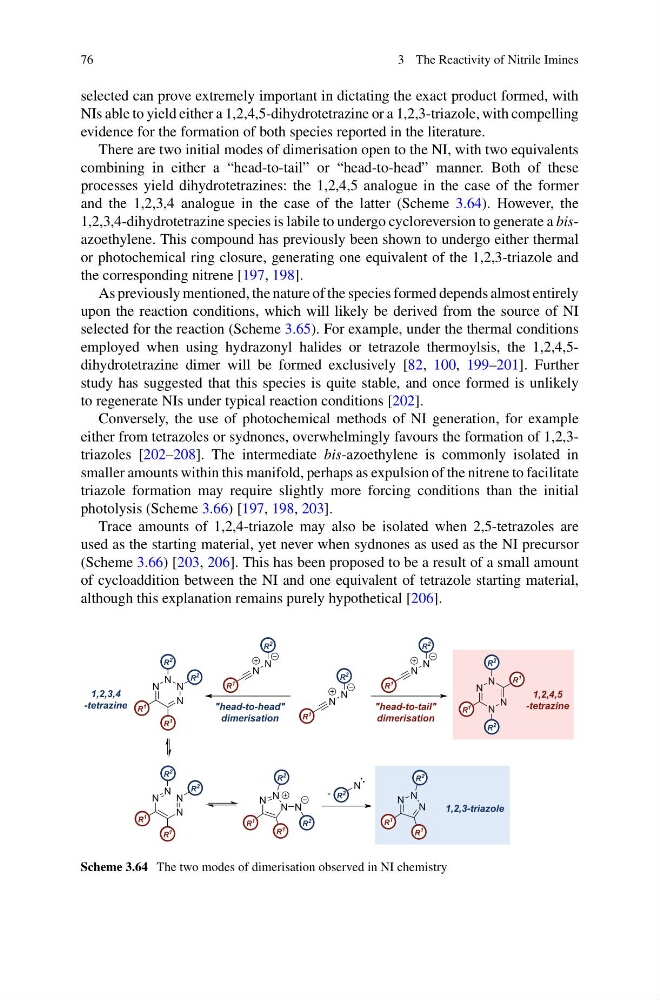
There are two initial modes of dimerisation open to the NI, with two equivalents
combining in either a “head-to-tail” or “head-to-head” manner. Both of these
processes yield dihydrotetrazines: the 1,2,4,5 analogue in the case of the former
and the 1,2,3,4 analogue in the case of the latter (Scheme 3.64). However, the
1,2,3,4-dihydrotetrazine species is labile to undergo cycloreversion to generate a bisazoethylene. This compound has previously been shown to undergo either thermal
or photochemical ring closure, generating one equivalent of the 1,2,3-triazole and
the corresponding nitrene [197, 198].
As previously mentioned, the nature of the species formed depends almost entirely
upon the reaction conditions, which will likely be derived from the source of NI
selected for the reaction (Scheme 3.65). For example, under the thermal conditions
employed when using hydrazonyl halides or tetrazole thermoylsis, the 1,2,4,5dihydrotetrazine dimer will be formed exclusively [82, 100, 199–201]. Further
study has suggested that this species is quite stable, and once formed is unlikely
to regenerate NIs under typical reaction conditions [202].
Conversely, the use of photochemical methods of NI generation, for example
either from tetrazoles or sydnones, overwhelmingly favours the formation of 1,2,3triazoles [202–208]. The intermediate bis-azoethylene is commonly isolated in
smaller amounts within this manifold, perhaps as expulsion of the nitrene to facilitate
triazole formation may require slightly more forcing conditions than the initial
photolysis (Scheme 3.66) [197, 198, 203].
Trace amounts of 1,2,4-triazole may also be isolated when 2,5-tetrazoles are
used as the starting material, yet never when sydnones as used as the NI precursor
(Scheme 3.66) [203, 206]. This has been proposed to be a result of a small amount
of cycloaddition between the NI and one equivalent of tetrazole starting material,
although this explanation remains purely hypothetical [206].
N
N
N
N
N
N
1,2,4,5
-tetrazine
N
N
N
N
1,2,3,4
-tetrazine
N
N
N
N
N N N
N
N N
N
1,2,3-triazole
R 1
R 2
N
N
R 1
R 2
N
N
R 1
R 2
R 1
R 1
R 1
R 1
R 1
R 1
R 1
R 1
R 1
R 1
R 2
R 2
R 2
R 2
R 2
R 2
R 2
R 2
R 2
"head-to-head"
dimerisation
"head-to-tail"
dimerisation
R 2
N
-
Scheme 3.64 The two modes of dimerisation observed in NI chemistry
3 The Reactivity of Nitrile Imines
selected can prove extremely important in dictating the exact product formed, with
NIs able to yield either a 1,2,4,5-dihydrotetrazine or a 1,2,3-triazole, with compelling
evidence for the formation of both species reported in the literature.
There are two initial modes of dimerisation open to the NI, with two equivalents
combining in either a “head-to-tail” or “head-to-head” manner. Both of these
processes yield dihydrotetrazines: the 1,2,4,5 analogue in the case of the former
and the 1,2,3,4 analogue in the case of the latter (Scheme 3.64). However, the
1,2,3,4-dihydrotetrazine species is labile to undergo cycloreversion to generate a bisazoethylene. This compound has previously been shown to undergo either thermal
or photochemical ring closure, generating one equivalent of the 1,2,3-triazole and
the corresponding nitrene [197, 198].
As previously mentioned, the nature of the species formed depends almost entirely
upon the reaction conditions, which will likely be derived from the source of NI
selected for the reaction (Scheme 3.65). For example, under the thermal conditions
employed when using hydrazonyl halides or tetrazole thermoylsis, the 1,2,4,5dihydrotetrazine dimer will be formed exclusively [82, 100, 199–201]. Further
study has suggested that this species is quite stable, and once formed is unlikely
to regenerate NIs under typical reaction conditions [202].
Conversely, the use of photochemical methods of NI generation, for example
either from tetrazoles or sydnones, overwhelmingly favours the formation of 1,2,3triazoles [202–208]. The intermediate bis-azoethylene is commonly isolated in
smaller amounts within this manifold, perhaps as expulsion of the nitrene to facilitate
triazole formation may require slightly more forcing conditions than the initial
photolysis (Scheme 3.66) [197, 198, 203].
Trace amounts of 1,2,4-triazole may also be isolated when 2,5-tetrazoles are
used as the starting material, yet never when sydnones as used as the NI precursor
(Scheme 3.66) [203, 206]. This has been proposed to be a result of a small amount
of cycloaddition between the NI and one equivalent of tetrazole starting material,
although this explanation remains purely hypothetical [206].
N
N
N
N
N
N
1,2,4,5
-tetrazine
N
N
N
N
1,2,3,4
-tetrazine
N
N
N
N
N N N
N
N N
N
1,2,3-triazole
R 1
R 2
N
N
R 1
R 2
N
N
R 1
R 2
R 1
R 1
R 1
R 1
R 1
R 1
R 1
R 1
R 1
R 1
R 2
R 2
R 2
R 2
R 2
R 2
R 2
R 2
R 2
"head-to-head"
dimerisation
"head-to-tail"
dimerisation
R 2
N
-
Scheme 3.64 The two modes of dimerisation observed in NI chemistry