

64
3 The Reactivity of Nitrile Imines
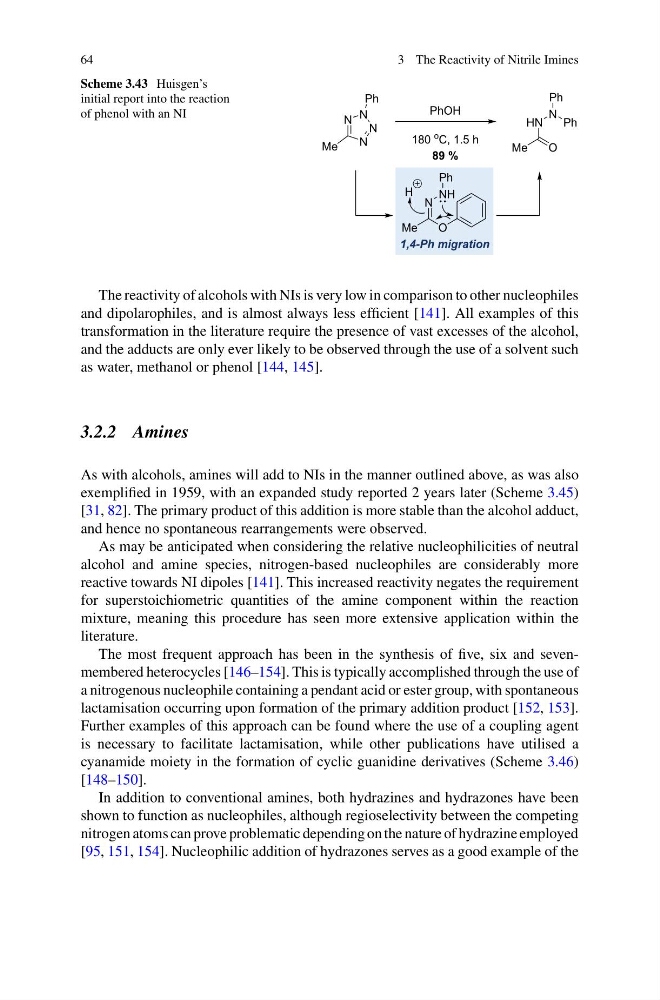
Scheme 3.43 Huisgen’s
initial report into the reaction
of phenol with an NI
N
N
N
N
Me
Ph
PhOH
180
o C, 1.5 h
89 %
HN
Ph
N
Me
Ph
O
N
O
NH
Me
Ph
1,4-Ph migration
H
The reactivity of alcohols with NIs is very low in comparison to other nucleophiles
and dipolarophiles, and is almost always less efficient [141]. All examples of this
transformation in the literature require the presence of vast excesses of the alcohol,
and the adducts are only ever likely to be observed through the use of a solvent such
as water, methanol or phenol [144, 145].
3.2.2 Amines
As with alcohols, amines will add to NIs in the manner outlined above, as was also
exemplified in 1959, with an expanded study reported 2 years later (Scheme 3.45)
[31, 82]. The primary product of this addition is more stable than the alcohol adduct,
and hence no spontaneous rearrangements were observed.
As may be anticipated when considering the relative nucleophilicities of neutral
alcohol and amine species, nitrogen-based nucleophiles are considerably more
reactive towards NI dipoles [141]. This increased reactivity negates the requirement
for superstoichiometric quantities of the amine component within the reaction
mixture, meaning this procedure has seen more extensive application within the
literature.
The most frequent approach has been in the synthesis of five, six and sevenmembered heterocycles [146–154]. This is typically accomplished through the use of
a nitrogenous nucleophile containing a pendant acid or ester group, with spontaneous
lactamisation occurring upon formation of the primary addition product [152, 153].
Further examples of this approach can be found where the use of a coupling agent
is necessary to facilitate lactamisation, while other publications have utilised a
cyanamide moiety in the formation of cyclic guanidine derivatives (Scheme 3.46)
[148–150].
In addition to conventional amines, both hydrazines and hydrazones have been
shown to function as nucleophiles, although regioselectivity between the competing
nitrogen atoms can prove problematic depending on the nature of hydrazine employed
[95, 151, 154]. Nucleophilic addition of hydrazones serves as a good example of the
3 The Reactivity of Nitrile Imines
Scheme 3.43 Huisgen’s
initial report into the reaction
of phenol with an NI
N
N
N
N
Me
Ph
PhOH
180
o C, 1.5 h
89 %
HN
Ph
N
Me
Ph
O
N
O
NH
Me
Ph
1,4-Ph migration
H
The reactivity of alcohols with NIs is very low in comparison to other nucleophiles
and dipolarophiles, and is almost always less efficient [141]. All examples of this
transformation in the literature require the presence of vast excesses of the alcohol,
and the adducts are only ever likely to be observed through the use of a solvent such
as water, methanol or phenol [144, 145].
3.2.2 Amines
As with alcohols, amines will add to NIs in the manner outlined above, as was also
exemplified in 1959, with an expanded study reported 2 years later (Scheme 3.45)
[31, 82]. The primary product of this addition is more stable than the alcohol adduct,
and hence no spontaneous rearrangements were observed.
As may be anticipated when considering the relative nucleophilicities of neutral
alcohol and amine species, nitrogen-based nucleophiles are considerably more
reactive towards NI dipoles [141]. This increased reactivity negates the requirement
for superstoichiometric quantities of the amine component within the reaction
mixture, meaning this procedure has seen more extensive application within the
literature.
The most frequent approach has been in the synthesis of five, six and sevenmembered heterocycles [146–154]. This is typically accomplished through the use of
a nitrogenous nucleophile containing a pendant acid or ester group, with spontaneous
lactamisation occurring upon formation of the primary addition product [152, 153].
Further examples of this approach can be found where the use of a coupling agent
is necessary to facilitate lactamisation, while other publications have utilised a
cyanamide moiety in the formation of cyclic guanidine derivatives (Scheme 3.46)
[148–150].
In addition to conventional amines, both hydrazines and hydrazones have been
shown to function as nucleophiles, although regioselectivity between the competing
nitrogen atoms can prove problematic depending on the nature of hydrazine employed
[95, 151, 154]. Nucleophilic addition of hydrazones serves as a good example of the