

3.1 1,3-Dipolar Cycloaddition
57
formation of thiadiazoline thiones through a single cycloaddition reaction [49, 106,
107].
The regiochemistry of such cycloadducts follows the same trend as that of
imines and nitriles. 1,2,3-Thiazolines are never observed, with only the 1,2,4thiazoline species formed as a product. Again, no studies have been conducted
towards understanding the origin of this regioselectivity, which seems to be consistent
throughout the cycloaddition of all classes of carbon-heteroatom double bonds to NIs.
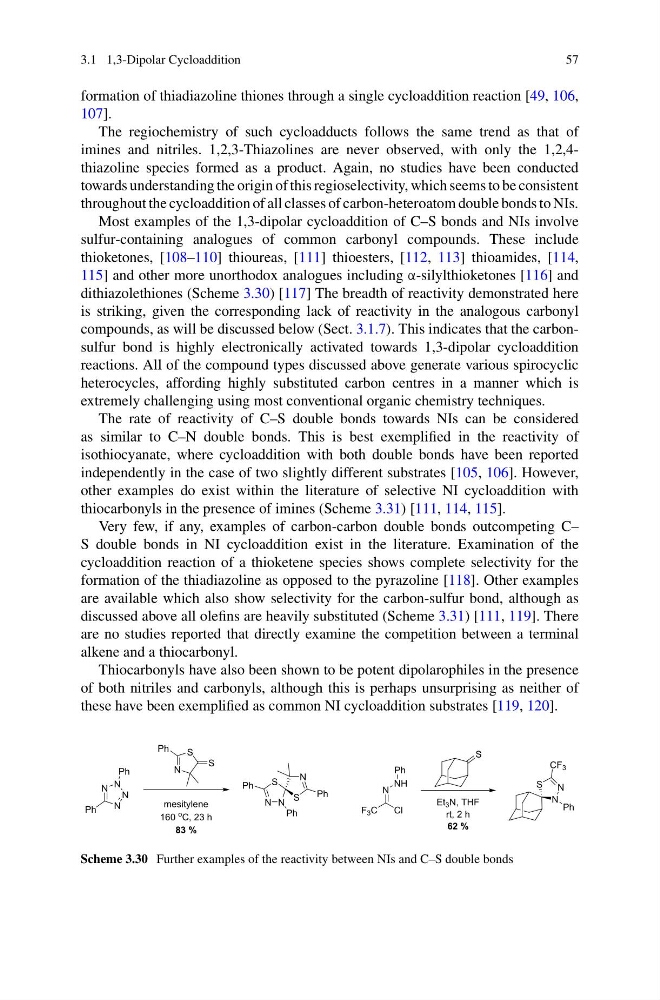
Most examples of the 1,3-dipolar cycloaddition of C–S bonds and NIs involve
sulfur-containing analogues of common carbonyl compounds. These include
thioketones, [108–110] thioureas, [111] thioesters, [112, 113] thioamides, [114,
115] and other more unorthodox analogues including α-silylthioketones [116] and
dithiazolethiones (Scheme 3.30) [117] The breadth of reactivity demonstrated here
is striking, given the corresponding lack of reactivity in the analogous carbonyl
compounds, as will be discussed below (Sect. 3.1.7). This indicates that the carbonsulfur bond is highly electronically activated towards 1,3-dipolar cycloaddition
reactions. All of the compound types discussed above generate various spirocyclic
heterocycles, affording highly substituted carbon centres in a manner which is
extremely challenging using most conventional organic chemistry techniques.
The rate of reactivity of C–S double bonds towards NIs can be considered
as similar to C–N double bonds. This is best exemplified in the reactivity of
isothiocyanate, where cycloaddition with both double bonds have been reported
independently in the case of two slightly different substrates [105, 106]. However,
other examples do exist within the literature of selective NI cycloaddition with
thiocarbonyls in the presence of imines (Scheme 3.31) [111, 114, 115].
Very few, if any, examples of carbon-carbon double bonds outcompeting C–
S double bonds in NI cycloaddition exist in the literature. Examination of the
cycloaddition reaction of a thioketene species shows complete selectivity for the
formation of the thiadiazoline as opposed to the pyrazoline [118]. Other examples
are available which also show selectivity for the carbon-sulfur bond, although as
discussed above all olefins are heavily substituted (Scheme 3.31) [111, 119]. There
are no studies reported that directly examine the competition between a terminal
alkene and a thiocarbonyl.
Thiocarbonyls have also been shown to be potent dipolarophiles in the presence
of both nitriles and carbonyls, although this is perhaps unsurprising as neither of
these have been exemplified as common NI cycloaddition substrates [119, 120].
mesitylene
160
o C, 23 h
83 %
N
N
N
N
Ph
Ph
N N
Ph
Ph
N
S
S
Ph
N
S
S
Ph
Et 3 N, THF
rt, 2 h
62 %
N
Cl
NH
Ph
F 3 C
S
S
N
N
Ph
CF 3
Scheme 3.30 Further examples of the reactivity between NIs and C–S double bonds
57
formation of thiadiazoline thiones through a single cycloaddition reaction [49, 106,
107].
The regiochemistry of such cycloadducts follows the same trend as that of
imines and nitriles. 1,2,3-Thiazolines are never observed, with only the 1,2,4thiazoline species formed as a product. Again, no studies have been conducted
towards understanding the origin of this regioselectivity, which seems to be consistent
throughout the cycloaddition of all classes of carbon-heteroatom double bonds to NIs.
Most examples of the 1,3-dipolar cycloaddition of C–S bonds and NIs involve
sulfur-containing analogues of common carbonyl compounds. These include
thioketones, [108–110] thioureas, [111] thioesters, [112, 113] thioamides, [114,
115] and other more unorthodox analogues including α-silylthioketones [116] and
dithiazolethiones (Scheme 3.30) [117] The breadth of reactivity demonstrated here
is striking, given the corresponding lack of reactivity in the analogous carbonyl
compounds, as will be discussed below (Sect. 3.1.7). This indicates that the carbonsulfur bond is highly electronically activated towards 1,3-dipolar cycloaddition
reactions. All of the compound types discussed above generate various spirocyclic
heterocycles, affording highly substituted carbon centres in a manner which is
extremely challenging using most conventional organic chemistry techniques.
The rate of reactivity of C–S double bonds towards NIs can be considered
as similar to C–N double bonds. This is best exemplified in the reactivity of
isothiocyanate, where cycloaddition with both double bonds have been reported
independently in the case of two slightly different substrates [105, 106]. However,
other examples do exist within the literature of selective NI cycloaddition with
thiocarbonyls in the presence of imines (Scheme 3.31) [111, 114, 115].
Very few, if any, examples of carbon-carbon double bonds outcompeting C–
S double bonds in NI cycloaddition exist in the literature. Examination of the
cycloaddition reaction of a thioketene species shows complete selectivity for the
formation of the thiadiazoline as opposed to the pyrazoline [118]. Other examples
are available which also show selectivity for the carbon-sulfur bond, although as
discussed above all olefins are heavily substituted (Scheme 3.31) [111, 119]. There
are no studies reported that directly examine the competition between a terminal
alkene and a thiocarbonyl.
Thiocarbonyls have also been shown to be potent dipolarophiles in the presence
of both nitriles and carbonyls, although this is perhaps unsurprising as neither of
these have been exemplified as common NI cycloaddition substrates [119, 120].
mesitylene
160
o C, 23 h
83 %
N
N
N
N
Ph
Ph
N N
Ph
Ph
N
S
S
Ph
N
S
S
Ph
Et 3 N, THF
rt, 2 h
62 %
N
Cl
NH
Ph
F 3 C
S
S
N
N
Ph
CF 3
Scheme 3.30 Further examples of the reactivity between NIs and C–S double bonds