

2.4 Tetrazoles
27
N
N
N
N
h
N
N
N
N
ISC
N
N
N
N
N
N
G
Charge
recombination
- competing process
- prolificacy dictated
by R
1 and R
2
S 1
S 0
ISC
- requires S 1 T n
energy match
- requires S 1 T n
orbital conformation
match
R
2
R
2
R
2
R
2
R
1
R
1
R
1
R
1
T 1
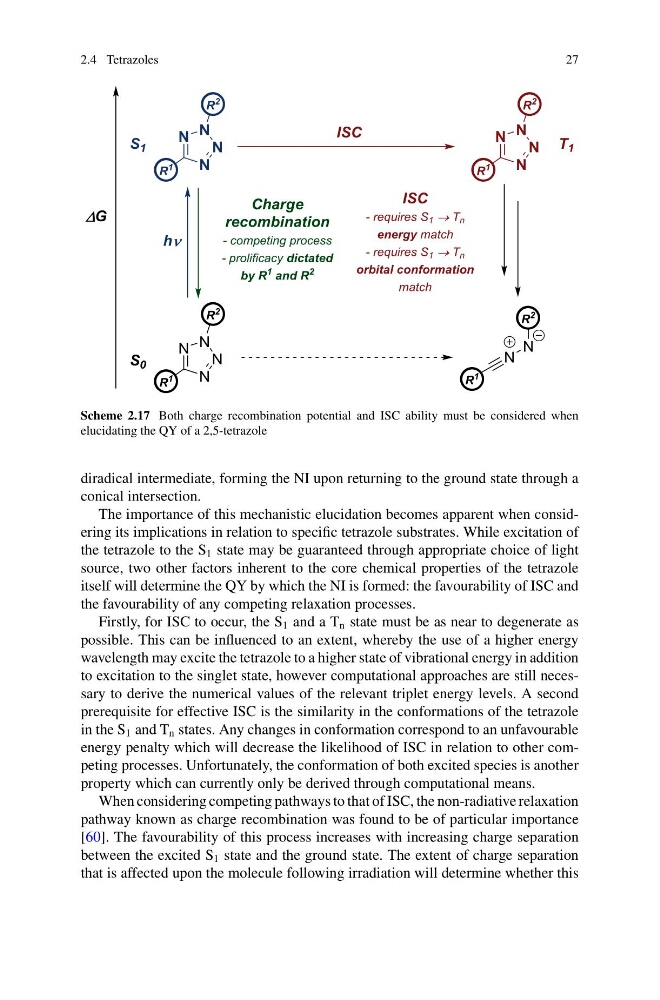
Scheme 2.17 Both charge recombination potential and ISC ability must be considered when
elucidating the QY of a 2,5-tetrazole
diradical intermediate, forming the NI upon returning to the ground state through a
conical intersection.
The importance of this mechanistic elucidation becomes apparent when considering its implications in relation to specific tetrazole substrates. While excitation of
the tetrazole to the S 1 state may be guaranteed through appropriate choice of light
source, two other factors inherent to the core chemical properties of the tetrazole
itself will determine the QY by which the NI is formed: the favourability of ISC and
the favourability of any competing relaxation processes.
Firstly, for ISC to occur, the S 1 and a T n state must be as near to degenerate as
possible. This can be influenced to an extent, whereby the use of a higher energy
wavelength may excite the tetrazole to a higher state of vibrational energy in addition
to excitation to the singlet state, however computational approaches are still necessary to derive the numerical values of the relevant triplet energy levels. A second
prerequisite for effective ISC is the similarity in the conformations of the tetrazole
in the S 1 and T n states. Any changes in conformation correspond to an unfavourable
energy penalty which will decrease the likelihood of ISC in relation to other competing processes. Unfortunately, the conformation of both excited species is another
property which can currently only be derived through computational means.
When considering competing pathways to that of ISC, the non-radiative relaxation
pathway known as charge recombination was found to be of particular importance
[60]. The favourability of this process increases with increasing charge separation
between the excited S 1 state and the ground state. The extent of charge separation
that is affected upon the molecule following irradiation will determine whether this
27
N
N
N
N
h
N
N
N
N
ISC
N
N
N
N
N
N
G
Charge
recombination
- competing process
- prolificacy dictated
by R
1 and R
2
S 1
S 0
ISC
- requires S 1 T n
energy match
- requires S 1 T n
orbital conformation
match
R
2
R
2
R
2
R
2
R
1
R
1
R
1
R
1
T 1
Scheme 2.17 Both charge recombination potential and ISC ability must be considered when
elucidating the QY of a 2,5-tetrazole
diradical intermediate, forming the NI upon returning to the ground state through a
conical intersection.
The importance of this mechanistic elucidation becomes apparent when considering its implications in relation to specific tetrazole substrates. While excitation of
the tetrazole to the S 1 state may be guaranteed through appropriate choice of light
source, two other factors inherent to the core chemical properties of the tetrazole
itself will determine the QY by which the NI is formed: the favourability of ISC and
the favourability of any competing relaxation processes.
Firstly, for ISC to occur, the S 1 and a T n state must be as near to degenerate as
possible. This can be influenced to an extent, whereby the use of a higher energy
wavelength may excite the tetrazole to a higher state of vibrational energy in addition
to excitation to the singlet state, however computational approaches are still necessary to derive the numerical values of the relevant triplet energy levels. A second
prerequisite for effective ISC is the similarity in the conformations of the tetrazole
in the S 1 and T n states. Any changes in conformation correspond to an unfavourable
energy penalty which will decrease the likelihood of ISC in relation to other competing processes. Unfortunately, the conformation of both excited species is another
property which can currently only be derived through computational means.
When considering competing pathways to that of ISC, the non-radiative relaxation
pathway known as charge recombination was found to be of particular importance
[60]. The favourability of this process increases with increasing charge separation
between the excited S 1 state and the ground state. The extent of charge separation
that is affected upon the molecule following irradiation will determine whether this